

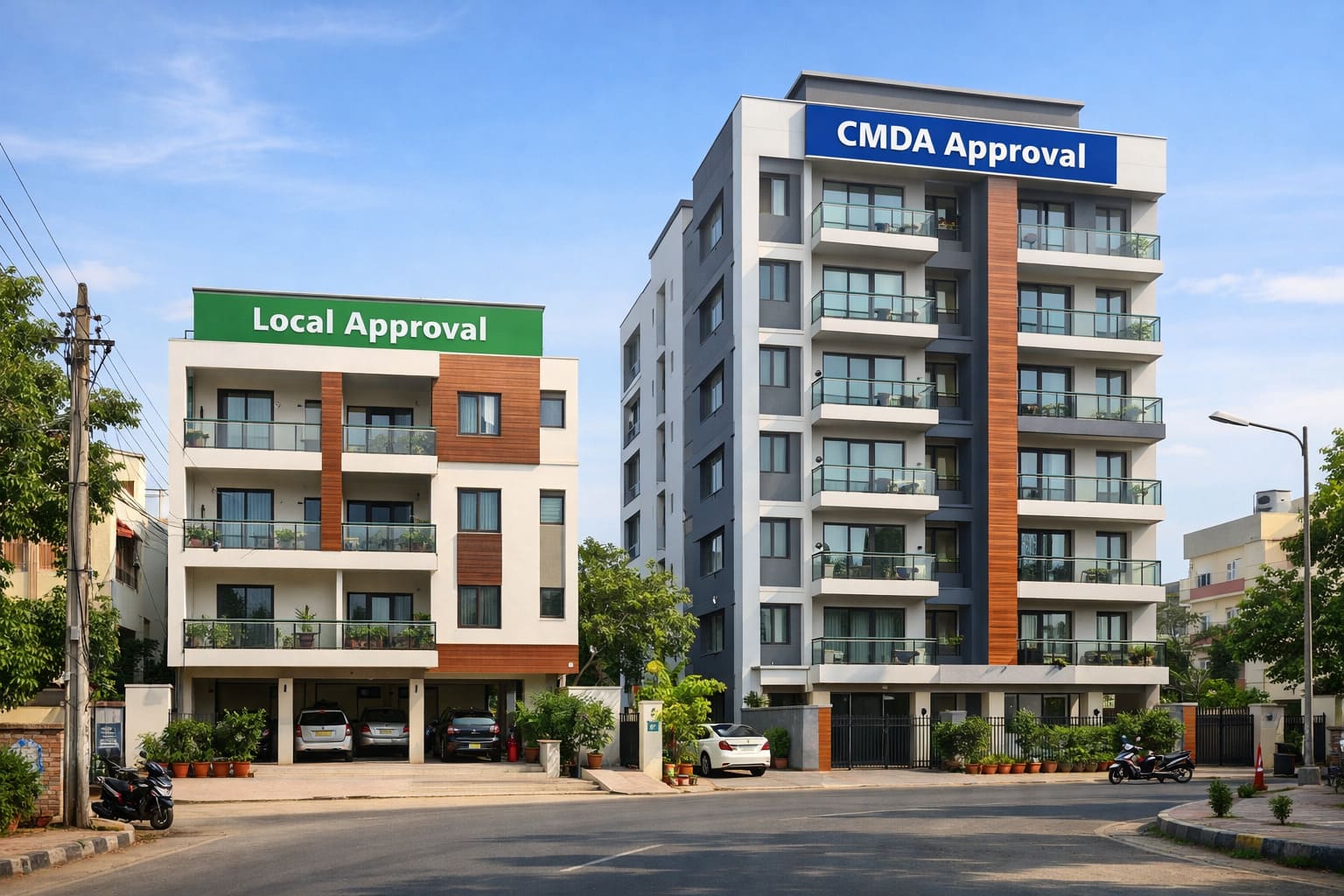
📍 Introduction: Faster Approvals, Same Rules
Getting building approval in Chennai has always been time-consuming. To fix this, the Chennai Metropolitan Development Authority (CMDA) has delegated certain approval powers to local bodies.
This means smaller projects can now be approved faster at the local level—but only if they strictly follow defined limits.
The delegation of building plan approvals to local bodies in Chennai is not entirely new—it has evolved over time. The foundation was laid with the Tamil Nadu Combined Development and Building Rules, 2019, which introduced clear limits for ordinary buildings and enabled decentralised approvals. However, the real shift has happened in recent years, as authorities like the Greater Chennai Corporation began actively implementing these powers. So while the policy has existed for a few years, its on-ground execution and impact are relatively recent.
🏢 Who Can Approve Your Building Now?
Planning approvals for eligible buildings can now be issued by:
- Greater Chennai Corporation (GCC)
- Municipal Corporations
- Municipalities
- Town Panchayats
👉 These authorities handle ordinary buildings within limits
👉 Larger or complex projects still go to CMDA
📏 Key Rule: The 14-Metre Height Limit
The most important rule to remember:
- Up to 14 metres height → Local body approval
- Above 14 metres → CMDA approval mandatory
⚠️ Special note:
Certain rooftop structures like lift rooms or water tanks may go up to 18.3 metres, but:
- This does not allow extra floors
- It is only for functional structures
🏠 Residential Building Limits
To qualify for local approval, your project must meet all these conditions:
- Built-up area: Up to 10,000 sq.ft.
- Maximum units: 16 dwelling units
- Height: Not exceeding 14 metres
- Building type:
- Stilt + 3 Floors
- OR Ground + 2 Floors
👉 If even one condition is exceeded, approval shifts to CMDA
🏢 Commercial Building Limits
For small commercial projects:
- Built-up area: Up to 300 sq.m. (~3,230 sq.ft.)
- Height: Up to 14 metres
- Floors:
- Ground + 2 Floors
- OR Stilt + 3 Floors
👉 Larger commercial developments must go through CMDA
⚖️ Legal Compliance Still Applies
All approvals—whether issued by local bodies or CMDA—must follow:
- Tamil Nadu Town and Country Planning Act, 1971
- Development regulations
- Master Plan zoning rules
👉 This delegation does not relax rules, it only changes the approval authority
🚀 Why This Change Matters
✔ Faster Approvals
Smaller projects no longer need to wait for centralized approval
✔ Reduced Delays
CMDA can focus on large and complex developments
✔ Better Local Handling
Local bodies understand area-specific conditions like roads and drainage
⚠️ Common Mistakes to Avoid
❌ Assuming local approval means relaxed rules
❌ Exceeding limits slightly and expecting approval
❌ Ignoring zoning and road width requirements
👉 Even small violations can lead to:
- Rejection
- Penalties
- Demolition risks
🧠 Smart Buyer & Builder Checklist
Before trusting any approved plan:
- Verify approval authority (GCC or CMDA)
- Check actual building height in metres
- Confirm number of units and built-up area
- Ensure no hidden extra floors
- Validate zoning compliance
👉 Don’t rely on claims—verify everything
📊 Real Example: Same Plot, Different Outcome
- A 12-unit apartment (under 14m) → Approved by GCC
- An 18-unit apartment (above limits) → Must go to CMDA
👉 Small changes can completely change the approval authority
📌 Conclusion
This system is designed to make approvals faster—but not easier.
👉 Stay within limits → Quick approvals
👉 Cross limits → CMDA takes control
🦁Verified services
At Verified.RealEstate, you can cross-check building approvals, validate zoning, confirm height and unit compliance, and ensure there are no hidden deviations from sanctioned plans. From plan approval verification to land use checks and survey validation, the platform helps you make legally safe property decisions—so you don’t end up trusting an approval that could later turn into a problem.