

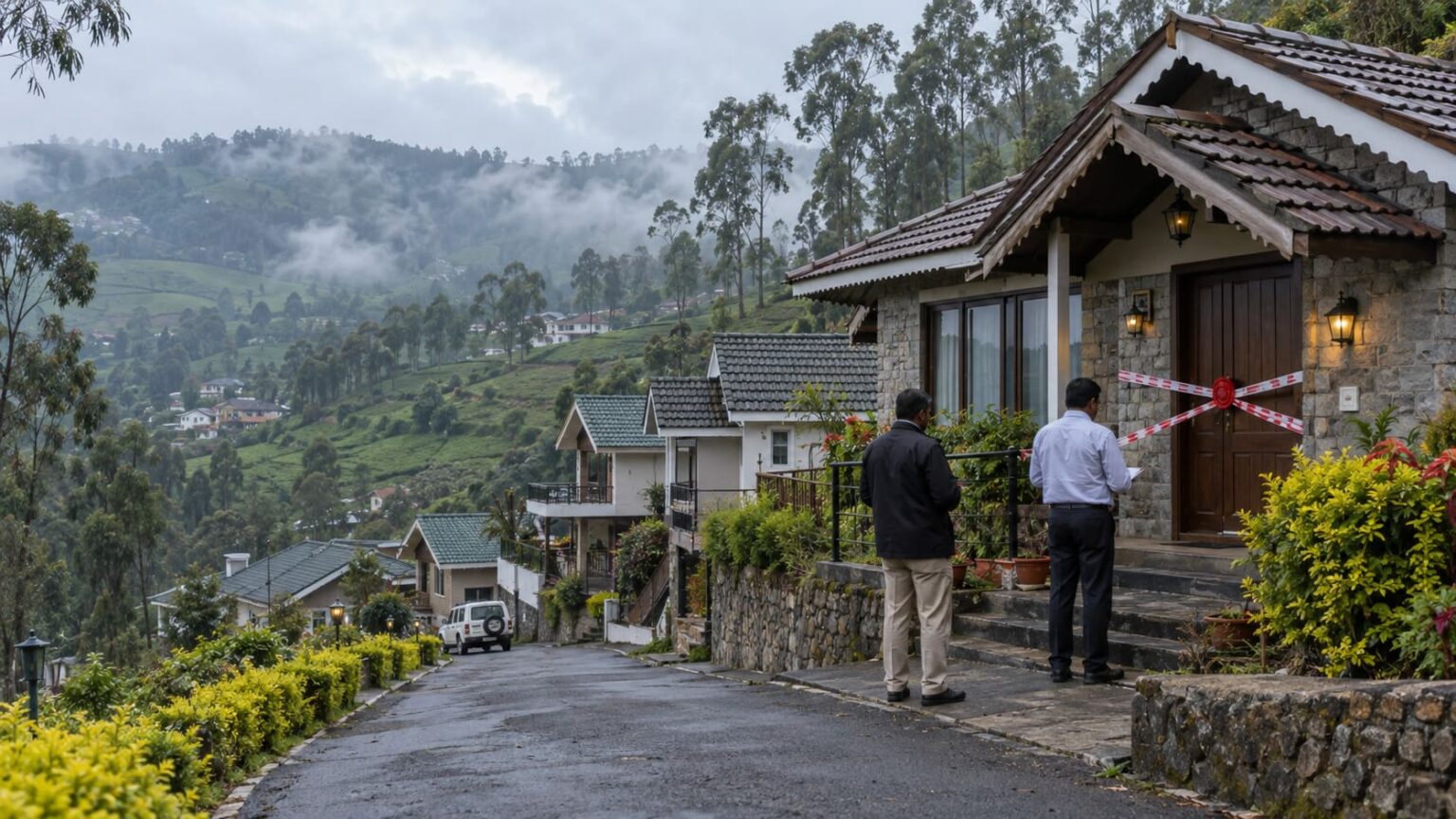
Ooty’s latest sealing drive is not just about six tourist cottages. It is part of a much larger crackdown that could change how property owners in the Nilgiris look at homestays, cottages and tourist accommodation.
The Nilgiris district administration and the Udhagamandalam (Ooty) Municipal Corporation are carrying out a steady lock-and-seal action against illegal cottages, homestays, and Bed & Breakfast (B&B) places.
While it looks like a simple check for tourism trade licenses, the actual action goes deeper. The state officials and the Special Bench of the Madras High Court are checking the original building approvals, permitted land use, and structural safety rules. The Madras High Court showed that 943 cottages, resorts, homestays and Bed & Breakfast establishments across Nilgiris had been identified for violations
The action follows complaints from social organisations and environmental activists that tourist cottages and homestays are operating even in residential areas, allegedly bypassing the Hill Station Building Rules (HSBR).
Both Nilgiris (Ooty) and Dindigul (Kodaikanal) are being monitored simultaneously by the High Court’s Special Bench to curb unchecked commercialization and protect hill ecology.
1. Core Legal Reasons Properties Are Called “Illegal”
Authorities are taking action based on three main legal checks:
A. Using a House as a Commercial Property Without Permission
The main reason for sealing properties is turning single-family houses into commercial tourist stays without converting the land use.
- The Legal Rule: Having permission to build a house does not automatically allow the owner to run it as a commercial hotel or cottage. Running a business in a residential building without proper conversion permission violates planning laws.
- Statutory Framework: Section 49 (application for planning permission) and Section 56 (power to order removal or stop unauthorized use) of the Tamil Nadu Town and Country Planning Act, 1971 give authorities the power to act against unauthorized building use.
B. Skipping Hill Area Conservation Authority (HACA) Approvals
Building in fragile hill stations across Tamil Nadu requires clearance under Hill Area Conservation Authority (HACA) guidelines and Hill Station Building Rules (HSBR).
- Commercial tourist stays must pass checks by local bodies, district committees, and state environmental panels.
- Many owners obtained simple residential building plans from local offices but skipped the mandatory district screening and state-level HACA clearances required for commercial operations.
C. Building Beyond Allowed Heights
- Building rules in the Nilgiris cap construction to Ground + 1 (G+1) upper floor due to landslide risks and earthquake safety zones.
- Adding extra floors (such as G+2 or G+3) under the cover of residential extension violates building height rules, making the structure illegal.
2. Exact Legal Rulings and Directives from the Madras High Court
The ongoing crackdown is directly guided by rulings from the Madras High Court:
A. High Court Directive on Non-Compliant Stays
“wherever they have not filed any compliance document, immediate action be taken and all further proceedings for locking and sealing and also stopping of the usage of the building, shall also be forthwith made…”
— Special Bench of the Madras High Court (Order in W.P. No. 15120 of 2019)
B. Scrutiny Required for Approvals and Licensing
“it shall be found out first whether the building is there with an approved plan and secondly, whether they are operating as per the Rules framed thereunder for the purpose of grant of licence…”
— Madras High Court (Order dated January 30, 2026, in W.P. No. 15120 of 2019)
C. Refusal to Stop Lock-and-Seal Actions
“If there is any violation or non-compliance of the directions issued by the special bench, it is for the petitioners to approach and plead before that bench… If any order was passed in these writ petitions, it would affect and interdict the proceedings which are being monitored periodically by the special bench.”
— Madras High Court Division Bench (Order in W.P. Nos. 10885 & 10892 of 2026, dismissing stays against municipal sealing)
D. Strict Rule on Discontinuance Notices
“If the owner or occupier, as the case may be, of land or building has not discontinued, the use of such land or building as required in the notice served under sub-section (1), within the time specified therein, the appropriate planning authority if prima facie…”
— Section 56(2-A) of the Tamil Nadu Town and Country Planning Act, 1971
In simple terms, the Tamil Nadu planning authorities have the strict authority to lock, seal, and shut down any property that operates without proper building approvals or licensing.
The Madras High Court has mandated that officials must check two things:
- whether a building has an approved construction plan and whether it complies with commercial tourism rules.
- If a property owner fails to stop illegal commercial operations after receiving a formal notice under Section 56(2-A) of the Town and Country Planning Act, authorities can immediately seal the building.
Furthermore, standard courts will not step in to grant stay orders or block these enforcement actions, as all appeals must go directly to the Special Bench monitoring hill-area conservation.
3. Regulatory Audit Summary (2025–2026)
         High Court Mandate Issued (April 2025)
                          │
                          ▼
        Field Surveys & Monitoring Formed (Late 2025)
                          │
                          ▼
       900+ Non-Compliant Structures Identified (August 2026)
                          │
                          ▼
        Mass Lock-and-Seal Actions Executed (September 2026)
Field inspections across the Nilgiris reveal the scale of non-compliance:
- Total Establishments Audited: 943+ properties flagged for potential planning, structural, or commercial violations.
- Sealed Structures: 79+ establishments locked and sealed outright following physical inspections.
- Under Review / Appeal: Hundreds of properties with pending applications under the B&B scheme, under-appeal statuses, or temporary voluntary closures.
Main Takeaways for Property Owners and Investors
- A Tourism License Does Not Fix Building Violations: Having a local business license or a online registration does not legalise a building constructed without approved plans or HACA permissions.
- Residential Houses Cannot Simply Be Rented Out Commercially: Running a house as a commercial homestay without formal conversion approval leads directly to lock-and-seal notices under Section 56.
- Strict Height Limits Stay in Force: Any extra floor built above the allowed G+1 limit without permissions will face closure or partial demolition.
For Buyers Notice
Why the 300 Sq. Metre Threshold Is Sealing Ooty Cottages?
Building rules in hill stations like Ooty trigger strict District and HACA clearances once a commercial property exceeds 300 sq. metres of total floor area.
- How Area Is Calculated: Authorities count the total built-up space across all floors—including attics, garages, outbuildings, and corridors—not just the ground footprint.
- The Buyer Trap: Brokers and contractors often give informal estimates that ignore these extra spaces, leading owners to build over the limit without required state-level approvals.
- How to Protect Yourself: Always hire a registered architect to measure the exact floor area under official building rules, and written Planning Permission from the local body (e.g., Udhagamandalam Municipality) and HACA clearance (if applicable) explicitly stating the approved area and commercial use before buying or building.