

A Turning Point in Understanding RERA’s Powers
RERA was created to protect homebuyers, regulate developers, and bring transparency to the real estate sector. But over time, confusion grew around what kinds of disputes RERA could actually decide. A recent Bombay High Court judgment (2025) has now given the clearest boundary: RERA cannot decide title disputes, grant declarations, or issue injunctions between allottees. At the same time, the Court reaffirmed earlier principles laid down in the landmark Neelkamal Realtors (2017) case, which established RERA’s constitutionality and regulatory strength. Together, these rulings provide a complete picture of what RERA can and cannot do.
The 2025 Dispute: Competing Claims Over the Same Flat
The controversy arose from a Navi Mumbai project where two different buyers claimed rights over the same apartment:
- Sana Hospitality Services Pvt. Ltd. had a registered sale deed from 2016.
- Another set of purchasers bought the same flat through a 2017 agreement for sale and even took possession in 2019.
Sana later secured a favourable order from the RERA Appellate Tribunal. The second set of buyers filed a civil suit seeking declarations of their rights, cancellation of the earlier deed, and injunctions. Sana argued that Section 79 of RERA bars civil suits and therefore only RERA should handle the conflict.
This brought the issue to the Bombay High Court:
Can RERA decide ownership, title, and declaration-based disputes between multiple buyers?
Bombay High Court’s 2025 Verdict: RERA Is Not a Civil Court
The Court issued a clear, authoritative ruling that resets expectations about RERA’s role.
Key Clarifications from the 2025 Judgment
- RERA cannot adjudicate title disputes between two allottees.
- RERA cannot grant civil court remedies, including:
- Declarations of ownership
- Cancellation of sale deeds
- Injunctions over possession
- Section 79 mentions that civil courts can hear a case if the remedy asked for is something RERA has no power to give.
- RERA’s ability to execute its orders like a civil court decree does not make it a civil court.
- Disputes involving proprietary rights, competing agreements, or double sales must be decided exclusively in civil courts.
This ensures that RERA stays focused on its intended role: regulating promoter behaviour, ensuring delivery, and protecting allottees within the framework of the Act—not resolving civil title conflicts.
Foundational Precedent: Bombay High Court’s 2017 Neelkamal Realtors Verdict
The 2025 ruling rests on principles first articulated in the milestone case Neelkamal Realtors & Ors. vs. Union of India (2017). This judgment upheld the entire RERA framework and clarified the nature of its powers. It remains the backbone of RERA jurisprudence in India.
Key Points from the 2017 Neelkamal Realtors Judgment
- RERA is fully constitutional and does not *infringe the rights of promoters.
- All ongoing projects at the time RERA came into force must comply with its provisions.
- Developers must adhere to updated timelines and obligations, even if the delay occurred before RERA.
- The Act is built on consumer protection, and its strict mechanisms are justified.
- The 70% escrow requirement for safeguarding buyer funds is valid and essential.
- RERA authorities can impose interest, penalties, compensation, and compliance orders.
- RERA functions as a specialised regulator, not as a substitute for civil courts.
- The judgment upheld RERA’s role in industry transparency, accountability, and fairness.
This 2017 decision laid the constitutional foundation, while the 2025 verdict clarifies jurisdictional boundaries.
*Infringe - to violate or break a rule, right, or law.What RERA Can Do: Strong Consumer and Regulatory Powers
Despite limitations on civil remedies, RERA retains wide, enforceable powers to regulate the industry and protect homebuyers.
RERA’s Core Powers Include:
- Ordering refunds, interest, compensation, and possession
- Enforcing compliance with agreement for sale obligations
- Monitoring project timelines and auditing finances
- Penalising promoters and real estate agents
- Ensuring proper use of escrow funds
- Protecting buyers from misrepresentation, delays, and unfair charges
RERA is a fast, efficient remedy for project-linked grievances—but not for ownership or title disputes.
Choosing the Right Forum: RERA vs Civil Court
The combined effect of the 2017 and 2025 judgments gives a simple rule:
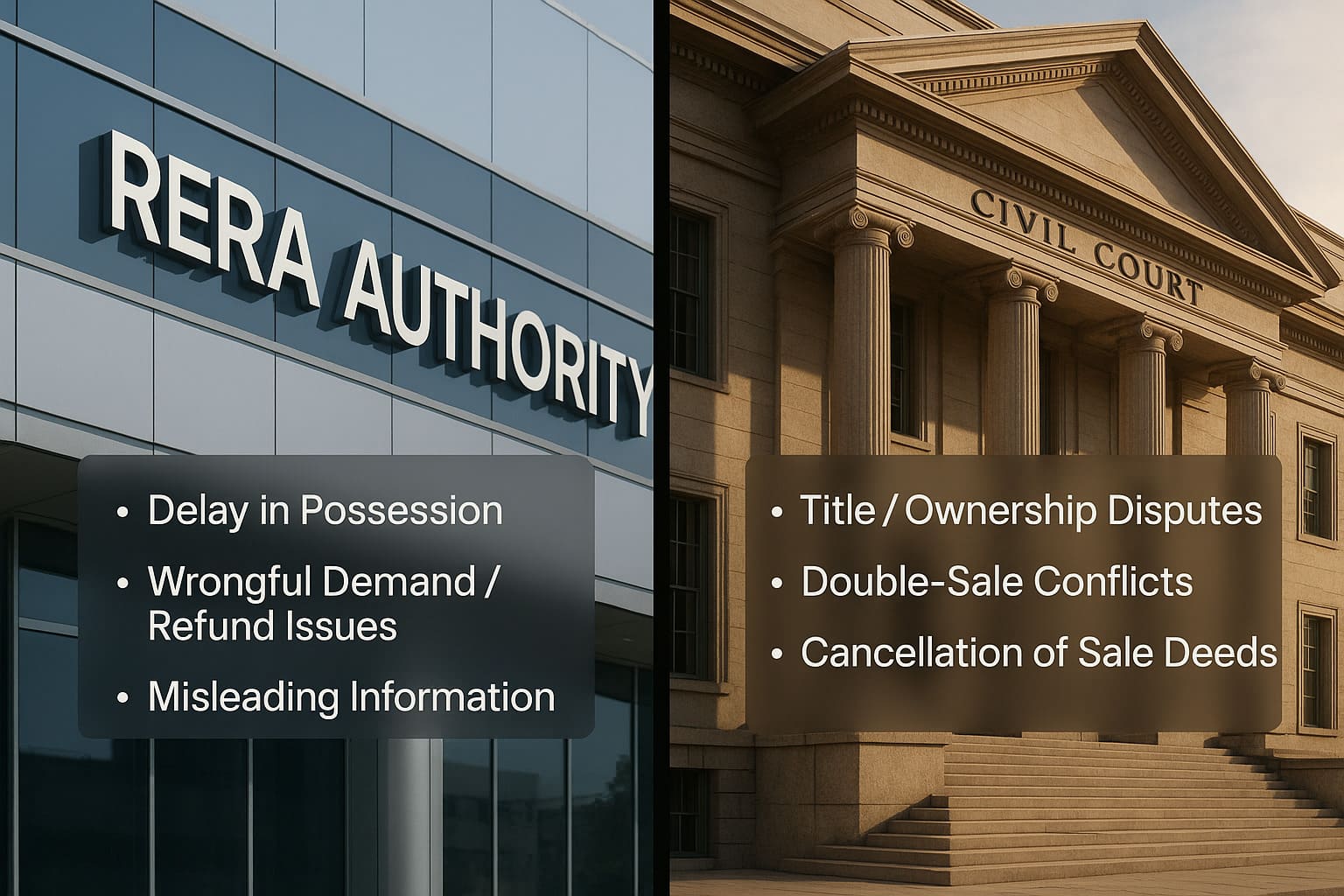
Use RERA for:
- Delay in possession
- Non-refund or wrongful demand
- Misleading advertisements
- Defective construction
- Non-registration of the project
- Breach of agreement obligations
Use Civil Court for:
- Title disputes
- Double-sale conflicts
- Cancellation or validity of sale deeds
- Declaratory reliefs
- Injunctions
- Questions of ownership or possession rights
This guarantees both speed and legal correctness.
Conclusion: A Clear Division of Powers for Greater Clarity and Accountability
The Bombay High Court’s rulings from 2017 and 2025 work together to define RERA’s true jurisdiction.
RERA is a powerful regulator but not a civil court.
It enforces promoter obligations, protects buyers, and ensures project discipline—but disputes over who owns what must go to civil courts.
This clarity strengthens the real estate dispute-resolution system and ensures that buyers and developers approach the correct forum from the very beginning.