

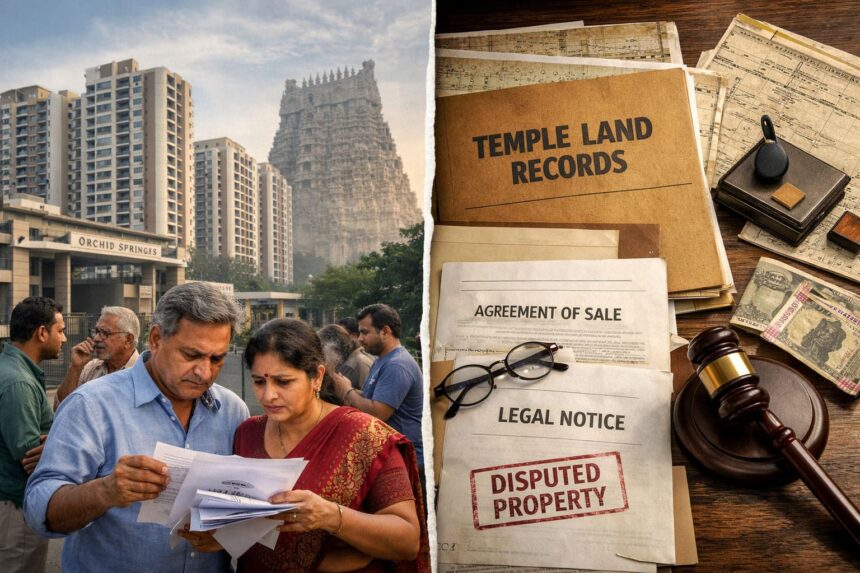
A ₹2,500 Crore Allegation Shakes Chennai’s Real Estate Market
A major real estate controversy has surfaced in Chennai, where an apartment project in Korattur — widely linked in public discussions to Urbanrise (earlier associated with the Orchid Springs project) — is facing serious allegations of being constructed on land claimed to belong to a temple.
Political leaders have alleged that over 2,000 flats were sold on disputed temple land, belonging to Sri Karapattira Sivaprakasa Swamigal Temple, with the total transaction value reportedly running into ₹2,500 crore. The matter has triggered panic among homebuyers, legal scrutiny, and renewed debate on land verification failures.
The Core Allegation
The dispute revolves around whether the land on which the apartments were constructed legally belongs to a temple governed by the Hindu Religious and Charitable Endowments Department (HR &CE).
According to public statements:
- The land was allegedly temple property.
- Apartments were developed and sold to thousands of buyers.
- A civil court reportedly observed that the land title is under dispute and linked to temple ownership.
- Buyers claim they were unaware of the underlying legal complications.
If proven, this raises a critical issue: Can property built on temple land be legally transferred to private buyers?
How Big Is the Financial Impact?
Reports indicate:
- Around 2,000+ housing units were sold.
- Buyers allege many took bank loans (₹50 lakh to ₹5 crore per flat) only to be blindsided when courts recognised the land as temple property, leaving the properties legally unsellable and potentially worthless.
- Some financial institutions are said to be re-evaluating the collateral status of these properties due to title uncertainty.
When land ownership itself is questioned, banks may classify such assets as high-risk, affecting resale, refinancing, or loan restructuring.
The Legal Risk: Why Temple Land Is Highly Sensitive
Temple lands in Tamil Nadu fall under strict protection mechanisms governed by the HR&CE framework.
Key concerns include:
- Temple lands cannot be freely alienated without proper sanction.
- Any transfer without statutory approval can be legally challenged.
- Even long-standing occupation does not automatically validate private ownership.
- Buyers may face prolonged litigation despite having registered sale deeds.
This is where most buyers get trapped — registration does not guarantee clear title.
Legal and financial ramifications
Reports suggest some banks have marked these properties as having “zero value” and are demanding additional documentation or action, since the title dispute undermines the collateral.
Homeowners have approached officials and lodged formal complaints seeking:
- a criminal investigation,
- action against the builder,
- compensation or buyback options,
What Buyers Should Learn from This Case
This issue is not about one builder or one project. It highlights a systemic gap in due diligence.
Before buying:
✔ Verify land classification through revenue records
✔ Check if land falls under HR&CE jurisdiction
✔ Examine parent documents thoroughly
✔ Confirm litigation status
✔ Conduct independent legal opinion — not just builder-provided reports
At Verified.RealEstate, we always stress one principle:
“Document clarity is more important than brochure promises.”
Possible Outcomes
That depends on court findings.
Possible outcomes may include:
- Settlement between stakeholders
- Compensation mechanisms
- Government intervention
- Prolonged litigation
- Validation if title is legally clarified
However, once temple ownership is judicially confirmed, private ownership claims become legally vulnerable.
Bigger Message for Tamil Nadu Real Estate
Tamil Nadu has thousands of acres classified under temple administration. Urban expansion has blurred boundaries between revenue land and institutional land.
This case may lead to:
- Stricter title audits
- Stronger HR&CE monitoring
- Bank-level re-evaluation of loan processes
- Higher compliance burden on developers
For serious investors, this reinforces one reality:
Land due diligence is not optional — it is survival.