

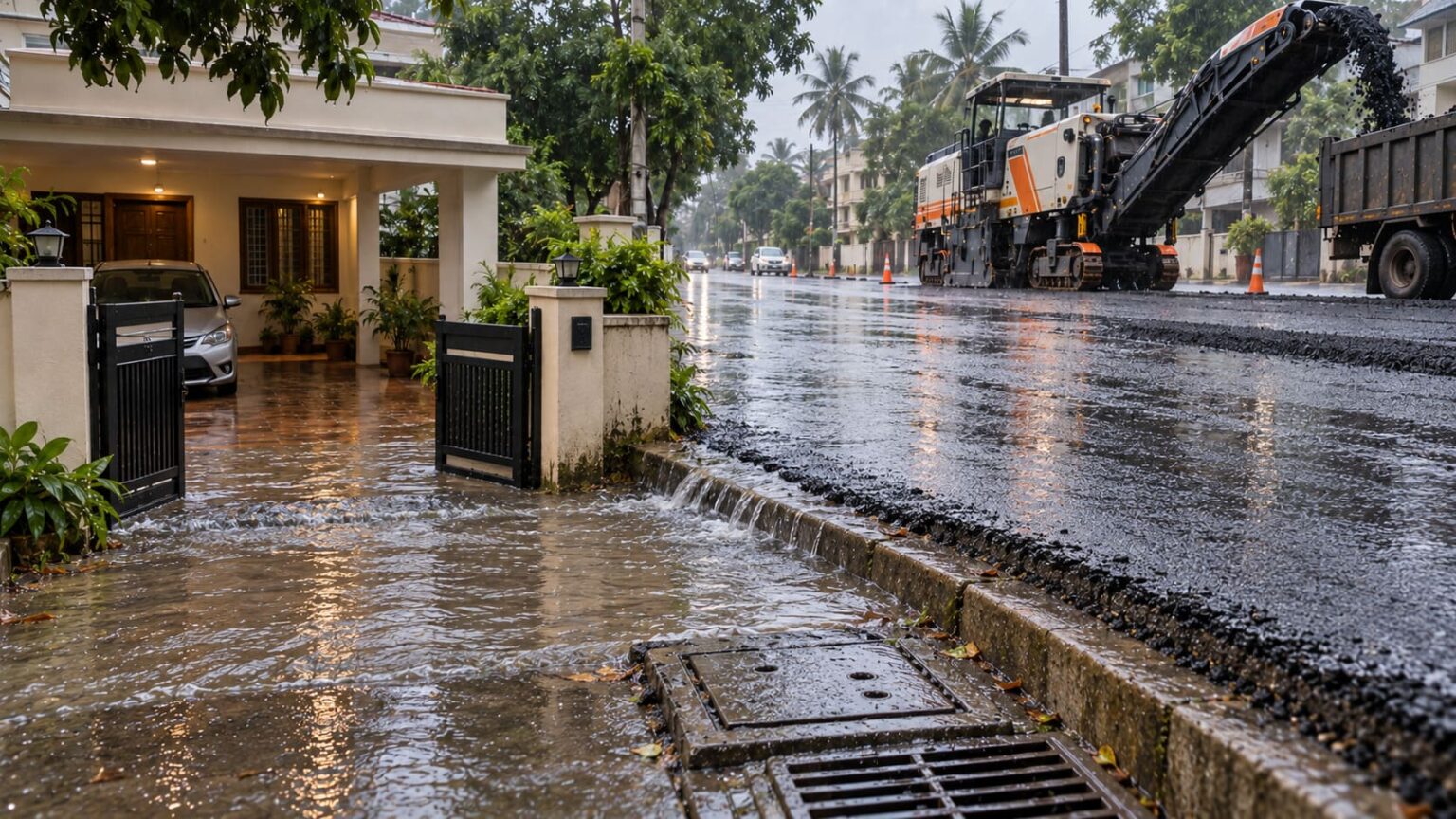
A house that once stood three steps above the street may now be level with it. After another round of road re-laying, its entrance may even sit below the road.
The house has not sunk. The road has risen.
This is happening when contractors place new asphalt, concrete, wet mix or paver blocks over an existing road without removing enough of the old surface. Over several re-laying cycles, even small increases can leave houses, shops, schools and drains below street level.
Why must a road be milled before relaying?
Milling is the process of removing a controlled thickness of the existing road surface before laying a new layer.
If a 40 mm surface is being added, engineers may remove a suitable portion of the existing layer first, depending on the approved road design. This helps renew the road without unnecessarily increasing its final height.
The Greater Chennai Corporation’s official Roads Department page says that its bus route roads are milled to ensure that road height does not increase. The Tamil Nadu government has also recognised and funded cold-milling machinery for Chennai road works for more than a decade.
The problem, therefore, is not a lack of engineering knowledge. It is poor execution and inadequate monitoring.
The High Court case that warned contractors
One of the most important proceedings was Mayiladuthurai Chamber of Commerce v. District Collector, W.P. No. 1963 of 2020.
The case concerned Pattamangalam Street in Mayiladuthurai. The petitioner wanted the authorities to scrape and level the existing road before re-aying it so that the street would not rise above nearby houses and shops.
During the proceedings in February 2020, a Madras High Court bench comprising Justices N. Kirubakaran and P. Velmurugan strongly criticised the practice of re-laying roads without milling.
The court observed that indiscriminate relaying makes roads rise while buildings appear to go down. This can cause rainwater to enter houses, obstruct drainage and create flooding.
- The bench said contractors who failed to mill or scrape roads before relaying should be identified and blacklisted.
- It also suggested informing the public about road contracts so residents could report work being carried out without milling.
This was a serious warning: failure to follow the approved relaying method could expose contractors to blacklisting and officials to accountability.
However, there is an important legal distinction. The blacklisting statement was made during the 2020 proceedings. The petition was finally disposed of in July 2024 after the court noted that the sanctioned work estimate already included picking and removing the existing bituminous surface and levelling the road.
Therefore, contractors are not automatically blacklisted every time someone alleges that milling was not performed. The violation must be established and the applicable tender conditions and legal procedures must be followed.
Tamil Nadu’s 2021 road-level direction
In May 2021, then Chief Secretary V. Irai Anbu directed the Highways Department to use milling while improving roads inside corporations, municipalities and town panchayats.
The reported direction said:
“Under no circumstances, the road surface in the corporations, municipalities and town panchayat limits shall be enhanced.”
It also required proper re-laying after milling to prevent flooding of adjoining homes.
The direction applied to Highways Department works within urban local-body limits, not automatically to every road maintained by every authority in Tamil Nadu.
Nevertheless, the government’s intention is clear: road improvement should not unnecessarily increase road height and put surrounding properties at risk.
Five years later, complaints continue
In August 2026, Arappor Iyakkam released a citizen-led road-height audit based on submissions from 157 participants.
The audit reported problems at:
- 245 locations across Tamil Nadu
- 42 locations in Chennai
- 203 locations elsewhere in the state
- 30 districts in total
Participants submitted GPS-tagged photographs, and some houses were reportedly approaching three feet below the adjoining roads.
The audit is not a professional topographic survey, so it cannot independently establish the exact historical rise of every road. But the number of complaints shows that this is not an isolated problem.
How raised roads increase flood risk
Raised roads are not the only cause of urban flooding. Heavy rain, blocked drains, inadequate stormwater systems, development over waterways and local terrain also play major roles.
However, the road-to-house level can decide whether street water enters an individual property.
When the road rises above the house entrance:
- Rainwater can flow towards the property instead of away from it.
- Parking areas and ground floors can become collection points.
- Stormwater drains may no longer match surrounding property levels.
- Manholes and utility chambers can become dangerous depressions.
- Gates and vehicle ramps may become difficult to use.
- Footpaths, drains and electricity boxes may need further reconstruction.
The government may spend public money to relay the road and then spend again to adjust the surrounding infrastructure.
Meanwhile, the homeowner may have to raise floors, rebuild gates, alter ramps or reconstruct drainage at private expense. Some homeowners who participated in the 2026 audit reportedly claimed that they had spent up to ₹40 lakh modifying affected buildings.
What should property buyers check?
Road level must become part of property due diligence, especially when buying an older independent house in a flood-prone area.
Buyers should check:
- The height of the road compared with the plot and finished floor
- Whether the entrance slopes towards the house
- The level and condition of the nearest stormwater drain
- Watermarks or signs of previous flooding
- Floors that appear to have been raised earlier
- Unusually low gates or compound walls
- Raised footpaths and sunken manholes
- Proposed road, sewer or stormwater projects nearby
A low-lying house is not automatically defective. But its elevation can materially affect flood risk, usability, renovation cost and future property value.
How can buyers check this risk?
Buyers can use Verified.RealEstate’s Geo Insights to understand a property’s elevation, slope, terrain and general drainage risk. The Flood Inundation Zone Finder can also identify mapped flood exposure. However, the exact difference between the road, plot entrance and finished floor must be confirmed through an on-site level survey before purchase.
Measurement must decide contractor payment
Simply photographing a milling machine is not enough. Authorities must measure and record:
Existing road level → road edge → drain level → footpath level → property entrance → finished floor level → proposed road level → completed road level
These measurements should be connected to a permanent benchmark and entered in the official Measurement Book.
Contractor completes road work
↓
Engineers inspect the completed road
↓
Does the road follow the approved design and avoid unnecessary elevation?
├── Yes → Release contractor payment
└── No → Withhold payment
↓
Was required milling skipped?
├── No → Order corrective work before payment
└── Yes → Invoke tender conditions
↓
Recover losses caused to the public
↓
Initiate blacklisting proceedings where legally justified.
Tamil Nadu needs properly maintained roads. But road maintenance must not bury the neighbourhood beside it.
A newly re-laid road cannot be judged only by how smooth and black it appears. Its real quality is also determined by whether the houses, drains and footpaths around it remain safe.