

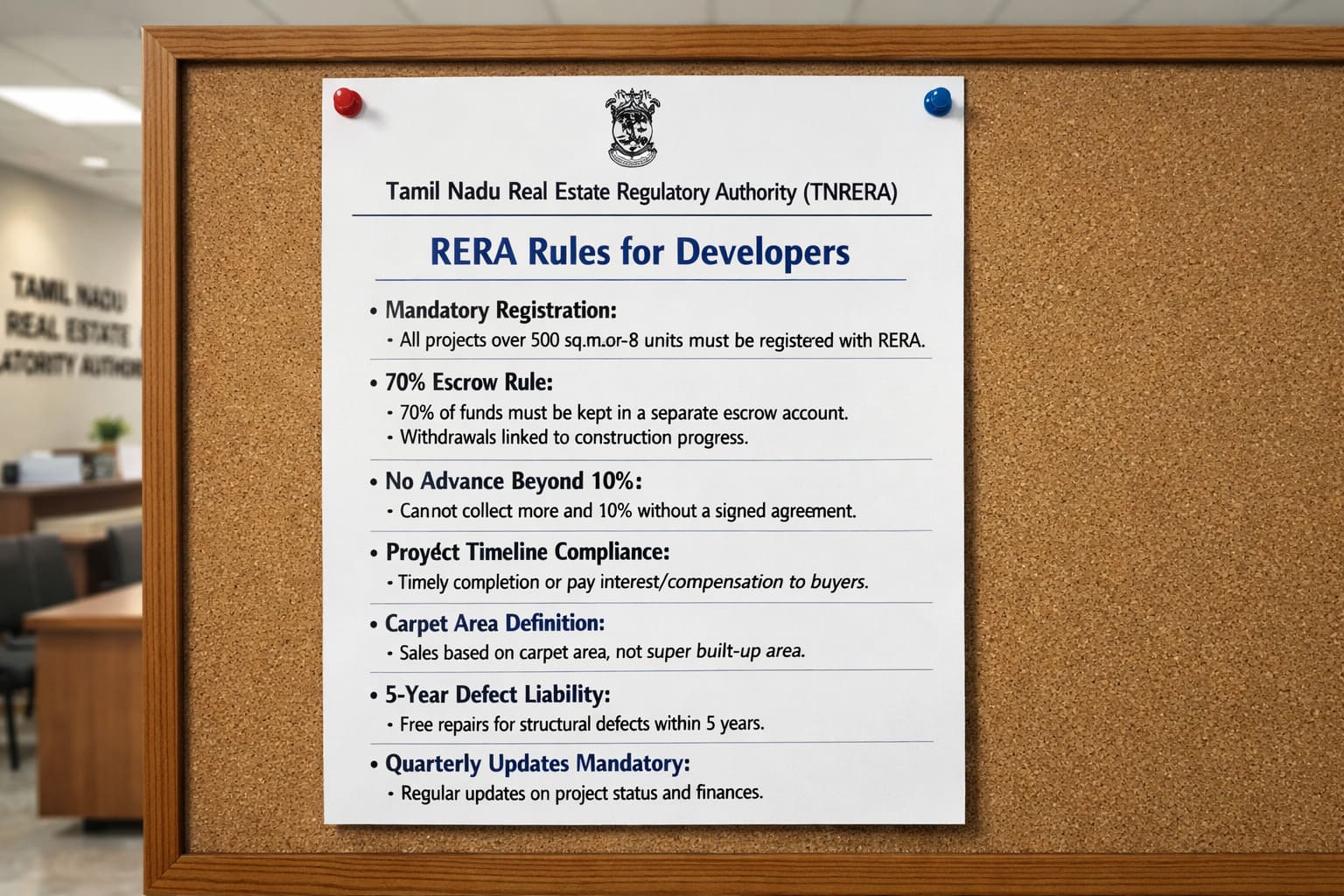
RERA Rules for Developers
The Real Estate (Regulation and Development) Act, 2016 was introduced to bring discipline, transparency, and accountability into real estate. On paper, it is one of the most structured regulatory frameworks in India.
But in practice, especially under Tamil Nadu Real Estate Regulatory Authority, the real story lies in how these rules are interpreted, implemented, and sometimes strategically navigated by developers.
Mandatory Project Registration
What the Law Says
Any project exceeding 500 sq.m or more than 8 units must be registered before advertising or selling.
Each project gets a unique RERA number, and all project details must be disclosed.
Practical Application
Developers often divide projects into phases or blocks.
- Each phase is registered separately
- Unit count appears smaller
- Compliance burden reduces
This allows developers to technically comply while limiting full regulatory visibility.
70% Escrow Rule
What the Law Says
70% of buyer funds must be deposited into a dedicated RERA account.
- Funds can only be used for land and construction
- Withdrawals must match construction progress
- Certified by engineer, architect, and CA
Practical Application
Tamil Nadu has strengthened this with a three-account system to prevent fund diversion.
However, developers may:
- Inflate construction costs
- Accelerate withdrawal eligibility
This creates a situation where compliance exists on paper, but financial discipline can still be manipulated.
Project Disclosure and Transparency
What the Law Says
Developers must disclose:
- Layout plans and approvals
- Land title details
- Project timelines
- Contractor information
- Quarterly progress updates
Practical Application
While disclosures are uploaded, they are often:
- Generic
- Not easily verifiable
- Delayed in updates
This limits the effectiveness of transparency unless buyers actively verify documents.
Land Title Disclosure
What the Law Says
Developers must provide clear and marketable title details of the land.
Practical Application
This is one of the biggest gaps in the system.
- Partial document chains are shown
- Legal heir issues or disputes may be hidden
- Unregistered settlements are not always visible
RERA ensures disclosure, but it does not guarantee title validity.
Advance Payment Restriction
What the Law Says
Developers cannot collect more than 10% of the property cost without a registered agreement.
Practical Application
Developers use alternative structures such as:
- Expression of Interest (EOI)
- Token booking amounts
- Application fees
These are positioned outside the legal definition of “advance,” allowing early fund collection.
Project Timelines and Delays
What the Law Says
Projects must be completed within the declared timeline.
If delayed:
- Buyers are entitled to interest
- Or full refund with interest
Practical Application
Developers frequently justify delays using:
- Force majeure clauses
- Approval delays
- External dependencies
Buyers often need to pursue legal action to enforce compensation.
Carpet Area Standardization
What the Law Says
Properties must be sold based on carpet area, ensuring clarity in usable space.
Practical Application
Marketing still highlights:
- Super built-up area
- Saleable area
This creates a perception gap between what is marketed and what is legally defined.
Defect Liability Period
What the Law Says
Developers must fix structural defects and workmanship issues within 5 years of possession at no cost.
Practical Application
Developers may:
- Delay responses
- Reclassify defects as maintenance issues
Escalation to RERA is often required for enforcement.
Enforcement and Penalties
What the Law Says
- Non-registration → up to 10% of project cost as penalty
- Continued violation → imprisonment possible
- Fund misuse → heavy financial penalties
Practical Application
Enforcement in Tamil Nadu is improving with:
- Digital complaint systems
- Increased financial scrutiny
- Higher penalties
However, execution delays still exist, giving developers time to respond strategically.
The Core Reality: Law vs System Behavior
RERA has fundamentally changed how developers operate:
Before RERA:
- Cash-driven operations
- Flexible timelines
- Limited accountability
After RERA:
- Structured financial flows
- Documentation-heavy processes
- Increased legal exposure
But developers have adapted.
They no longer bypass the system directly—they work within it, strategically.