

Tamil Nadu has secured industrial investment commitments worth ₹2.07 lakh crore in 2025, following the signing of over 270 Memoranda of Understanding (MoUs) with domestic and global companies, according to the state Industries Department.
The investments span manufacturing, electronics, aerospace, defence, logistics, and IT sectors, with a strong push toward regional diversification beyond Chennai.
Scale of Investments and Job Creation
The signed MoUs collectively represent one of Tamil Nadu’s largest single-year investment commitments, with the government estimating over four lakh direct and indirect employment opportunities once projects are implemented. These commitments reflect formal intent by companies and are expected to roll out in phased timelines over the next few years.
Sector-Wise Investment Focus
The bulk of the investment commitments are concentrated in future-ready and export-oriented sectors, including:
- Advanced manufacturing and industrial engineering
- Electronics and semiconductor-related units
- Aerospace and defence manufacturing
- Railways and heavy engineering
- IT services and Global Capability Centres (GCCs)
- Port-linked and maritime industries
These sectors typically require large land parcels, logistics support, and long-term infrastructure planning, directly influencing industrial real estate demand.
Geographic Spread Across Tamil Nadu
A defining feature of this investment cycle is the shift away from Chennai-centric development.
Key initiatives include:
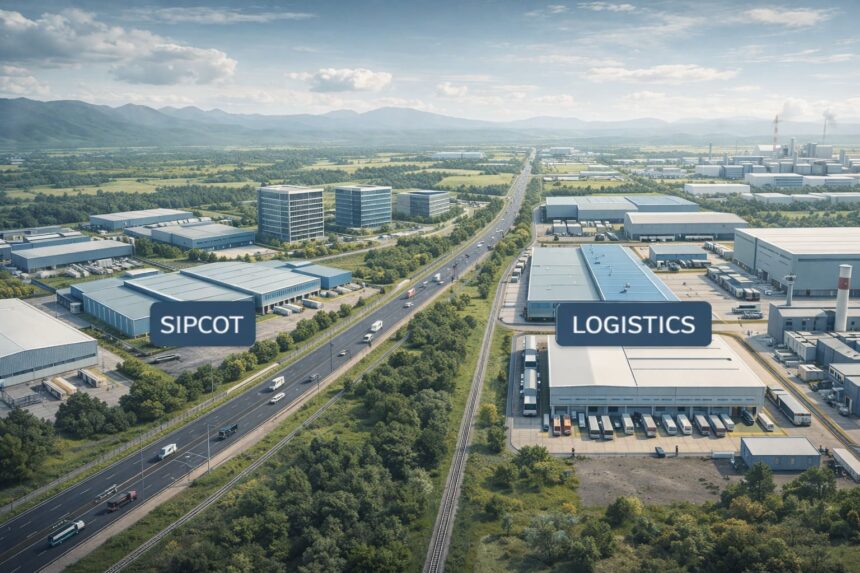
- New SIPCOT industrial parks announced in Madurai, Tenkasi, and Thiruvarur, bringing industrial development to first-time locations
- Expansion of industrial estates and manufacturing zones in Tier-2 and Tier-3 cities
- Development of TIDEL Neo IT parks in smaller cities to decentralise IT employment
- Announcement of a large TIDCO Global City project near Chennai, planned as an integrated industrial-commercial zone
This approach aims to create balanced regional growth and reduce pressure on existing urban clusters.
Infrastructure and Industrial Real Estate Implications
The scale and distribution of these investments will have a direct impact on real estate and infrastructure development across the state.
Key implications include:
- Rising demand for industrial land parcels in new SIPCOT locations
- Increased requirement for warehousing, logistics parks, and supply-chain infrastructure
- Growth of office space and support commercial development around TIDEL Neo parks
- Secondary demand for worker housing, rental accommodation, and urban amenities near industrial hubs
Impact on Real Estate Markets
From a real estate perspective, the investment commitments are expected to:
- Strengthen long-term demand for industrial and logistics real estate
- Improve land absorption in non-metro districts
- Encourage planned development rather than speculative land conversion
However, pricing impact is expected to be gradual and phase-driven, linked to actual project execution rather than announcements alone.
What Buyers and Investors Should Note
- MoUs indicate intent, not immediate construction
- Land demand will materialise only after approvals, land acquisition, and project grounding
- Areas around announced industrial parks may see price expectations rise ahead of execution
- Buyers should verify zoning, approvals, and infrastructure timelines before making decisions
Verified.RealEstate Insight
Large investment announcements often trigger speculative land activity. However, industrial growth translates into real estate value only when projects move from MoU stage to on-ground execution. Investors and land buyers should rely on document verification, zoning checks, and approval status rather than headline figures.