

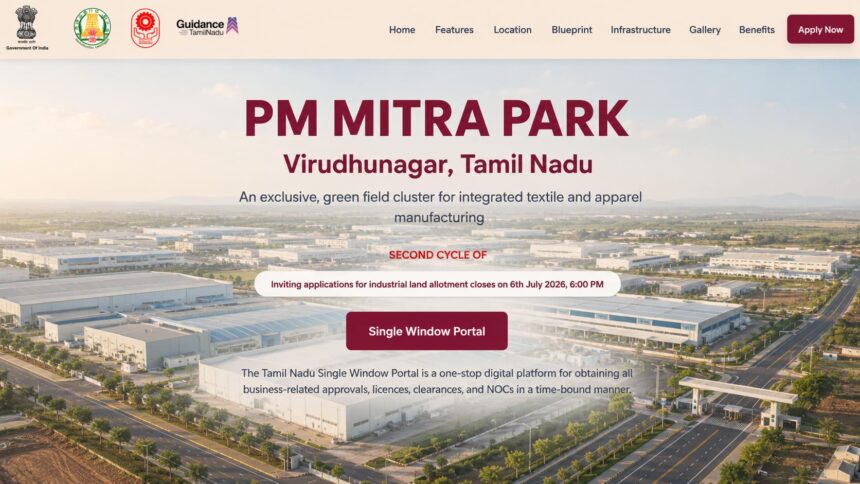
The PM MITRA Park at E. Kumaralingapuram in Virudhunagar, Tamil Nadu, represents a structural shift in India’s textile manufacturing landscape. Spanning 1,052 acres, this mega-cluster addresses a historical bottleneck in southern India’s textile supply chain: the lack of centralized, large-scale, and environmentally compliant processing infrastructure.
With an approved Detailed Project Report (DPR) of ₹1,894 crore and over ₹550 crore in basic infrastructure works already under execution, the park is on track for its official December 2027 completion target. Here is an in-depth analysis of the plot ecosystem, eligibility criteria, financial obligations, and onboarding protocols for prospective investors.
Industrial Zoning & Sector-Specific Plots
The park’s master plan is organized into specialized zones to encourage co-location benefits, reducing transit times and material-handling costs across the manufacturing lifecycle:
- Apparel Manufacturing & Knitwear Zones: Optimized for high-density cutting, sewing, garment dyeing, and packaging operations. These plots are positioned for easy access to logistics hubs and park amenities.
- Processing Zone (Dyeing & Printing): Formulated specifically for wet processing units. These plots are directly integrated into the shared environmental utility pipelines.
- Technical Textiles & Man-Made Fibre (MMF): Spaces structured to handle heavy machinery load footprints, including filament extrusion lines, non-woven fabric production, coating, and laminating facilities.
- Plug-and-Play Space for MSMEs: Featuring 13 lakh sq ft of ready-to-move industrial sheds and factory buildings, allowing smaller enterprises to establish operations without construction delays.
Industry Eligibility: Who Can Apply?
To maintain the park’s integrity as a dedicated textile ecosystem, the land allotment policy restricts entry exclusively to companies operating within the textile and garment value chain.
Permitted Manufacturing & Processing Activities
- Fibre Processing & Spinning: Ginning, baling, scouring, carding, combing, ring spinning, open-end spinning, and air-jet spinning.
- Fabric Production: Weaving, knitting, and man-made filament extrusion.
- Wet Processing & Finishing: Dyeing, printing, bleaching, finishing, and garment washing.
- Garmenting & Apparel Assembly: Cutting, sewing, stitching, embroidery, and final packaging for apparel and made-ups (bed linen, curtains, towels, blankets).
- Advanced Manufacturing: Technical textiles and specialized textile machinery manufacturing.
Approved Allied Infrastructure
Applications are also open to support-service providers, including textile testing laboratories, quality certification bodies, product development centers, industrial warehousing, and specialized packaging units.
Financial Commitments & Allottee Charges
SIPCOT’s allocation framework balances accessible entry costs with structural safeguards to prevent land speculation.
| Fee Component | Financial Rate / Requirement |
| Initial Plot Deposit | ₹50,000 per acre (Credited toward the final plot cost) |
| Application Fee | ₹10,000 + GST (Non-refundable) |
| Lease Rental | One-time nominal lease rent of ₹100 per allotment |
| Annual Maintenance | ₹2,900 + GST per acre per month (Fixed for the first year) |
| Caution Deposit | Standard 5% of plot value (An additional 5% may be requested in competitive multi-application scenarios) |
| Tax Component | 18% GST applicable on all statutory service fees |
Step-by-Step Land Allotment Procedure
The onboarding process is managed digitally through the official SIPCOT portal: https://sipcotweb.tn.gov.in/pm-mitra/public/. Because the park operates under strict development timelines, applicants must adhere to a definitive processing schedule:
1.Digital Portal Submission:
Applicants log into the SIPCOT portal to submit project details, including product categories, water/power load metrics, proposed layouts, and business registration documents (PAN, GSTN, Udyam registration, or FDI approvals). Proposals must include a Detailed Project Report (DPR), a certified shareholding pattern, and a PERT chart defining construction timelines. Government identification documents for promoters are verified at this stage.
2.Land Allotment Committee Scrutiny:
The multi-departmental committee evaluates proposals against objective criteria: investment density, projected employment per acre, export potential, technological innovation, and sustainability targets (such as water recycling commitments).
3.Letter of Intent (LoI) Execution:
Successful applicants receive a formal Letter of Intent. The investor has a strict window of 7 calendar days to formally accept the terms and plot allocation.
4.Balance Premium Settlement:
The remaining balance of the total land premium must be paid within 60 days of LoI acceptance. A 30-day grace period is available but incurs a 10% simple interest charge on the outstanding balance.
5.Lease Registration & Handover:
The formal lease deed must be registered within 30 days of full payment. SIPCOT is contractually obligated to hand over physical possession of the industrial plot within 15 working days of deed execution.
What is the Current Application Status?
Applications are currently open under the second cycle for industrial land allotment at the PM MITRA Textile Park in Virudhunagar, with the deadline fixed as 6 July 2026, 6:00 PM. The land is offered as industrial plots on long-term lease, not as ordinary freehold sale.
Current Investors & Commitments
The park operates under a Special Purpose Vehicle (SPV) framework—PM Mega Integrated Textile Regions and Apparel Park Tamil Nadu Limited—with 51% equity held by the State Government and 49% by the Central Government. This public-backed governance model has secured strong early market confidence.
Initial Allocation Metrics
As of the latest official approvals, 23 distinct investors have been formally allotted land within the PM MITRA Park in Virudhunagar. Their incoming operations account for the following metrics:
- Land Allotted: 190.44 acres of industrial space.
- Committed Capital: Nearly ₹2,192.21 crore ($264 million) in private industrial investment.
- Employment Potential: Projected to generate approximately 15,000 direct formal jobs.
The investments from these 23 companies span the entire textile value chain, including integrated manufacturing setups, yarn and fabric production facilities, wet processing/finishing units, apparel manufacturing plants, and technical textiles.
Target Investor Profile
The incoming pipeline consists of two primary corporate profiles:
- Global Export Conglomerates: International brands and large-scale transnational exporters. The park’s built-in sustainability compliance provides these entities with clear ESG (Environmental, Social, and Governance) traceability, which is increasingly required by western consumer markets.
- Domestic Manufacturing Consortia: Established players from existing Tamil Nadu textile clusters (such as Rajapalayam, Tiruppur, Coimbatore, and Madurai) expanding or relocating their processing operations to take advantage of shared utility economics.
Eco-Friendly Utilities & Infrastructure
The primary structural advantage of the Virudhunagar park is its shared environmental infrastructure, designed to reduce individual compliance risks and capital expenditures for tenant firms.
Phased Infrastructure Deployment:
While the park’s master blueprint accounts for an ultimate 20 MLD (Million Liters per Day) Zero Liquid Discharge (ZLD) framework and a 15 MLD Common Effluent Treatment Plant (CETP), current implementation follows a modular approach.
A state eProcurement tender issued on an EPC basis establishes an initial 5.0 MLD ZLD-based CETP (valued at ₹119.74 crore, inclusive of a 5-year operations mandate). This approach ensures that treatment capacities scale in tandem with real factory output, keeping initial tariff structures stable for early-stage investors.
Green Energy & Transport Links
To support sustainability goals, the park integrates a 20 MW solar power plant alongside centralized steam boilers, allowing factories to plug directly into clean thermal and electrical networks. Combined with direct access to export shipping lines via the Thoothukudi Port (106 km via NH-44), the PM MITRA Park provides a highly competitive, compliant, and structurally sound base for modern textile manufacturing in South India.