

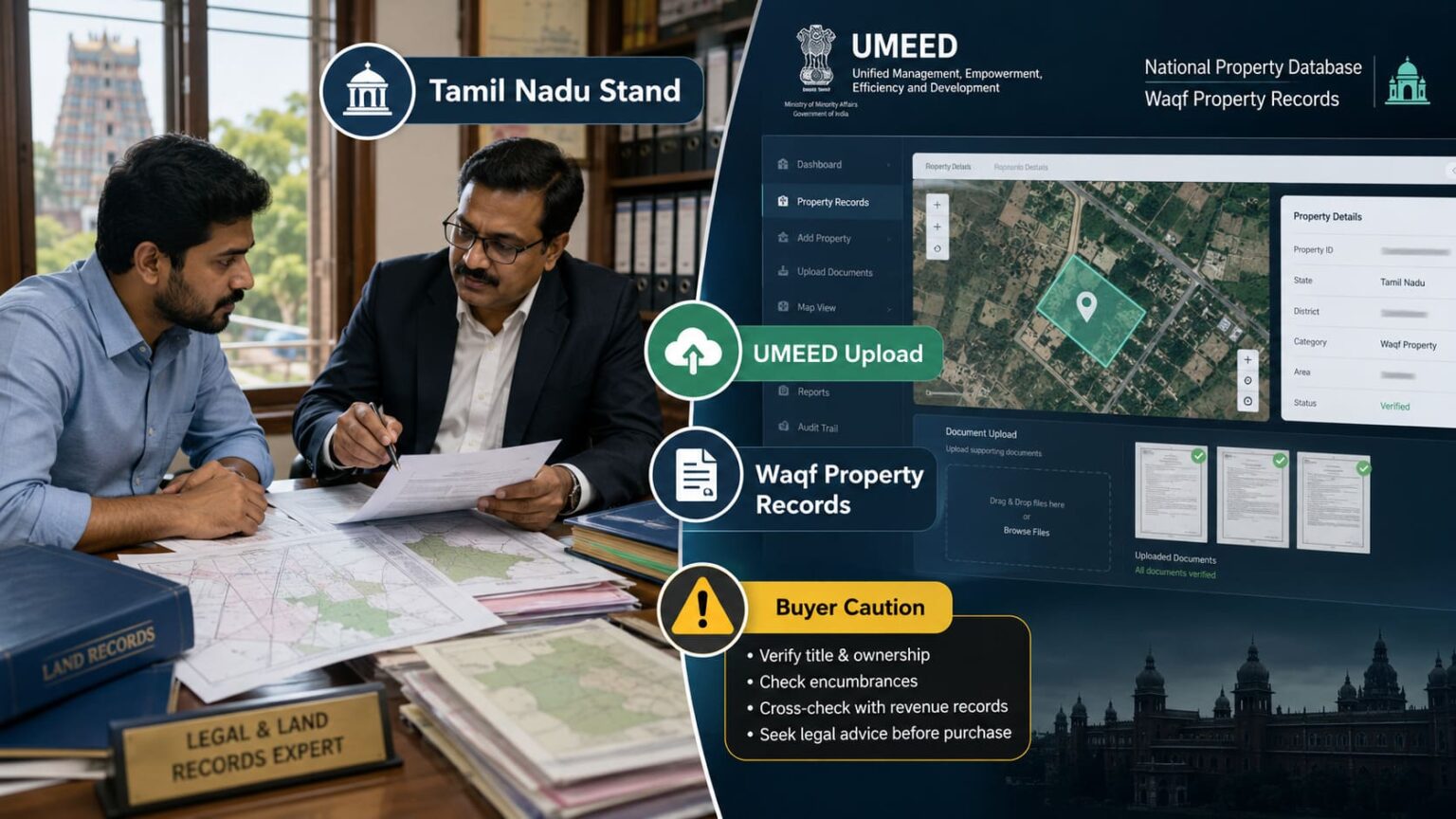
Tamil Nadu’s Stand on the New Waqf Act
Tamil Nadu has stated that it will not implement the new Waqf Act in the State. According to Minister for Minorities Welfare S M Nasar Shahjahan, the State government will continue with the existing system of Waqf administration and will not bring in certain provisions introduced under the new amendment.
The Minister made the statement while receiving the first batch of Tamil Nadu Hajj pilgrims who returned to Chennai. He also said the State would seek an extension from the Centre for uploading Waqf property details on the UMEED portal because practical difficulties had arisen in the upload process.
What Was Changed Under the Waqf Amendment?
The Waqf Amendment Act, 2025 amended the earlier Waqf Act, 1995. The Centre’s stated aim was to make Waqf property administration more transparent through better registration, digital records, survey processes, and accountability of Waqf Boards. The Union government has pointed to issues such as delay in surveys, property disputes, incomplete records, and litigation as reasons for the changes.
Some Important changes include:
Waqf by user was removed. Earlier, a property could be treated as Waqf based on long usage for religious/charitable purposes. The amendment says Waqf should be created through proper declaration/endowment and that the person creating Waqf must own the property.
Collector’s role was increased. Earlier, Waqf survey work was handled through Survey Commissioners. The amendment empowers the Collector / revenue officers to conduct surveys and handle certain disputes involving government property claimed as Waqf.
Waqf Board’s power to decide whether a property is Waqf was removed. PIB says the earlier Waqf Board power to inquire and determine Waqf property has been removed under the amendment.
Property details must be uploaded on a central portal. Section 3B requires every Waqf registered before the 2025 amendment to file details of the Waqf and its property on the central portal/database within the prescribed period.
Non-Muslim members can be included in Waqf bodies. The amended law provides for wider composition of State Waqf Boards, including women, different Muslim sects, professional members, and two non-Muslim members excluding ex-officio members.
What Tamil Nadu Says It Will Not Do
Tamil Nadu’s objection is mainly around two areas.
First, the State has said it has not appointed non-Muslim members to the Waqf Board and will not do so in the future. This is one of the specific amended provisions that the Minister highlighted while explaining the State’s position.
Second, Tamil Nadu has said it is facing difficulties in uploading Waqf property details on the UMEED portal. The Minister said the State would ask the Centre to extend the deadline, and resolutions regarding the issue would also be passed.
In simple terms, Tamil Nadu is not saying that Waqf property records are irrelevant. It is saying that the State does not agree with implementing the new amended framework in its current form, especially the provision on non-Muslim members and the deadline-driven digital upload process.
What Other States Have Done So Far
The position across India is not uniform. Some States have moved ahead with the UMEED upload process, while others have faced delays or sought extensions.
Press Information Bureau (PIB), said that, as of 2 March 2026, 6,29,527 properties had been initiated, 2,87,695 properties had been validated and approved, and 38,083 had been rejected after verification on the UMEED system. PIB also said 17 States/UTs had been granted extensions by Waqf Tribunals from February 2026 onwards.
Karnataka has been reported as the first State to complete uploading all its Waqf properties onto the UMEED platform. This is significant because Karnataka had also initially opposed parts of the amendment, but later completed the property upload process.
Telangana sought more time, and the Waqf Tribunal extended the deadline for uploading Waqf property details on the UMEED portal up to March 31, 2026. The Telangana Waqf Board informed the Tribunal that the number of identified Waqf properties had increased after the upload process began, showing how digitisation can reveal additional records that may not have been fully consolidated earlier.
Reports also suggest that States such as Gujarat, Uttar Pradesh and Madhya Pradesh had approached their respective Waqf Tribunals and secured extensions for uploading Waqf property records.
So, the correct position is this: the full implementation of the amended Waqf framework is still politically and legally debated, but the UMEED property upload process has already started in several States.
Why Waqf Land Verification Matters Before Buying Property
For Buyers and developers, conducting proper due diligence before purchasing a property is essential to avoid buying land that may fall within, overlap with, or be claimed as religious or Waqf-related land or temple land . Checking only the patta, encumbrance certificate and sale deed history may not be enough, especially for older land parcels or properties with religious, charitable or institutional history.
Buyers should verify whether the property lies in any notified or claimed Waqf area, appears in Waqf-related records, has links to mosque, dargah, burial ground, madrasa or charitable use, or is involved in any Waqf Board claim, tribunal case, objection or pending dispute
The Bigger Picture
Tamil Nadu’s stand shows that the new Waqf framework is not being accepted uniformly across India. While the Centre is pushing for centralised digital property records through UMEED, some States are questioning certain provisions and seeking more time for compliance.
For real estate stakeholders, the takeaway is clear: Waqf property verification should not be ignored just because the State has taken a political or administrative stand against the new Act. Until there is full clarity, buyers, developers and lenders should treat Waqf-related land history as a serious due diligence item.
Abbreviations Used
UMEED — Unified Waqf Management, Empowerment, Efficiency and Development: A central digital portal for uploading and managing Waqf property records.