


1. Introduction
In Tamil Nadu real estate, the term Power of Attorney (PoA) frequently arises—particularly when landowners live abroad, joint families own undivided property, or elderly parents transfer handling to children. However, PoAs are widely misunderstood and often misused.
This article explains the role, types, legal standing, and risks associated with using PoA in land and flat transactions across Tamil Nadu.
2. What is a Power of Attorney?
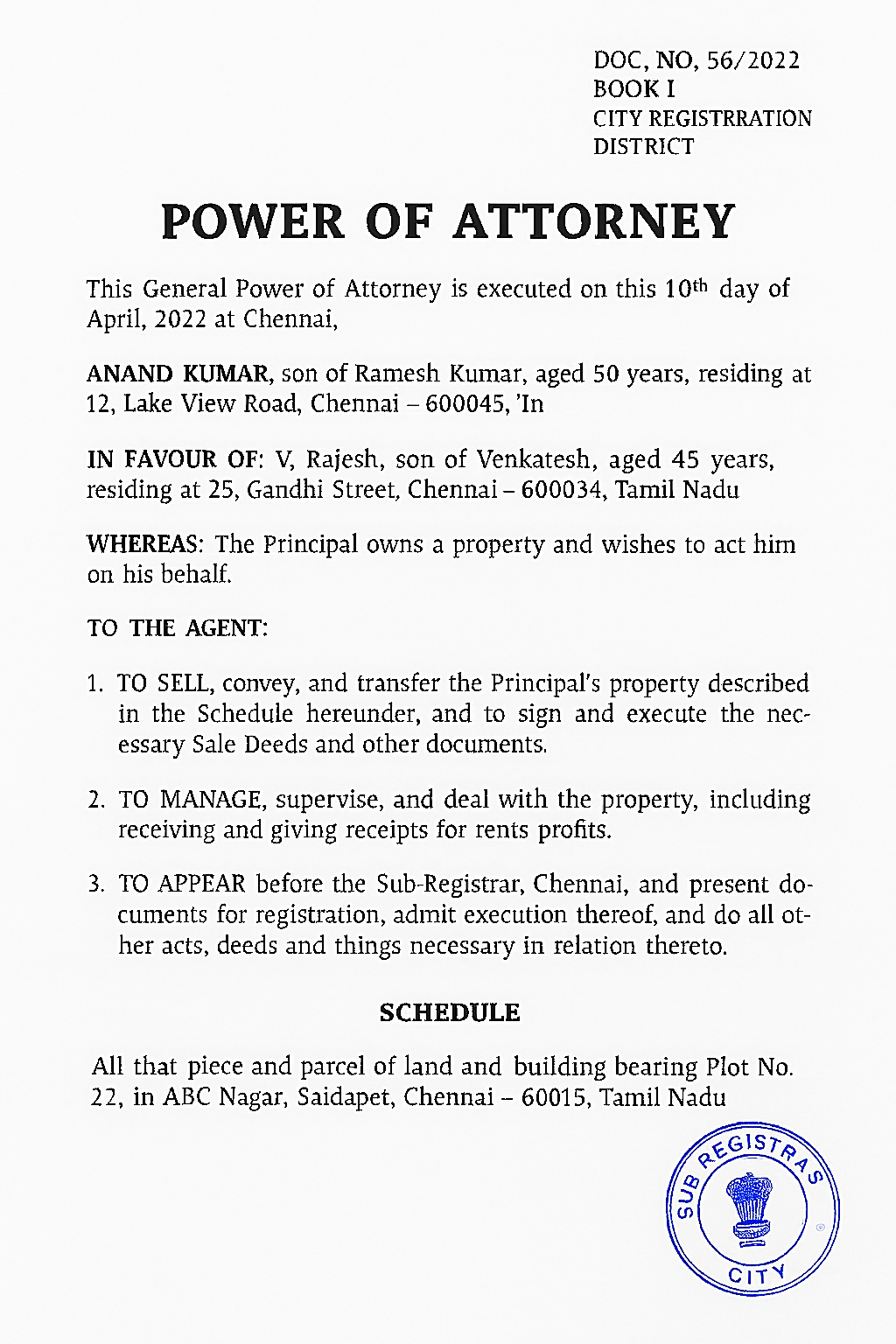
A Power of Attorney is a legal document that grants someone (the agent) the authority to act on behalf of another person (the principal) in specific or broad matters.
In real estate, this typically means:
- Selling or leasing land
- Collecting rent or dues
- Managing property paperwork
- Appearing before registration authorities
A PoA does not give ownership—it only grants authority to act.
3. Types of Power of Attorney
| Type of PoA | Meaning & Usage |
|---|---|
| General PoA | Grants broad rights over multiple transactions (sale, lease, collection) |
| Special (Specific) PoA | Grants authority for a single, clearly defined act (e.g., selling one property) |
| Registered PoA | Legally recognized if registered at Sub-Registrar Office (mandatory in TN) |
| Notarized PoA | For minor authority or private affairs, not valid for land sale |
In Tamil Nadu, only registered PoAs are accepted for sale or transfer of immovable property.
4. When Is PoA Used in Tamil Nadu?
- NRI or out-of-state landowners authorizing family to sell
- Elderly or ill persons delegating tasks to a trusted relative
- Joint family property, where one member manages all dealings
- Legal heirs, using PoA to complete sale on behalf of siblings
It’s commonly used in places like Chennai, Coimbatore, and Madurai where buyers and sellers live far apart.
However, misuse is rampant—fraudulent agents sell without knowledge of principals, or use expired PoAs.
5. Is Sale Through PoA Legal?
A Power of Attorney alone is not a Sale Deed.
However, if a PoA is registered and specific to sale, and the agent executes the Sale Deed on behalf of the owner, then:
- The buyer’s name enters the Sale Deed
- The PoA must be verified by Sub-Registrar at registration
- EC will show buyer’s name as the latest owner
In Tamil Nadu, after the 2011 Supreme Court ruling (Suraj Lamp case), PoA cannot replace Sale Deed. Properties must be transferred via registered Sale Deed, not just through PoA + payment.
6. Dangers of Misusing PoA
| Risk | Explanation |
|---|---|
| Forgery or impersonation | Fake agents executing PoAs and selling to third parties |
| Expired or revoked PoA | Old or revoked PoA used illegally |
| Broad powers in General PoA | Agents misusing powers beyond intended limits |
| Ownership confusion | Buyers mistakenly believe PoA = ownership |
Buyers should always insist on verifying the PoA, its registration date, scope of authority, and whether it has been revoked or replaced.
7. How to Verify a Power of Attorney
- Ask for a copy of the registered PoA document
- Cross-check the Sub-Registrar Office (SRO) where it was registered
- Check if the PoA is still valid (not expired or revoked)
- Ensure the agent is executing only what’s authorized
- Validate the Sale Deed has correct reference to the PoA document number
8. What If I’m Buying a Property via PoA?
As a buyer:
- Ensure the PoA is registered and specific to the transaction
- Insist on Sale Deed signed by PoA agent + stamp duty paid
- Check EC shows your name after registration
- Avoid deals that rely only on PoA + payment receipt (invalid post-2011)
Need help navigating your property journey? Click here to access expert-verified real estate services you can trust.
Conclusion
Power of Attorney is a useful legal tool—but also a dangerous one in the wrong hands. In Tamil Nadu, misuse is rampant in land scams, and buyers often confuse it with true ownership.
If you’re buying from someone acting as a PoA agent:
- Be cautious
- Get the documents verified
- Insist on a proper Sale Deed and mutation
Remember: Only registration creates ownership. Power just delegates authority.