

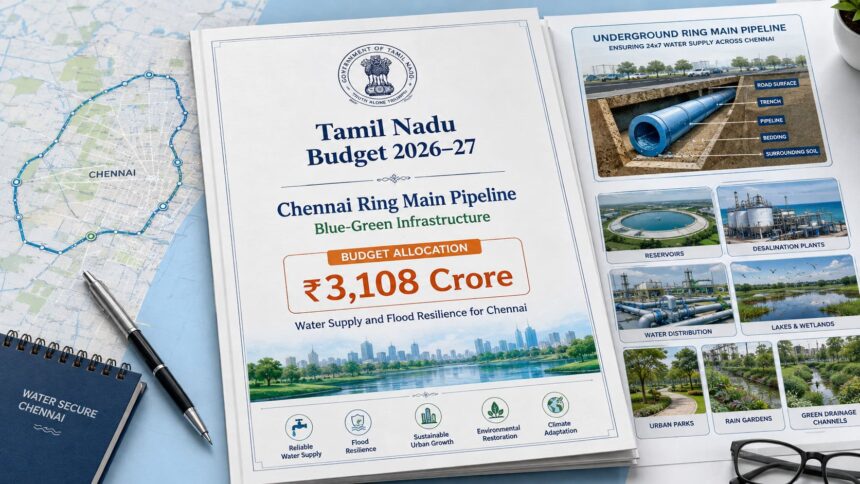
Chennai is set to receive a major upgrade to its drinking-water and flood-management systems. In the Tamil Nadu Budget 2026–27, the state government announced a ₹3,108-crore Ring Main Pipeline Project and new blue-green infrastructure projects around the city’s water bodies.
Together, these projects aim to improve water supply, reduce flooding and make Chennai better prepared for future climate challenges.
What Is the Chennai Ring Main Pipeline Project? 🚰
The Ring Main Pipeline will create an interconnected drinking-water network across Chennai.
At present, different parts of the city depend on separate reservoirs, desalination plants and pipelines. When a major pipeline is damaged or a water source is temporarily unavailable, supply may be interrupted in several localities.
The new ring pipeline will connect Chennai’s important water sources and distribution points. This will allow Metrowater to redirect water from another source during repairs, shortages or emergencies.
The project is expected to:
- Provide a more reliable drinking-water supply
- Reduce water pressure problems in tail-end areas
- Prevent major supply disruptions
- Improve water distribution across Chennai
- Support the long-term goal of uninterrupted water supply
An earlier version of the project proposed a circular pipeline connecting five reservoirs and two desalination plants, along with booster stations that could redirect water during supply failures.
How Will the Ring Pipeline Help Chennai Residents?
The project will work like a ring road, but for drinking water.
Instead of water travelling through only one fixed route, the interconnected network will provide alternative routes. When one pipeline is closed for maintenance, water can potentially be supplied through another section of the network.
This could reduce Chennai’s dependence on tanker water during supply interruptions and improve access in areas that currently receive water with low pressure.
However, the real benefit will depend on proper execution, regular maintenance and strong connections between the main pipelines and local household distribution networks.
What Is Blue-Green Infrastructure? 🌿💧
Blue-green infrastructure uses water bodies, wetlands, trees, parks and natural drainage spaces to manage rainwater and reduce flooding.
The “blue” part refers to rivers, lakes, canals, ponds and wetlands. The “green” part includes parks, trees, landscaped areas and open spaces that absorb rainwater.
The government plans to introduce blue-green infrastructure around Chennai’s water bodies to improve environmental protection and strengthen the city’s ability to handle heavy rainfall.
Such projects can help:
- Increase rainwater storage
- Reduce waterlogging and urban flooding
- Improve groundwater recharge
- Protect lakes and waterways from encroachment
- Create cleaner public spaces
- Reduce heat in densely built areas
Part of a Larger Chennai Water Plan
The Municipal Administration and Water Supply Department has received ₹29,863 crore in the Tamil Nadu Budget 2026–27, compared with ₹26,678 crore in the previous year. The government has also announced plans to restore Chennai’s polluted waterways, including the Cooum and Adyar rivers.
Other ongoing water projects in different parts of chennai include
- improvements to treatment plants,
- sewerage networks and
- continuous water-supply systems
What Does This Mean for Chennai Real Estate? 🏙️
Reliable drinking water and better flood protection can improve the liveability of residential areas.
Localities with weak water pressure, tanker dependence or frequent flooding may benefit if the projects are completed properly. Better water infrastructure can also support new housing and commercial development in Chennai’s expanding suburban areas.
However, property buyers should not depend only on future infrastructure announcements. They must still check the area’s present water source, flood history, stormwater drainage, groundwater condition and Metrowater connection before purchasing a property.
A Major Step—But Execution Will Matter
The ₹3,108-crore Ring Main Pipeline and blue-green infrastructure plan could address two major problems faced by Chennai: unreliable water distribution and urban flooding.
The announcements are promising, but the final impact will depend on timely completion, proper maintenance and whether blue-green projects genuinely restore natural water systems instead of merely building walls and fences around them.
If implemented correctly, these projects could help Chennai move towards a safer, greener and more dependable urban water system.