

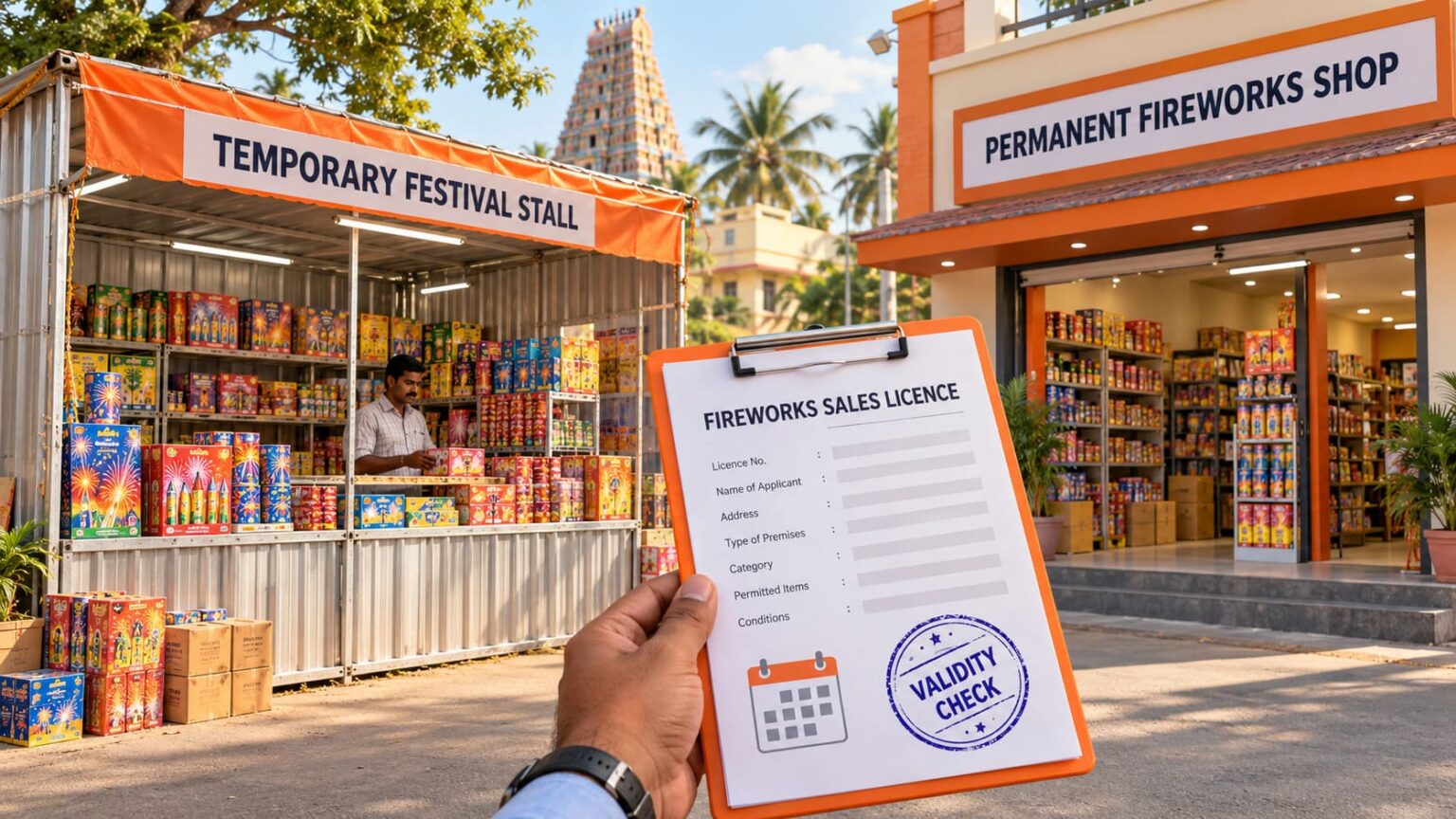
Setting up a temporary firecracker stall on your property or leasing your land out to seasonal retail traders can be a lucrative venture during the festive season. However, because fireworks are classified as hazardous explosives, property owners cannot simply rent out space without rigorous legal and safety vetting.
Navigating local regulations, layout specifications, and understanding the strict validity rules of the required licenses are crucial to avoiding heavy penalties, property damage, or legal liability.
Understanding License Validity for Firecracker Stalls
Under the Explosives Rules, 2008 (Form LE-5), firecracker sales licenses are strictly categorized based on duration:
- Temporary Festival Licences (Rule 84): For seasonal Diwali or festival markets, authorities issue temporary licenses that are strictly valid for a maximum of 15 days from the date of issue (though certain provisions or local district notifications can stretch administrative windows up to 30 days depending on the specific district administration guidelines).
- Permanent Shop Licences: If a property owner maintains a permanent, dedicated outlet authorized for fireworks, the licence can remain valid for up to 10 financial years, subject to annual fee payments and compliance checks.
- Non-Transferability: The explosive licence is issued specifically to the applicant/occupier for the designated survey number and layout. Property owners must ensure that renters secure their own valid temporary licenses rather than operating under informal or expired permissions.
Key Considerations for Property Owners
Before signing a lease agreement or erecting a temporary stall on your land, evaluate these mandatory parameters:
1. Mandatory Location and Distance Buffers
Your land must meet strict spatial safety limits from surrounding infrastructure to even qualify for a temporary explosive license:
- The 50-Metre Rule: The stall must be located at least 50 metres away from schools, hospitals, nursing homes, and places of worship.
- Hazardous Proximity: It cannot be near petrol pumps, gas stations, or high-voltage power lines with overhead cabling.
- Access Routes: The setup must not obstruct main roads, fire brigade access lanes, or public pedestrian pathways.
2. Structural and Layout Compliance
If you are building the shed or leasing open land for temporary structures:
- Floor Area: Individual stalls must measure strictly between 9 to 25 square metres.
- Exits: Structures require independent entrances and emergency exits opening directly into open air, with doors swinging strictly outwards.
- Inter-Stall Gaps: If multiple stalls occupy your land, a clear safety gap of at least 3 metres must be maintained side-by-side between non-combustible stalls to prevent fire spread.
3. Documentation and Legal Safeguards
- Proof of Ownership & NOC: You will need to provide property documents (Sale Deed, Patta, tax receipts) and execute a formal No Objection Certificate (NOC) or lease agreement explicitly allowing the storage and sale of authorized low-emission green fireworks.
- Safety Equipment: The property must feature mandatory safety gear, including fire extinguishers (DCP/CO₂) and buckets filled with dry sand.
- Indemnity Clauses: Always include robust indemnity clauses in your rental agreement protecting the landowner from third-party liabilities, property damage, or legal penalties resulting from tenant negligence or regulatory violations.
Areas to Strictly Avoid for Firecracker Stalls
A property owner or tenant planning to set up or lease land for a firecracker stall must strictly avoid setting up in locations that violate statutory safety buffers or local court mandates.
Based on the Explosives Rules (Rule 84) and high court directives, the following areas and property types must be entirely avoided:
1. Densely Populated & Narrow Commercial Streets
- Avoid: Narrow bazaars, congested market lanes, and high-density commercial streets (e.g., historical precedent bars setups in narrow commercial hubs like Parry’s Corner, Bunder Street, or George Town).
- Why: The lack of open escape routes and close proximity to multi-story buildings creates extreme fire hazards and traps people in the event of an accident.
2. Proximity to Sensitive Public Infrastructure
Any land located within 50 metres of the following entities is legally disqualified from getting an explosive license:
- Schools and Educational Institutions
- Hospitals, Nursing Homes, and Diagnostic Centres
- Places of Worship (Temples, Mosques, Churches, etc.)
3. Hazardous and High-Risk Zones
- Fuel Stations & Gas Depots: Never set up near petrol pumps, LPG storage facilities, or hazardous material warehouses.
- Power Lines: Avoid properties positioned directly under high-voltage power lines or areas with overhead electrical cabling that pose a spark hazard.
- Industrial Storage: Areas storing flammable chemicals, heavy timber, plastics, or combustible waste.
4. Public Roads, Pavements, and Transit Hubs
- Avoid: Public footpaths, active roadways, pavements, or transit hubs (such as bus stands or railway reservation zones).
- Why: Selling or storing firecrackers on public pathways is strictly prohibited by law because it blocks emergency vehicle access and puts pedestrian traffic at direct risk.
Wrapping Up: Safe Leasing for a Festive Season
Renting your land or setting up property for festival firecracker sales can be a rewarding seasonal opportunity, but safety and legal compliance must always come first. By verifying Form LE-5 license validity periods, adhering to strict 50-metre distance buffers, avoiding hazardous zones, and maintaining proper lease agreements with clear indemnity clauses, property owners can protect their investments and ensure a safe, hassle-free festive season.