

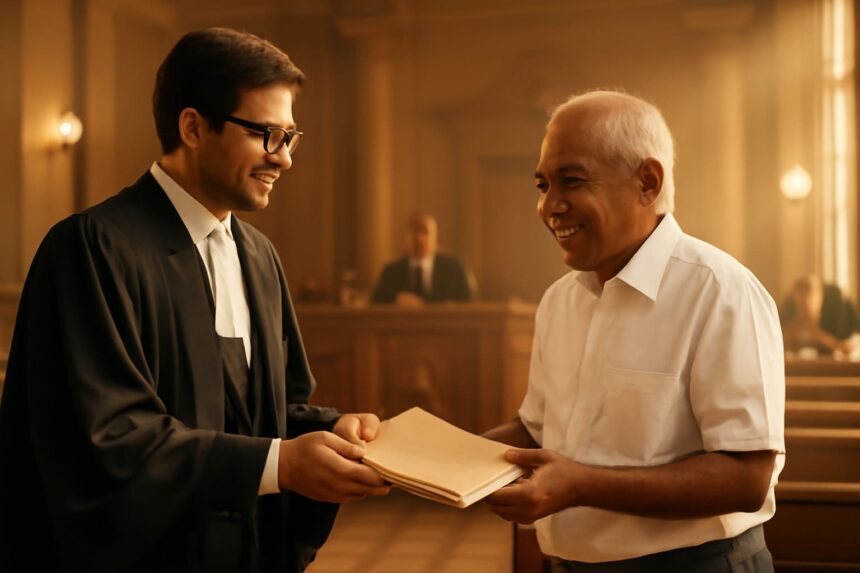
Overview: A Father’s Victory, A Legal Milestone
In a monumental decision on April 22, 2025, the Supreme Court of India delivered clarity on one of the most debated property law issues in Hindu families—whether property inherited or purchased after partition still remains ancestral, and if consent from heirs is necessary to sell it.
The court ruled:
Once a joint Hindu family property is partitioned, the individual shares become self-acquired properties. These can be sold, transferred, or bequeathed without the consent of coparceners or legal heirs.
The case stemmed from a father’s decision to sell a property purchased from his brother post-partition—only to be legally challenged by his own children. After 31 years of litigation, the father won.
Family Dispute Timeline: How It All Began
This case involved C. Jayaramappa, who inherited property with his two brothers, C. Thippeswamy and C. Eshwarappa, after their father passed away intestate. Here’s the timeline of key events:
- May 9, 1986 – The three brothers executed a partition deed, splitting their father’s property.
- October 16, 1989 – Jayaramappa bought his brother Thippeswamy’s share with personal funds and a private loan.
- March 11, 1993 – He sold this acquired property to repay the loan.
- 1994 – His four children filed a legal suit, claiming the property was ancestral, and that they were entitled to it by birth.
This sparked a 31-year legal battle across trial court, first appellate court, Karnataka High Court, and eventually the Supreme Court.
The Legal Debate: Ancestral or Self-Acquired?
Children’s Argument:
- The father used joint family funds or ancestral money (including ₹10,000 from partition and a gift from their grandmother).
- As coparceners, they had a birthright in the property.
- Therefore, he couldn’t sell it without their consent.
Father’s Defense:
- The disputed property was purchased after partition from his brother using personal income and a loan.
- He worked multiple jobs to repay the debt.
- The proceeds of the sale went toward his daughter’s wedding and children’s welfare.
Supreme Court’s Verdict: Crystal Clear and Precedent-Setting
The Supreme Court reversed the Karnataka High Court’s decision, restoring the First Appellate Court’s ruling in favor of the father.
Key judicial observations:
- Partition creates distinct, self-acquired shares. “As per Hindu law, after partition, each party gets a separate and distinct share. This share becomes their self-acquired property, and they have absolute rights over it.”
- No blending of property occurred. “No intention to abandon separate rights was established. The doctrine of blending does not apply unless there’s clear, voluntary intent to convert personal property into joint family property.”
- No legal proof of ancestral funding. “Oral claims about family funds or grandmother’s money were not supported by any documented evidence. In law, documents prevail over verbal testimony.”
- High Court misjudged facts. “The High Court failed to notice that the partition took place in 1986, whereas the suit property was purchased in 1989—a clear error in law and fact-finding.”
Final ruling:
“The property sold in 1993 was self-acquired, and the father had every legal right to sell it without his children’s consent.”
Why the Doctrine of Blending Was Not Applied
In Hindu law, a person can blend self-acquired property with joint family property only if they voluntarily abandon personal ownership. However, in this case:
- The property was not inherited through blending, but purchased post-partition.
- No proof existed that the Will-received property was used for purchase.
- Therefore, the doctrine of blending was ruled irrelevant.
Why the Children Lost the Case: Expert Insights
“Mere existence of children in a Hindu joint family does not automatically entitle them to their father’s self-acquired property,”
says Akshat Pande, Managing Partner, Alpha Partners.
“Post-partition, each share loses its ancestral character,”
says Bijal Ajinkya, Partner at Khaitan & Co.
“This case shows the importance of distinguishing between coparcenary property and post-partition acquisitions,”
adds Avikshit Moral, Partner at S&R Associates.
Industry Response: A Win for Real Estate Stability
“This ruling empowers rightful stakeholders and accelerates stalled real estate transactions,”
says Amit Goyal, Managing Director, Sotheby’s International Realty India.