

Understanding the Difference Between Patta and Legal Ownership
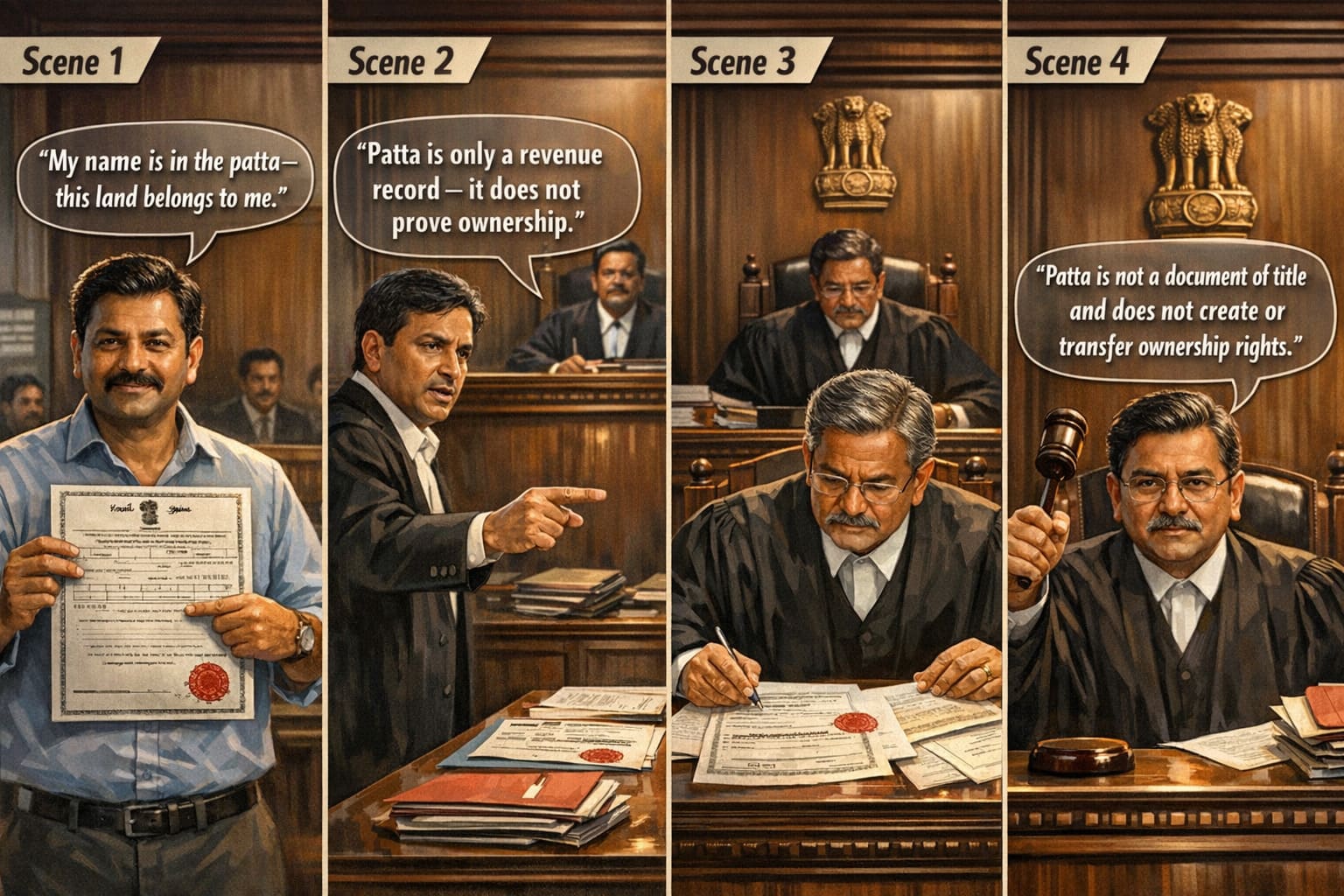
In Tamil Nadu real estate transactions, many buyers assume that if a person’s name appears in the patta, the land automatically belongs to them. This is one of the most common misconceptions in property transactions.
In reality, patta is only a revenue record maintained by the government. It helps authorities track landholders for administrative purposes such as tax collection and land classification. However, legal ownership of land is determined by title documents, not by patta entries.
Courts have repeatedly clarified that patta cannot be treated as proof of ownership, especially when disputes arise.
What Exactly Is a Patta?
Patta
A patta is issued by the Tamil Nadu Revenue Department and contains basic information about a piece of land, including:
- Name of the landholder
- Survey number and subdivision number
- Village, taluk, and district details
- Classification of land (nanjai or punjai)
- Land area
It is primarily used for revenue administration and taxation purposes. While it indicates that the government recognizes a person as the landholder for revenue records, it does not establish legal ownership.
Difference Between Patta and Title Documents
The confusion often arises because patta carries the landholder’s name. However, ownership is legally proven through title documents, not revenue entries.
Important documents that establish ownership include:
- Registered Sale Deed
- Parent or Mother Documents showing the chain of ownership
- Encumbrance Certificate (EC) indicating registered transactions
- Partition Deed, Settlement Deed, or Gift Deed where applicable
These documents form the title chain, which courts examine to determine who legally owns the property.
Patta only serves as supporting evidence alongside these documents.
What the Courts Have Said About Patta
Courts have repeatedly clarified that patta is primarily a revenue record and not a document that proves ownership of land. Several historical and modern judgments reinforce this principle and explain how pattas should be interpreted in property disputes.
| Case | Year | What the Court Explained |
|---|---|---|
| Freeman v. Fairlie | 1836 | The court distinguished between patta as evidence of land records and conveyance documents that actually transfer ownership. A patta alone cannot establish ownership. |
| Ramchunder Dutt v. Jughes Chunder Dutt | 1873 | Clarified that a patta may sometimes confirm an existing right, but it does not independently create ownership. |
| Secy. of State v. Kasturi Reddi | 1903 | The court held that pattas issued in ryotwari territories mainly indicate revenue obligations and do not automatically grant title to the land. |
| Srinath Rai v. Pratap Udai Nath Sahi Deo | 1923 | Explained that in the zamindari system, pattas issued by landlords generally represented tenancy rights rather than ownership. |
| Pushwati Alakh Narayan v. Secy. of State | 1926 | The court emphasized that pattas can be revised or modified by revenue authorities, so they cannot be treated as permanent proof of title. |
| Smt. Annammal v. Ammavasai (Madras High Court) | 2010 | The court clearly ruled that patta is not a document of title and does not create or extinguish ownership rights. Ownership must be proven through registered title documents such as sale deeds and parent documents. |
Why Relying Only on Patta Can Be Risky
The court rulings discussed above clearly explain why patta alone cannot be treated as proof of land ownership. The following are some of the key reasons behind this legal position.
1. Patta can be changed through administrative procedures
Revenue officials can modify patta entries after applications, subdivisions, or mutations.
2. Patta may contain clerical errors
Mistakes in survey numbers or landholder names can occur.
3. Patta does not show ownership history
It does not reveal how the land was acquired or transferred over time.
4. Patta does not prove legal transfer of property
Only registered documents executed under property laws can transfer ownership.
What Buyers Should Verify Before Purchasing Land
Before purchasing land in Tamil Nadu, buyers should verify:
- Registered Sale Deed
- Parent Documents for at least several decades
- Encumbrance Certificate (EC)
- Patta and revenue records
- Survey and subdivision records
- Layout or planning approvals if applicable
Ownership becomes reliable only when all these records align and show a clear chain of title.
Need Help Checking Patta Details? Verified.RealEstate Has Tools for That
If you are checking a property in Tamil Nadu, you don’t have to struggle with confusing government portals or complicated land records. Verified.RealEstate (VRE) provides simple tools and services that help you understand patta documents quickly and clearly.
Here’s how VRE can help you:
• Patta Application Service – Need to apply for a new patta or transfer an existing one? VRE’s team can assist you through the process and help ensure the application is handled properly.
• Patta / Chitta Viewer – Instantly view important land records like Patta, Chitta, TSLR, and A-Register extracts for properties in Tamil Nadu in one place.
• Patta Analyzer – Simply upload your patta document and the tool will automatically read and extract key details such as:
- Owner name
- Survey number
- Land extent
- Land classification
- Subdivision details
This helps you understand the document without needing to decode technical terms.
These tools are designed to make land record verification easier, faster, and more transparent for property buyers and landowners in Tamil Nadu.
Conclusion
A patta is an important revenue record, but it does not prove ownership of land in Tamil Nadu. Courts have consistently ruled that legal ownership must be established through valid title documents and a clear chain of ownership.
The Madras High Court’s ruling in Smt. Annammal v. Ammavasai reinforces this principle by confirming that patta alone cannot determine ownership rights.
For buyers and investors, the key lesson is simple: never rely on patta alone when evaluating a property. Proper title verification is essential before making any land purchase.