

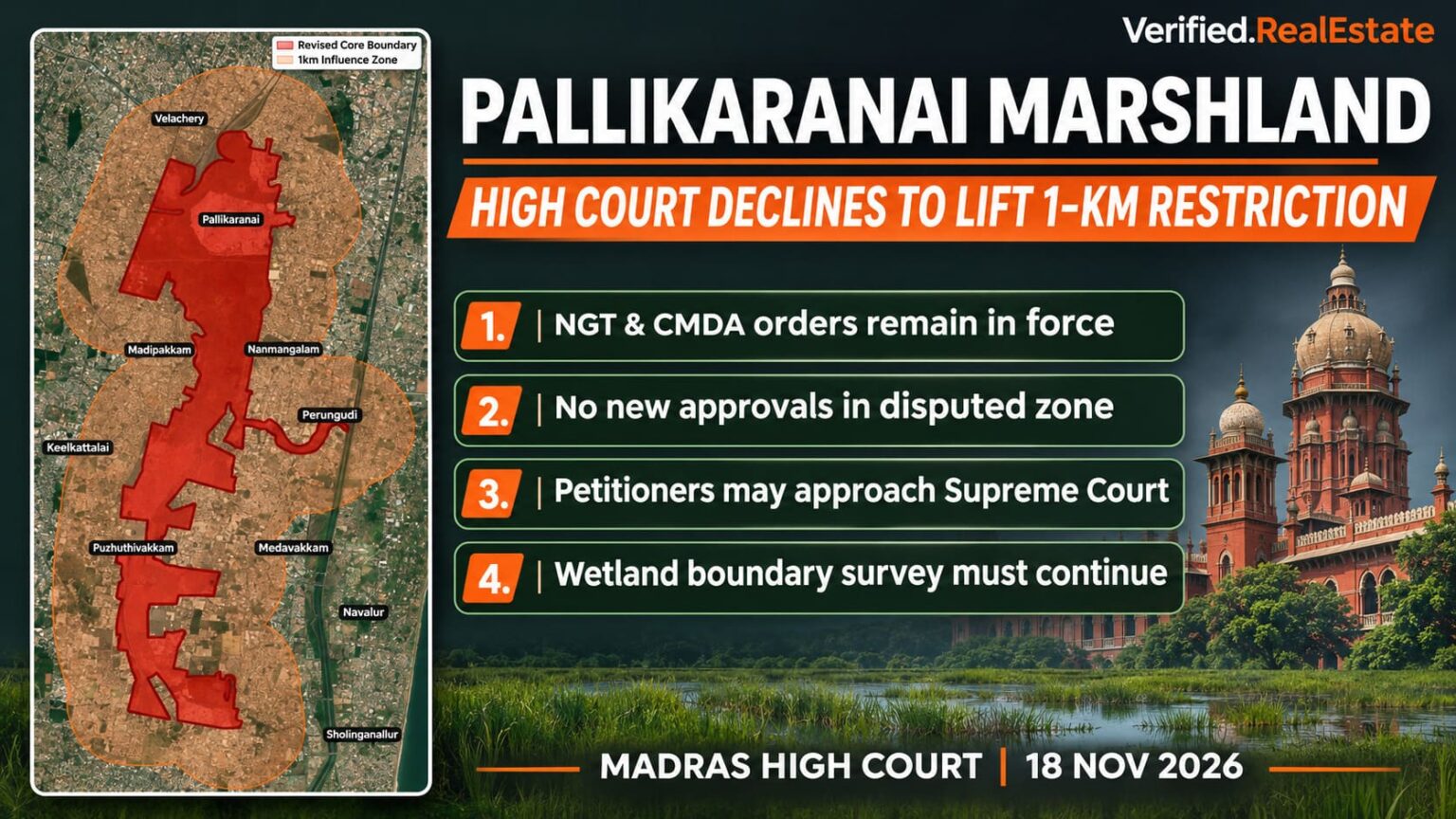
The existing construction approval restrictions around Pallikaranai Marshland will continue for now, while the Supreme Court oversees the wetland boundary verification process.
The Madras High Court, on 18 November 2026, declined to lift the construction approval restrictions within a one-kilometre radius of the Pallikaranai Marshland Ramsar Site in Chennai.
The Court disposed of 13 petitions filed by real estate developers, residents’ associations and landowners challenging the restrictions.
However, the Court did not quash the existing orders. Instead, it allowed the petitioners to approach the Supreme Court for further relief.
This decision is important for property owners, homebuyers and developers in Pallikaranai and neighbouring areas of South Chennai.
Why Was Construction Restricted Around Pallikaranai Marshland?
Pallikaranai Marshland was designated a Ramsar Site in April 2022, recognising its international importance as a wetland.
The marsh plays an important role in storing rainwater, reducing flooding and supporting local wildlife.
In 2023, concerns arose over construction debris being dumped and a road being laid inside the marshland near Perumbakkam.
The National Green Tribunal (NGT) took up the matter.
On 24 September 2025, the NGT directed the authorities to complete a scientific assessment and finalise an Integrated Management Plan for the wetland.
Until then, the Chennai Metropolitan Development Authority (CMDA) was directed not to grant new planning approvals within the marshland and its one-kilometre Zone of Influence.
Following this direction, CMDA issued an order on 9 October 2025 restricting development approvals in the identified area.
Why Did Property Owners and Developers Approach the High Court?
The restrictions affected a large area of South Chennai, including developed residential neighbourhoods and privately owned properties.
CREDAI on behalf of Several landowners and developers questioned the decision to apply a uniform one-kilometre restriction.
Their main concerns included:
- The restricted area included existing residential developments and private patta lands.
- Some landowners were unable to obtain new building approvals.
- Developers faced delays in their proposed projects.
- Certain property owners disputed whether their land was actually within the wetland boundary.
The petitioners argued that the restricted area should be determined through a scientific assessment rather than a fixed distance alone.
They therefore approached the Madras High Court seeking relief.
Wetland Authority Proposed Reducing the Restricted Area
During the proceedings, the Tamil Nadu State Wetland Authority submitted a revised proposal.
The proposal suggested reducing the interim Zone of Influence from approximately 3,474 hectares to 128.19 hectares, covering 36 survey numbers.
The revised area focused on land considered important for maintaining water flow and drainage connections to the marshland.
The proposal also suggested allowing regulated construction under environmental safeguards.
However, this was only an interim proposal.
The final wetland boundary and Zone of Influence still required scientific verification and official notification.
Importantly, the proposed reduction has not been approved by the Court and has not replaced the existing restrictions.
What Did the Madras High Court Decide on 18 November 2026?
The Madras High Court examined the petitions and the revised proposal submitted by the Wetland Authority.
The Madras High Court had to consider two important questions:
- Could the High Court hear the petitions when the NGT Act already provides an option to appeal to the Supreme Court?
- Could the High Court change the one-kilometre restriction or settle disputed land boundaries while the Supreme Court was already overseeing the wetland boundary verification process?
The Court decided that it had the power to hear the petitions. However, it declined to change the restrictions because the Supreme Court was already supervising the boundary verification process
The High Court considered that changing the restricted area or deciding individual land-boundary disputes at this stage could interfere with the Supreme Court’s ongoing proceedings.
Therefore, the Court:
- Declined to cancel the existing NGT and CMDA orders.
- Refused to permit new building approvals in the disputed zone.
- Allowed the petitioners to approach the Supreme Court for clarification or modification of the restrictions.
- Directed the relevant authorities to complete the wetland boundary verification and statutory notification process.
The High Court has not permanently fixed the one-kilometre buffer as the final Zone of Influence. It has left the existing restrictions unchanged for now.
What Does This Mean for Property Owners in Pallikaranai?
Property owners whose lands fall within the restricted area may continue to face difficulties in obtaining new planning permissions.
However, the judgment does not automatically cancel existing pattas, registered sale deeds or previously granted building approvals.
The legal position of each property depends on its location, existing permissions and applicable regulations.
So, the Property owners should distinguish between three situations:
1. Vacant land: Owners planning new construction should verify whether their land falls within the restricted area before applying for approval.
2. Existing buildings: Owners should examine their approved plans and existing permissions. The judgment does not automatically declare every existing building within the zone illegal.
3. Pending building applications: Applications affected by the CMDA restriction may remain pending until the legal position changes or further directions are issued.
A valid patta establishes a revenue record relating to landholding, but it does not automatically guarantee permission to construct a building.
Which Areas Could Be Affected?
The dispute concerns land around Pallikaranai Marshland and its identified Zone of Influence.
The wider proceedings involve properties in areas including Pallikaranai, Perumbakkam, Sholinganallur, Perungudi, Karapakkam, Injambakkam and Okkiyam Thoraipakkam.
However, this does not mean every property in these localities is restricted.
The applicability of the restrictions depends on the property’s exact location and survey number in relation to the relevant wetland boundary and restricted-area maps.
Property owners should verify their individual survey numbers with the appropriate authorities.
What Happens Next?
The next major development may come from the Supreme Court.
The petitioners have been permitted to approach the Supreme Court to seek clarification, modification or approval of the revised interim Zone of Influence.
Meanwhile, the Tamil Nadu State Wetland Authority, Directorate of Survey and Settlement and National Centre for Sustainable Coastal Management must continue the boundary verification process.
The final boundaries and Zone of Influence must be determined in accordance with the Wetlands (Conservation and Management) Rules, 2017, and the Supreme Court’s directions.
Until further orders are issued, the existing planning approval restrictions remain unchanged.
To Sum Up
The Madras High Court’s decision means that the existing construction approval restrictions around Pallikaranai Marshland remain in place for now.
Before buying or developing a property in the surrounding areas, buyers and owners should verify the survey number, land-use classification, building approvals and whether the property falls within the restricted zone.
The proposed reduction of the restricted area has not yet received judicial approval. Further changes may depend on the Supreme Court’s directions and the final wetland boundary verification.
A valid patta or registered sale deed does not automatically guarantee construction permission. Always verify the property’s legal and planning status before proceeding.
Verified.RealEstate will continue tracking developments in the Pallikaranai Marshland case, including future Supreme Court directions and official changes to the restricted area.
Case details: CREDAI Chennai v. Member Secretary and connected writ petitions, Madras High Court, 18 November 2026. Neutral Citation: 2026:MHC:4601.