

Layout Approval Comes First
In Tamil Nadu, layout approval is the foundation of all legal land development. Whether land is split into smaller plots or combined into a larger parcel, such changes are recognised only when they operate within an approved layout framework sanctioned by authorities such as DTCP, CMDA, Local Planning Authorities (LPA), or NTDA, depending on the jurisdiction.
Without layout approval:
- Plot sales become legally risky
- Registrations face objections
- Building approvals may be denied
- Future infrastructure and civic access remain uncertain
Sub-division and amalgamation are not shortcuts. They are regulated planning actions allowed only after layout approval and only under clearly defined conditions.
Sub-Division and Amalgamation in the Layout Process
Once a layout is approved, landowners or developers may seek limited modifications to suit practical or market needs. DTCP permits this through sub-division and amalgamation, provided the original planning logic of the layout remains intact.
These approvals are issued as technical approvals by the Member Secretary of the concerned Local Planning Authority, strictly governed by planning regulations and Government instructions.
Sub-Division of Plots: When and How It Is Permitted
What Sub-Division Means
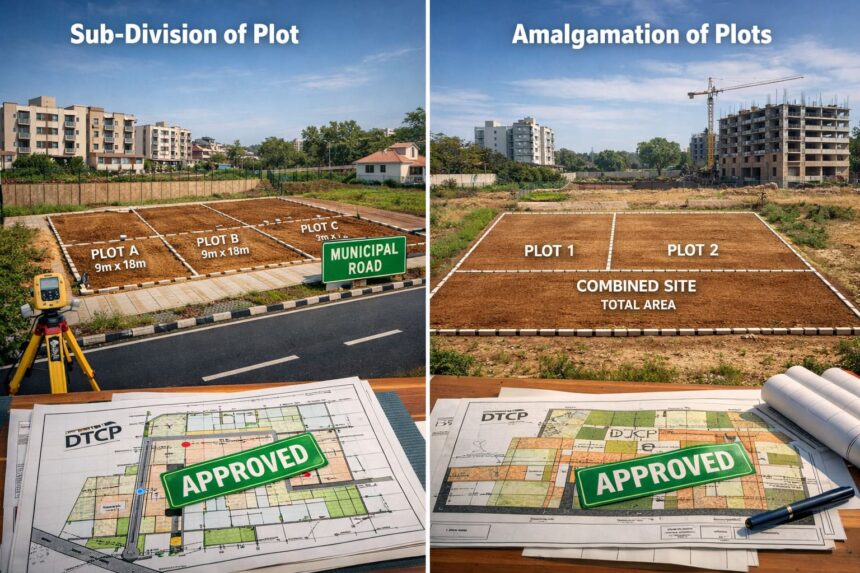
Sub-division refers to splitting a single approved plot into two or more smaller plots, without altering the approved road network or layout structure.
Basic Conditions for Sub-Division Approval
Sub-division may be approved only if:
- The site lies within an approved layout
- The plot directly *abuts a recognised public road
- The road is owned and maintained by a local body
- Minimum plot dimensions are maintained
- No existing or adjoining site becomes non-compliant
Sub-division will not be approved in unauthorised layouts or where the proposal attempts to create new roads or access ways.
Public Road Requirement: The Most Critical Check
A plot is eligible for sub-division only if it fronts an officially recognised public road.
Accepted Roads
- Corporation roads
- Municipal roads
- Town Panchayat roads
- Panchayat Union roads
Even roads originally formed by private developers qualify only if formally taken over by the local body, with certification from the Executive Authority.
Not Accepted
- Private layout roads not handed over
- Access paths shown only in sale deeds
- Roads inside unauthorised layouts
- Cart tracks or informal pathways
This rule exists to ensure permanent legal access, emergency movement, drainage connectivity, and civic maintenance.
Minimum Plot Dimensions for Sub-Division
| Planning Area | Minimum Size |
|---|---|
| DDP Areas | 9 m × 18 m |
| Non-DDP Municipalities & Town Panchayats | 6 m × 18 m |
| Panchayat Union Areas | 12 m × 18 m |
Additionally, sub-division must not reduce adjoining plots below minimum standards. DTCP evaluates all affected plots together, not just the proposed split.
Regulatory Violations That Lead to Rejection
Sub-division will be rejected if it violates:
- Building Rules
- Multi-Storeyed Building Rules
- Public Building Rules
- Master Plan or Detailed Development Plan (DDP)
- CRZ regulations
- Hill Area Building Rules
- Heritage Town regulations
- Any other notified urban planning regulations
If a proposal causes planning violations in existing buildings, approval is denied.
Amalgamation of Plots: Combining Sites Within an Approved Layout
What Amalgamation Means
Amalgamation is the merging of two or more adjacent approved plots into a single larger site, usually for apartments, commercial buildings, or institutional development.
Conditions for Amalgamation Approval
Amalgamation may be approved if:
- All plots are within an approved layout
- The combined site *abuts a recognised public road
- Minimum width, depth, and extent norms are satisfied
- Adjoining sites remain compliant
- The proposal aligns with Master Plan and DDP regulations
When Amalgamation Is Not Allowed
- In unauthorised layouts
- Where access roads are private or unrecognised
- If the proposed building violates Building Rules
- If planning density or land use norms are breached
Amalgamation cannot be used to bypass planning controls or regularise illegal developments.
DTCP Regulates These Changes Strictly
DTCP’s approach is consistent:
Once a layout is approved, its planning integrity must not be diluted.
Sub-division and amalgamation are allowed only as controlled refinements, not as tools to:
- Increase density beyond norms
- Create unsafe access
- Overload infrastructure
- Introduce future legal disputes
Any proposal that alters the basic planning structure triggers fresh layout-level scrutiny.
Key Takeaway for Landowners and Buyers
- Layout approval is non-negotiable
- Sub-division and amalgamation are conditional privileges, not rights
- Legal road access is the backbone of approval
- Private roads and unauthorised layouts are deal-breakers
Before buying, selling, or modifying plots, verifying layout approval status and road recognition is essential—a step often overlooked until approvals fail.
Verified.RealEstate Assists with Sub-Division and Amalgamation Approvals
Verified.RealEstate assists landowners, developers, and investors in obtaining sub-division and amalgamation approvals from the Tamil Nadu Government by managing the process end-to-end. This includes layout approval verification, public road recognition checks, compliance review under DTCP, LPA, CMDA, and DDP norms, preparation of application drawings, and authority coordination—helping prevent rejections, delays, and future legal issues.
* Abut - to directly touch or share a common boundary with something, such as a plot directly touching a road without any intervening land.