

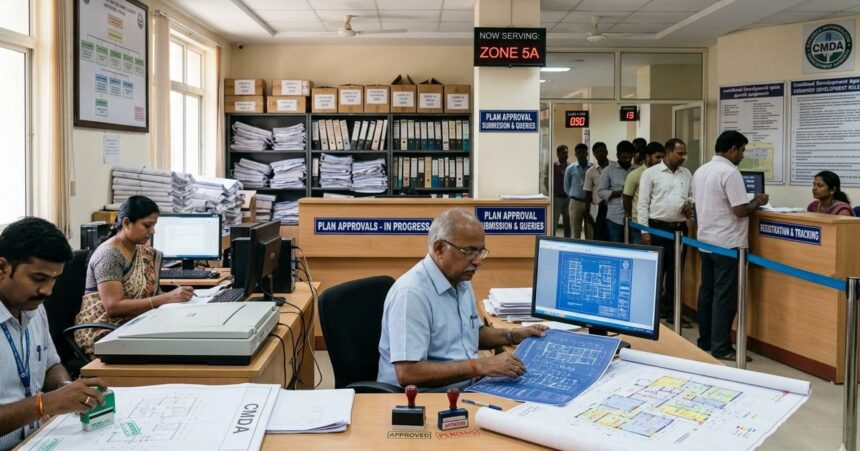
For the past few years, the Chennai Metropolitan Development Authority (CMDA) operated less like a regulatory body and more like a mega-contractor. From massive infrastructure overhauls to ambitious building projects, the authority was actively pouring concrete all over the city.
Historically, the CMDA’s greatest successes weren’t individual buildings, but the blueprints of entire self-sustaining neighborhoods—think of the master-planned layouts of Anna Nagar, Mogappair, or the Koyambedu complex.
But a massive financial reality check has forced a dramatic course correction.
Facing steep deficits, the CMDA is officially pulling the plug on direct construction. Instead, it is pivoting back to its foundational legal mandate: strategic urban planning, zoning, and development approvals.
Here is an inside look at why this financial reset happened, how administrative restructuring followed, and how it will reshape the future of Chennai’s real estate landscape.
The ₹3,000 Crore Reality Check
The CMDA’s financial strain began with an aggressive push into physical infrastructure development. While well-intentioned, the execution drained the authority’s reserves.
- The Spending: Over a two-year period, the CMDA committed nearly ₹3,000 crore toward heavy construction and infrastructure works.
- The Deficit: This massive capital outlay completely eroded the authority’s decades-old accumulated corpus fund, which had been steadily built up through interest earnings since 1972. This has pushed its balance sheet into a negative position of roughly ₹1,500 crore.
- The Missing Expertise: Beyond the numbers, internal reviews highlighted a structural flaw: the CMDA was simply not built to be a builder. Lacking the massive engineering pipelines and dedicated maintenance wings of bodies like the Greater Chennai Corporation (GCC) or the Highways Department, executing large-scale civil projects proved to be an uphill battle.
Realizing that building the city was draining the resources needed to plan the city, leadership decided it was time to step back.
From Terminals to Markets: The Projects That Fueled the Crisis
The ₹3,000 crore spending sprint saw the CMDA venture far beyond its traditional regulatory scope, taking on the direct construction of massive public infrastructure.
Key projects included:
Thirumazhisai Bus Terminus: A major satellite bus terminal designed to handle traffic on Chennai’s western corridors.
Mudichur Bus Terminus: Built specifically to house private omni-buses to further decongest central city traffic.
Ornamental Fish Market: A specialized commercial market hub set up to streamline local trade for breeders and vendors.
Mudhalvarin Padaipagams: Modern youth innovation hubs and creative co-working spaces.
Public Libraries: A network of modern public library buildings funded and constructed across various city limits.
Vada Chennai Valarchi Thittam: Structural upgrades, parks, community halls, and civic projects executed under the North Chennai Development Scheme.
Historically, the CMDA simply provided funding to other line departments based on specific project proposals, rather than venturing into full-fledged construction itself. This recent experiment left the authority bearing the massive upfront construction costs without any long-term operational revenue to show for it.
Back to Basics: What is CMDA’s Core Mandate?
Under the Tamil Nadu Town and Country Planning Act, 1971, the authority is meant to be the city’s architect and regulator, not its brick-and-mortar builder.
Its true core responsibilities include:
- Master Plan Formulation: Blueprinting Chennai’s decades-long expansion maps and enforcing macro-zoning rules to systematically organize residential, commercial, and industrial spaces.
- Planning Permissions: Scrutinizing and issuing legal clearances for building layouts, plot subdivisions, and high-rise developments to ensure safety and rule compliance.
- Land Pooling & Layouts: Partnering with peripheral landowners to pool tracts of land, design orderly neighborhoods with proper roads and parks, and return high-value, developed plots back to the owners.
- Enforcement Watchdog: Monitoring structural safety, issuing Completion Certificates (CC), and cracking down on unauthorized or heavily deviated constructions.
Pivot to Planning: The New Strategy and Restructuring
By retreating from active construction sites, the authority is redirecting its energy toward high-impact urban governance. This structural shift is also being mirrored at the state governance level.
In tandem with this financial reset, the government has dismantled the dedicated CMDA ministry originally created by the previous administration, reverting control of the department directly back under the direct oversight of the Housing Ministry, as was the practice in the past.
With administration realigned, the CMDA is focusing heavily on three areas:
1. Finalizing the Third Master Plan (TMP)
With Chennai expanding rapidly, the upcoming Third Master Plan is critical. By freeing up administrative bandwidth, the CMDA can focus entirely on blueprinting the city’s growth, sustainable zoning, and climate-resilient infrastructure for the next two decades.
2. Monetization Through Land Pooling
To recover from its ₹1,500 crore deficit, the CMDA is shifting from building structures to assembling land. This strategy generates healthy revenue through development charges and layout creation rather than high-risk construction.
3. Faster Planning Approvals
The ultimate win for Chennai’s real estate sector is speed. With the state government granting the CMDA direct powers to clear high-rise project proposals, a singular focus on approvals means significantly reduced red tape and faster clearance timelines for developers.
What This Reset Means for Chennai Real Estate
     [ Old Approach ]                   [ New Focus ]
  Heavy Infrastructure Build         Streamlined Approvals
  Corpus Fund Depletion              Land Pooling Revenue
  Delayed Project Timelines          Faster Vertical Growth
For homebuyers, investors, and developers in Chennai, this pivot is a positive sign.
When a planning authority tries to act as a contractor, bureaucracy slows down and project delivery stalls. By returning to its core identity under the Housing Ministry, the CMDA can better manage Chennai’s rapid vertical growth, enforce smarter zoning regulations, and clear administrative bottlenecks for both the private and public sectors.
Chennai is expanding at a record pace. With the CMDA back at the drawing board instead of the construction site, the city might finally get the structured, sustainable growth it needs.
Verified Services
For investors, developers, and property sellers, obtaining CMDA approval support is an important step for investing in, after building, or for selling a property. It is always safer to work through a trusted and secure platform like the Verified Real Estate team, which offers end-to-end assistance for property approvals and related compliance services.