

India is witnessing rapid growth in Global Capability Centres (GCCs), with nearly one new centre being established every day, according to Union Finance Minister Nirmala Sitharaman. This marks a sharp rise from about one GCC per week in 2024, signalling a major shift in how multinational companies view India.
The acceleration reflects increasing confidence among global firms in India’s talent pool, digital infrastructure and policy environment, as well as a growing preference to build long-term, in-house capabilities rather than rely solely on outsourced services.
Global Capability Centre
A GCC is a facility set up by a multinational company to handle key global operations such as software development, artificial intelligence, cybersecurity, data analytics, finance, and research. Unlike outsourcing, these centres are owned and operated by the company itself.
India’s Growing GCC Ecosystem
India currently hosts over 2,100 GCCs employing around 2.3 million professionals and generating nearly $100 billion annually. More than 500 Forbes Global 2000 companies already operate GCCs in the country, and India is estimated to host over half of the world’s GCCs. The government aims to expand this to around 5,000 centres by 2030.
Shift from Cost to Capability
India is no longer seen only as a low-cost destination.
GCCs are now handling high-value functions such as
- AI,
- engineering research,
- cybersecurity, and
- product development.
Many centres are also contributing to global strategy and innovation, reflecting India’s growing role as a capability hub.
Rise of AI-Driven GCCs
More than half of new GCCs in India are AI-focused, creating higher-value jobs and driving innovation.
These centres work on areas like
- automation,
- predictive analytics,
- fraud detection, and
- advanced software tools.
Smaller Cities as the Next Growth Drivers
While GCCs have traditionally been concentrated in cities like Bengaluru, Hyderabad, and Chennai, rising costs and congestion are pushing expansion into Tier-II and Tier-III cities.
The Finance Minister highlighted cities such as Tiruchirappalli, Mysuru, Visakhapatnam, Chandigarh, and Varanasi as emerging destinations due to their talent pool, improving infrastructure, and lower operating costs.
Why Tiruchirappalli Stands Out
Tiruchirappalli offers strong engineering talent, educational institutions, and better affordability compared to larger metros. It has the potential to attract GCCs in areas like engineering design, software development, analytics, and AI, provided it develops quality office space and infrastructure.
Tamil Nadu’s Expanding GCC Landscape
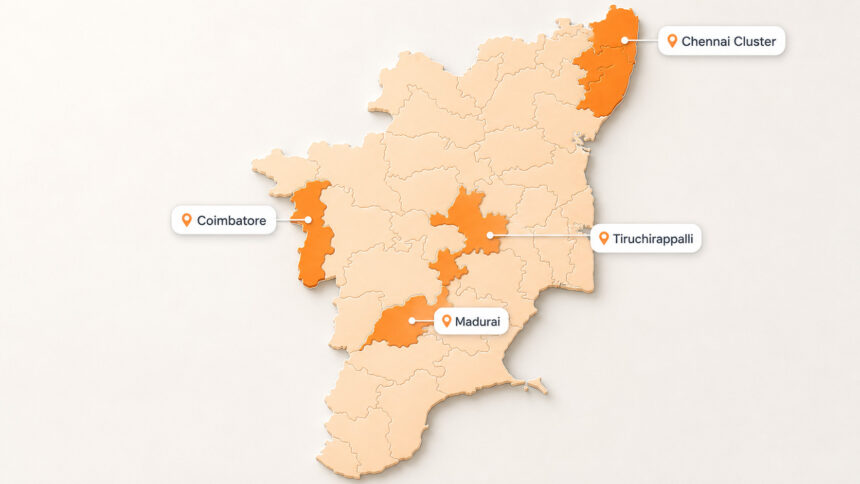
Tamil Nadu has emerged as one of India’s leading GCC destinations, with more than 430 Global Capability Centres operating across the state. This growth is driven by a strong talent pool, robust infrastructure, and proactive government policies that support technology and innovation-led investments.
Chennai leads the ecosystem with over 350 GCCs, mainly concentrated along the OMR, Taramani, Guindy, Porur, Ambattur and Radial Road business corridors, making it one of the most mature GCC clusters in the country.
Coimbatore has also developed into a strong Tier-II GCC hub with more than 80 centres, supported by its engineering talent, educational institutions and comparatively lower operating costs, attracting companies looking for scalable and cost-efficient operations.
Tiruchirappalli and Madurai are being promoted as emerging GCC locations, with improving infrastructure and talent availability, although official city-wise operating numbers have not yet been disclosed.
Economic Impact of GCC Expansion
GCCs can significantly boost local economies by increasing demand for office space, housing, retail, hospitality, and professional services. They also support skill development, startups, and infrastructure growth, creating a multiplier effect in emerging cities.
Untapped Potential
Despite its leadership, nearly two-thirds of Fortune Global 2000 companies have yet to establish GCCs in India. This presents a large opportunity for future growth, especially in smaller cities that can offer the right ecosystem.
Impact on Real Estate
GCC expansion is expected to drive demand for Grade-A offices, commercial developments, and housing in both major and emerging cities. However, real estate growth will depend on actual corporate investments rather than speculation.
A New Phase for India’s GCC Story
India’s GCC sector is entering a new phase driven by advanced capabilities, AI, and expansion beyond metros. Achieving the goal of 5,000 GCCs by 2030 will depend on talent availability, infrastructure, and coordinated efforts between government, industry, and educational institutions.
If these conditions are met, GCC growth could reshape employment and real estate markets across India’s emerging cities.
Verified Real Estate & Corporate Services
For businesses looking to establish or expand their commercial presence, Verified Real Estate offers specialized services in identifying, evaluating, and securing high-quality commercial spaces across key Indian markets.
From office leasing and investment advisory to end-to-end transaction support, their platform helps companies make informed real estate decisions aligned with their operational and growth strategies.
Learn more at https://corporate.verified.realestate/.