

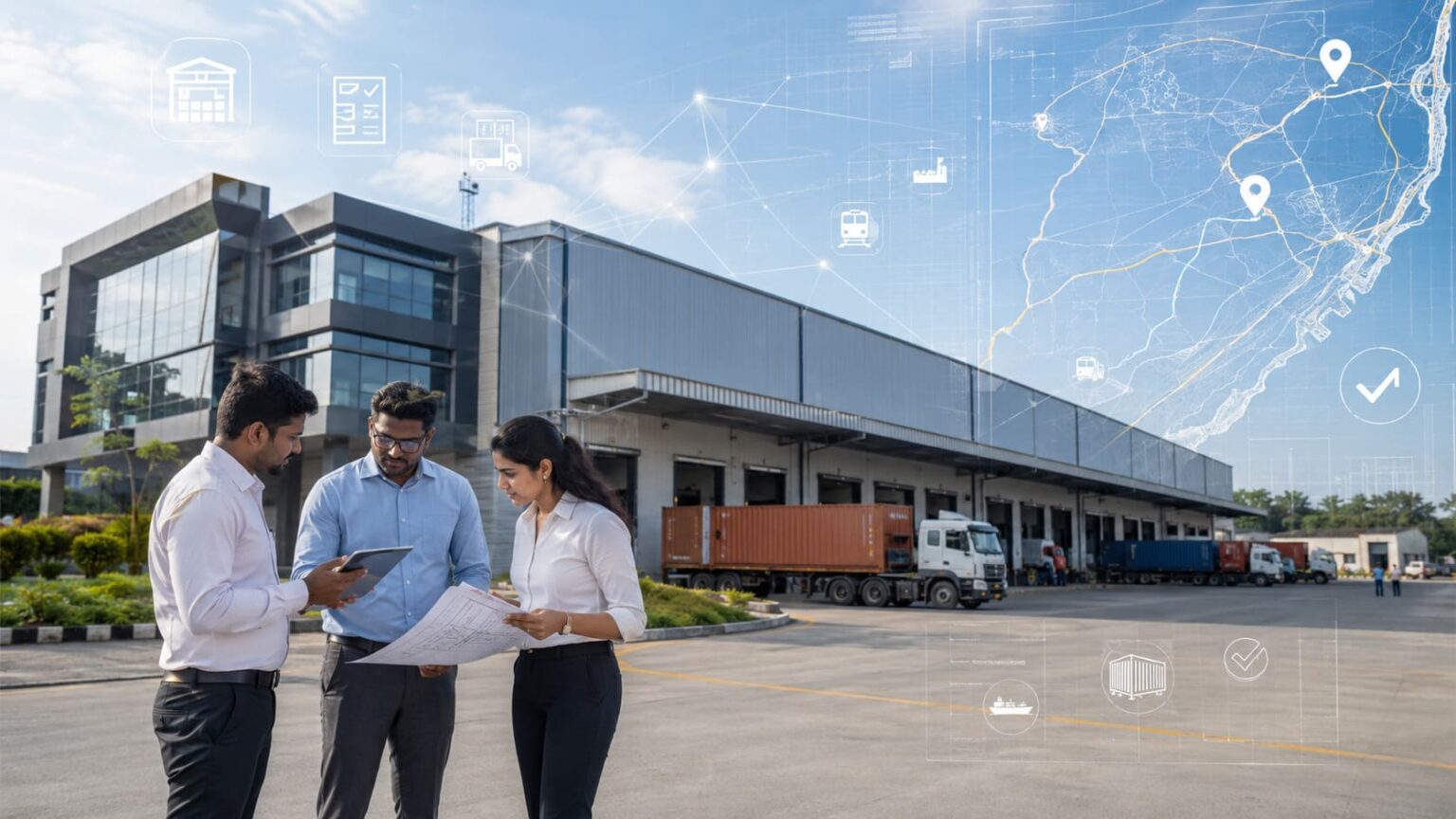
Logistics and Warehousing: The Backbone of Modern Business
Logistics covers the movement, storage and delivery of goods from the manufacturer to the final customer. Warehousing forms a major part of this system by providing space for inventory storage, sorting, packaging and distribution.
Third-party logistics, commonly known as 3PL, allows businesses to outsource activities such as transportation, warehousing, order fulfilment and last-mile delivery. A well-planned logistics network may include a large mother warehouse, regional distribution centres, cold-storage facilities and smaller last-mile hubs located closer to customers.
Chennai has developed into an important logistics and warehousing destination because of its ports, manufacturing clusters, highways and access to major consumer markets across South India.
Key warehousing belts include Sriperumbudur and Oragadam, the Gummidipoondi–Ennore corridor, and the GST Road–Vandalur region.
Government Policies Supporting the Logistics Industry
The National Logistics Policy and the PM GatiShakti National Master Plan aim to improve coordination between road, rail, ports and other infrastructure networks. They also encourage digital systems, better planning and reduced delays in the movement of goods.
The Tamil Nadu Logistics Policy and Integrated Logistics Plan 2023 supports warehouses, cold-chain facilities and multimodal logistics parks through infrastructure planning, single-window clearances and eligible investment incentives. The policy also supports 24-hour operations and proposes measures to simplify approvals for logistics and warehousing developments.
Critical Specifications for Choosing Warehousing Sites
Selecting the right warehousing site requires evaluating both physical building specifications and location dynamics. Each facility in a supply chain serves a distinct purpose, requiring tailored features:
1. Facility Specifications & Node Matching
- Primary / Mother Warehouses: Located near major freight spines and highways, these large boxes require a clear height of 12 meters or more, high dock ratios, and heavy floor-loading capacity for high-density racking.
- Regional Distribution Centers (DCs): Positioned near key transit corridors, regional hubs typically operate with 10 to 12 meters of clear height to handle fast throughput and regional sorting.
- Last-Mile Hubs: Situated closer to urban centers, these smaller facilities focus on rapid city access and local vehicle circulation rather than vertical storage height.
- Cold Chain & Automated Spaces: Require verified power redundancy, dedicated diesel generator (DG) backup, and heavy slab load capacities to handle heavy equipment and uninterrupted temperature control.
2. Physical & Operational Readiness
Beyond size and height, site selection must prioritize:
- Dock Ratios and Circulation: Adequate loading docks and staging areas prevent bottlenecks during peak transport hours.
- Slab Loading: Ensuring the floor slab can support heavy automated systems, forklift traffic, and tall rack installations.
- Access to Transit Corridors: Proximity to port corridors, highway spines, and peripheral rings keeps transport efficient.
3. Legal and Compliance Verification
A facility is only as secure as the legal foundation beneath it. Crucial checks before signing any lease include:
- Clean Title and Zoning: Confirming that the land is legally clear of encumbrances and approved for industrial/logistics use.
- Sanctioned Plans: Verifying building plan approvals, structural integrity, and local municipality clearances.
- Safety & Fire Compliance: Ensuring the building meets fire safety norms, floor load limits, and local environmental guidelines.
Essential Logistics Office Requirements
- Operational Control Layout: Open-plan dispatch zones for multi-screen fleet tracking, plus a separate counter for drivers to submit paperwork without entering main work areas.
- Redundant Power & High-Speed Internet: Uninterrupted power (UPS/DG backup) and dual fiber internet to ensure 24/7 uptime for Transport Management Systems (TMS).
- Strategic Location & Access: Situated adjacent to warehouses or major transport corridors, with dedicated parking for staff and visiting drivers.
- Document & Space Security: Biometric access control, secure storage for customs and transit documents, and roughly 80–100 sq. ft. per desk.
Site Selection with Corporate by Verified Real Estate
Corporate by Verified Real Estate takes the friction out of industrial real estate and site selection. Instead of treating every warehouse and logistic office, as a standard building, the team studies the company’s demand locations, product profile, storage volume, delivery timelines and service levels.
By combining AI-driven analytics with boots-on-the-ground execution, the firm helps businesses build, scale, and secure verified logistics and warehousing network
Their area of expertise is in assisting and carrying out groundwork which includes
- Shortlisting Verified Sites: Shortlisting potential buildings and land only after physically verifying that title deeds, zoning regulations, and local compliance approvals are clean.
- Property & Land Checks: Verifying the actual asset on the ground rather than relying strictly on marketing brochures, ensuring the land has clean title, appropriate zoning, and no encumbrances.
- Compliance & Sanction Verifications: Inspecting building plan sanctions, local municipality approvals, structural floor-load capacities, and fire safety compliance certificates prior to lease signing.
- Technical Infrastructure Readiness: Checking and confirming floor slab loading capacities, uninterrupted power redundancy, and dedicated diesel generator (DG) backups against actual operational needs (especially for automated and cold-chain facilities).
- Lease Negotiations & Documentation: Handling lease negotiations for rent rates, escalation clauses, fit-out terms, and exit conditions per location, followed by complete legal lease documentation.
- Fit-out & Go-Live Operations: Supporting racking installations, final compliance sign-offs, and operational handover to ensure the facility goes live smoothly.
Building a Reliable Logistics Network
The right logistics property must support faster movement, safe storage, future expansion and uninterrupted operations. Businesses should therefore evaluate the entire distribution network rather than selecting an isolated warehouse.
By combining network planning, property verification, AI-led analysis and physical site assessment, Corporate by Verified.RealEstate helps companies choose warehousing locations built on legally and operationally verified ground.