

A Major Step Toward Transparent Land Records in Tamil Nadu
The Government of Tamil Nadu has taken a major step toward improving transparency in property ownership by introducing two important digital services: Integrated Land Records and Patta Transfer History.
Although the Integrated Land Records service was launched earlier, it was temporarily stopped because some land records had not been fully updated in the system. After resolving these technical issues, the service was officially resumed following its inauguration on 4 March 2026.
These services are now available through the Tamil Nadu e-Services portal, making it easier for citizens to verify land details and track changes in property ownership online.
How to Access Integrated Land Records Online
To check integrated land records, citizens can visit the official Tamil Nadu government portal:
On the homepage, you will find the option called Integrated Land Records.
After selecting this option, the system will ask for several location details:
- District
- Taluk
- Village
- Ward
- Block
- Town Survey Number
- Subdivision Number
Once these details are entered, the user must provide a mobile number and verify it through an OTP (One-Time Password) received on the phone.
After verification, the portal redirects to the Integrated Land Record Management portal maintained by the Survey and Settlement Department under the Government of Tamil Nadu.
What Information Is Available in the Integrated Land Record Portal
This portal allows citizens to view important land documents such as:
- A-Register
- Patta Details
- Field Measurement Book (FMB) Map
All these details are displayed on a single page, making it easier to verify land records without visiting government offices.
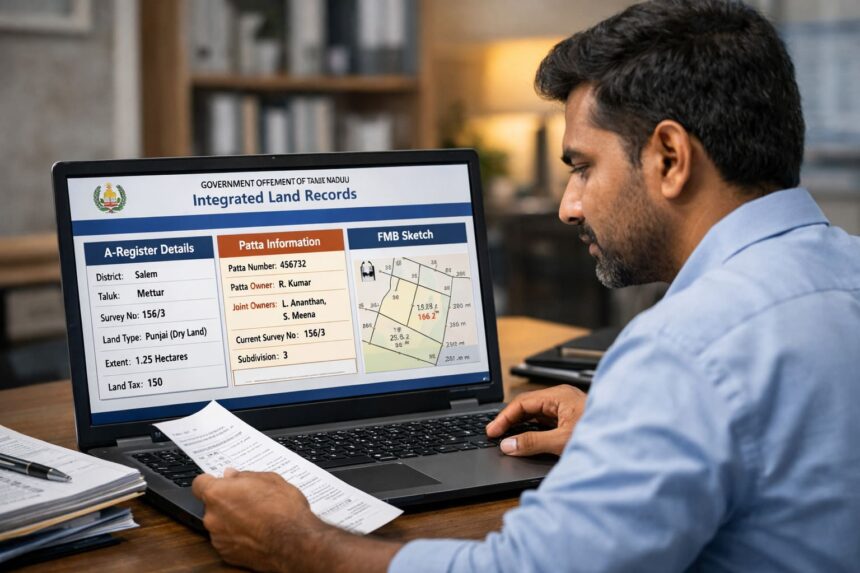
Snapshot of Details Available in the Integrated Land Records Portal
The Integrated Land Records portal combines multiple land records and displays them together on a single page. This allows users to view all the key informations regarding the property from this single page.
A-Register Details (Land Classification Record)
The A-Register provides the basic land information maintained by the Revenue Department, such as:
- Ward number
- Survey number and subdivision number
- Land classification (Ryotwari land or Government land)
- Land type – Nanjai (wet land) or Punjai (dry land)
- Soil classification
- Land extent in hectares
- Land assessment or tax details
Patta Details (Ownership Record)
The portal also displays the complete patta information, including:
- Patta number
- Name of the landowner
- Names of co-owners in case of joint pattas
- Survey number and subdivision linked to the patta
- Ownership status of the land parcel
FMB Details (Field Measurement Book)
The FMB section provides the survey map and measurement details of the property, such as:
- Survey number and subdivision boundaries
- Shape and layout of the land parcel
- Boundary measurements
- Adjacent survey numbers of neighbouring lands
- Official survey sketch used for boundary verification
By presenting A-Register, Patta, and FMB details together, the Integrated Land Records portal allows citizens to quickly understand the classification, ownership, and physical boundaries of a property from a single interface.
This service is done at free of cost. Thedocument can be downloaded or print outs can also be taken.
Introduction of Patta Transfer History (Launched on 4 March 2026)
Another important service introduced recently is the Patta Transfer History system, which was also launched on 4 March 2026.
Earlier, there were cases where duplicate pattas were created without proper registration, and such changes often could not be easily identified through an Encumbrance Certificate (EC). This allowed fraudulent transfers to occur in some situations.
With the new Patta Transfer History feature, citizens can now check how many times a patta has been transferred and when those changes happened. This greatly improves transparency and helps prevent land fraud.
How to Check Patta Transfer History Online
To access the Patta Transfer History service, citizens must visit the Tamilnilam Citizen Portal.
Step-by-Step Process
- Go to the ➡ Tamilnilam Citizen Portal.
- Register or log in using your email ID and mobile number.
- Enter the OTP received on your phone for verification.
- Complete the registration by providing your address and personal details.
- After logging in, you will reach the homepage dashboard.
- Select the option “History of Patta Transfer.”
Fees for Patta Transfer History
To access the patta transfer history records, users must pay:
- ₹60 – Application Fee
- ₹50 – History Search Fee – the fee depends on the timeline selected.
You must enter first enter the property details such as:
- District
- Taluk
- Village
- Ward
- Block
- Town Survey Number
- Subdivision Number
You have to select the timeline or period for which you want to check the patta transfer history. The system will then process the request. The amount to be paid depending on the timeline chosen will be shown below. Then you will redirected to select the option of mode of payment.
Acknowledgement and Application Receipt
Once the payment is completed, the system generates an Acknowledgement Receipt containing details such as:
- Application type: Request for old patta transfer details
- Applicant name
- Father’s name
- Phone number
- Application number
- Registration date
Example of an Application Record
Application Number: 2026/0125/08/000002
Registration Date: 07-03-2026
Property Details:
- District: Salem
- Taluk: Mettur
- Village: Kothur West
Search period example:
- 01-01-2021 to 31-12-2021
Viewing the Patta Transfer Statement
After submitting the request, users can go to the Status option in the Tamilnilam portal to check the status of their applications.
Within about 30 seconds, the system will display the applications submitted so far. By selecting the application number, users can open the detailed report.
The details in the downloadable document usually includes:
- Department: Revenue and Disaster Management Department
- Document title: Previous Patta Transfer Details / Patta Transfer History Statement
- Search period
- District, Taluk, and Village
The statement also contains:
- Survey number and subdivision
- Current patta number
- Name of the current landowner
- Type of transfer
- Land area in hectares
- Previous survey and patta details
- Current survey and patta details
This document can be downloaded and saved for future reference.
Current Status of the Portal
Both the Tamilnilam Citizen Portal and the Integrated Land Records portal are currently in a development and data-integration phase. As the system is still being expanded, complete historical records for all districts are not yet available. At present, certain regions such as Salem and several rural areas already have accessible records, while data for many other locations, including parts of Chennai and some urban areas, is still being updated in the system. As the government continues to digitize and integrate land records across the state, more districts and property details are expected to be gradually added to both portals.
As the database expands, more land records will become accessible through the portal.
Why These Services Are Important for Property Buyers
The introduction of Integrated Land Records and Patta Transfer History marks a major improvement in Tamil Nadu’s land administration system.
These services help property buyers:
- Verify ownership details quickly
- Check historical changes in pattas
- Identify suspicious transfers
- Reduce the risk of land fraud
- Access government records without visiting offices
For anyone planning to buy land, checking these records has now become an essential part of property due diligence.
Platforms like Verified.RealEstate also encourage buyers to verify critical property records such as Patta, EC, and survey details before making any investment decision.