

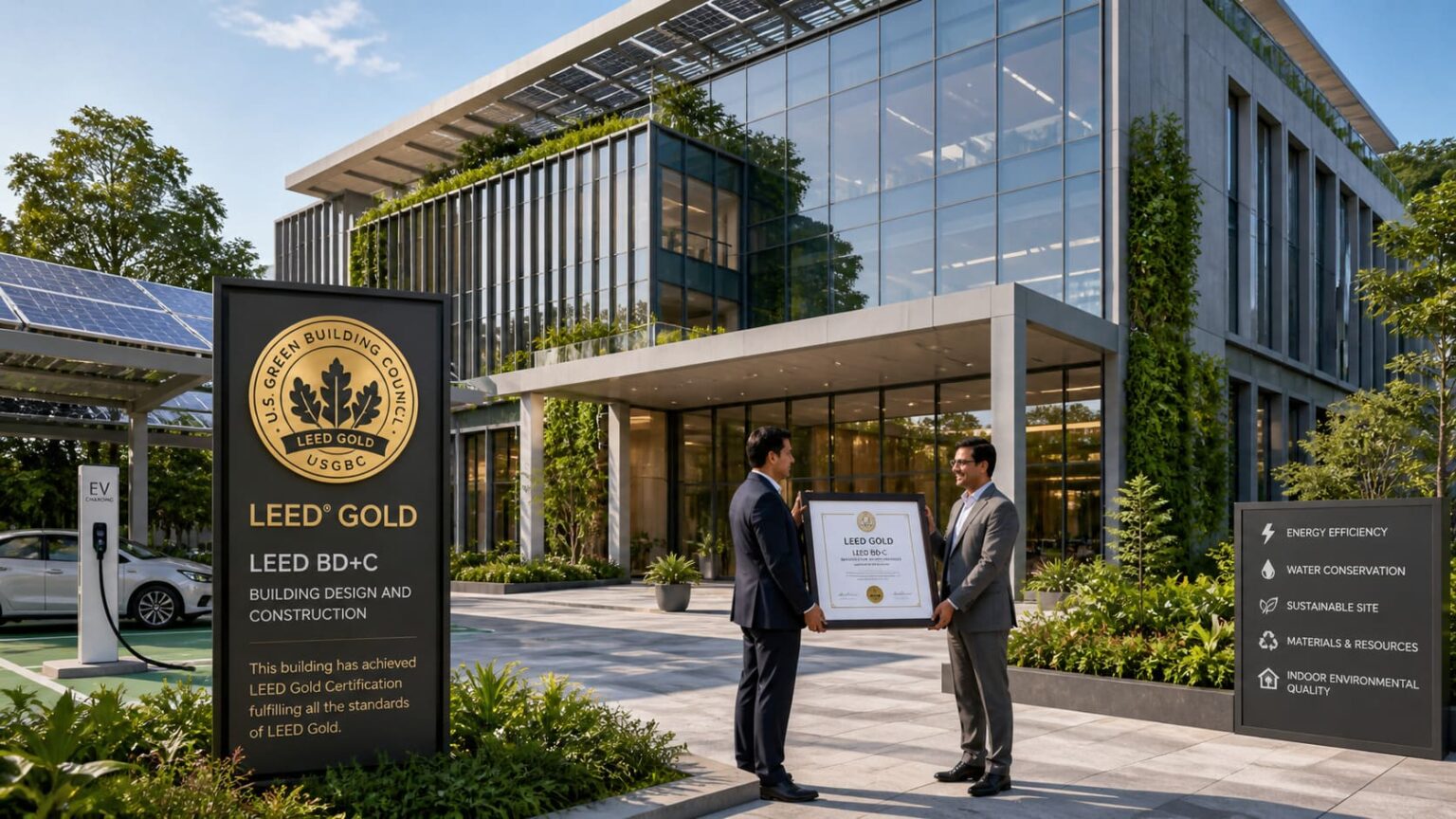
How Do Buildings Get a LEED Certificate?
In recent years, we often hear terms like LEED Certified, LEED Silver, LEED Gold, and LEED Platinum in office buildings, commercial spaces, IT parks, and premium real estate projects. But what does it actually mean, and how does a building apply for it?
LEED, or Leadership in Energy and Environmental Design, is a globally recognised green building certification system. It evaluates how sustainably a building is designed, constructed, operated, and maintained. A LEED-certified building is expected to perform better in areas such as energy efficiency, water conservation, indoor air quality, material selection, waste management, and occupant comfort.
For developers, investors, and occupiers, LEED is no longer just a “green label”. It has become a serious marker of building quality, long-term cost efficiency, and environmental responsibility.
Choose the Right LEED Rating System
The first step is to identify which LEED rating system applies to the project. This depends on the nature of the building and the stage of development.
- New building: LEED BD+C (Building Design and Construction)
- Existing building: LEED O+M (Operations and Maintenance)
- Office interior: LEED ID+C (Interior Design and Construction)
- Township/neighbourhood: LEED ND (Neighbourhood)
- Residential project: LEED Homes
Choosing the wrong category can delay the process and create unnecessary documentation issues. That is why developers usually involve a sustainability consultant or LEED professional early in the planning stage.
Step-by-step process to apply for LEED certification
1. Check project eligibility
Before applying, the project must meet LEED’s Minimum Program Requirements. For example, the project should be in a permanent location, have a reasonable project boundary, and meet minimum size requirements.
2. Create a LEED Online account
The project team registers the building through LEED Online or Arc, depending on the project type. LEED Online is the main platform where the team submits forms, uploads documents, assigns consultants, and tracks credits.
3. Register the project and pay the registration fee
At this stage, the owner/developer enters the project details, selects the correct LEED rating system, and pays the registration fee. Registration only means the project has entered the LEED process; it does not mean the building is certified yet.
4. Appoint a LEED consultant or LEED AP
Technically, a project owner can apply directly, but practically, most developers appoint a LEED consultant or LEED Accredited Professional because the process involves technical documentation, energy modelling, water calculations, material records, site planning, indoor air quality reports, and commissioning documents.
5. Plan credits from the design stage
LEED certification is points-based. The project must satisfy all mandatory prerequisites and then earn optional credit points. The total points decide the final rating level: Certified, Silver, Gold, or Platinum. USGBC notes that projects must meet mandatory prerequisites and pursue optional credits to earn certification.
6. Prepare documentation
This is the main workload. Documents may include:
Design drawings, site plans, energy model reports, water efficiency calculations, HVAC details, lighting design, material purchase records, waste management reports, commissioning reports, ventilation details, indoor air quality documents, and photographs.
For an office building, documentation often focuses on energy efficiency, water savings, indoor air quality, sustainable materials, parking/transport access, waste management, and occupant comfort.
7. Submit application for review
Once the documentation is ready, the team submits the application through LEED Online and pays the certification review fee. GBCI then conducts the technical review.
8. Respond to review comments
GBCI may ask for clarifications or corrections. The project team must respond with revised documents or explanations.
9. Receive certification decision
After successful review, the project receives its LEED certification level. The building can then officially market itself as a LEED Certified, LEED Silver, LEED Gold, or LEED Platinum project
LEED levels
After the review is completed, the building receives its final certification level based on the points achieved.
The common LEED certification levels are:
| LEED Rating | Points Required |
|---|---|
| Certified | 40–49 points |
| Silver | 50–59 points |
| Gold | 60–79 points |
| Platinum | 80+ points |
So, when a project is called a LEED Gold office building, it means it has achieved between 60 and 79 points under the LEED system. A LEED Platinum building has achieved 80 or more points and represents a higher level of sustainability performance.
Developers Preference
For Indian real estate, especially in cities like Chennai, Bengaluru, Hyderabad, Pune, Mumbai, and Delhi NCR, LEED certification has become increasingly relevant in premium office and commercial developments.
Among LEED rating levels, most Indian developers usually aim for LEED Gold.
It offers the best balance between brand value, sustainability recognition, tenant appeal, and practical cost feasibility
Most developers in India prefer LEED Gold because it gives strong green-building credibility without the higher cost and complexity of Platinum certification.
Common Mistakes Developers Should Avoid
Many projects lose time or credits due to
- choosing the wrong rating system
- delaying consultant involvement
- failing to preserve construction-stage records
- using materials without proper documentation
- ignoring commissioning requirements
- assuming that green design alone is enough.
LEED certification is not only about design intention. It is about documented proof.
Property Buyers and Investors Should Note:
A LEED certificate may tell you about a building’s sustainability performance. A proper real estate verification process with the assistance of a verified real estate developer tells you whether the property is legally and practically safe to proceed with.
LEED , IGBC Certification:
Q1: Is LEED or IGBC certification mandatory?
A: No. It is generally optional for most real estate projects.
Q2: Why is LEED or IGBC certification valuable?
A: It proves that the building follows recognised sustainability standards.
Q3: How does it help developers?
A: It improves brand value, market appeal, and tenant confidence.
Q4: How does it help buyers or tenants?
A: It indicates better energy savings, comfort, and long-term building performance.
LEED Vs IGBC
Q1: Which green building certification do most Indian developers commonly choose?
A: Most Indian developers commonly choose IGBC certification because it is India-focused, locally recognised, and widely adopted.
Q2: When do developers prefer LEED certification?
A: Developers often prefer LEED certification for premium Grade A offices, IT parks, commercial towers, and projects targeting multinational tenants.
Q3: In simple terms, what is the difference?
A: IGBC is more common locally, while LEED is often preferred for global corporate appeal.