


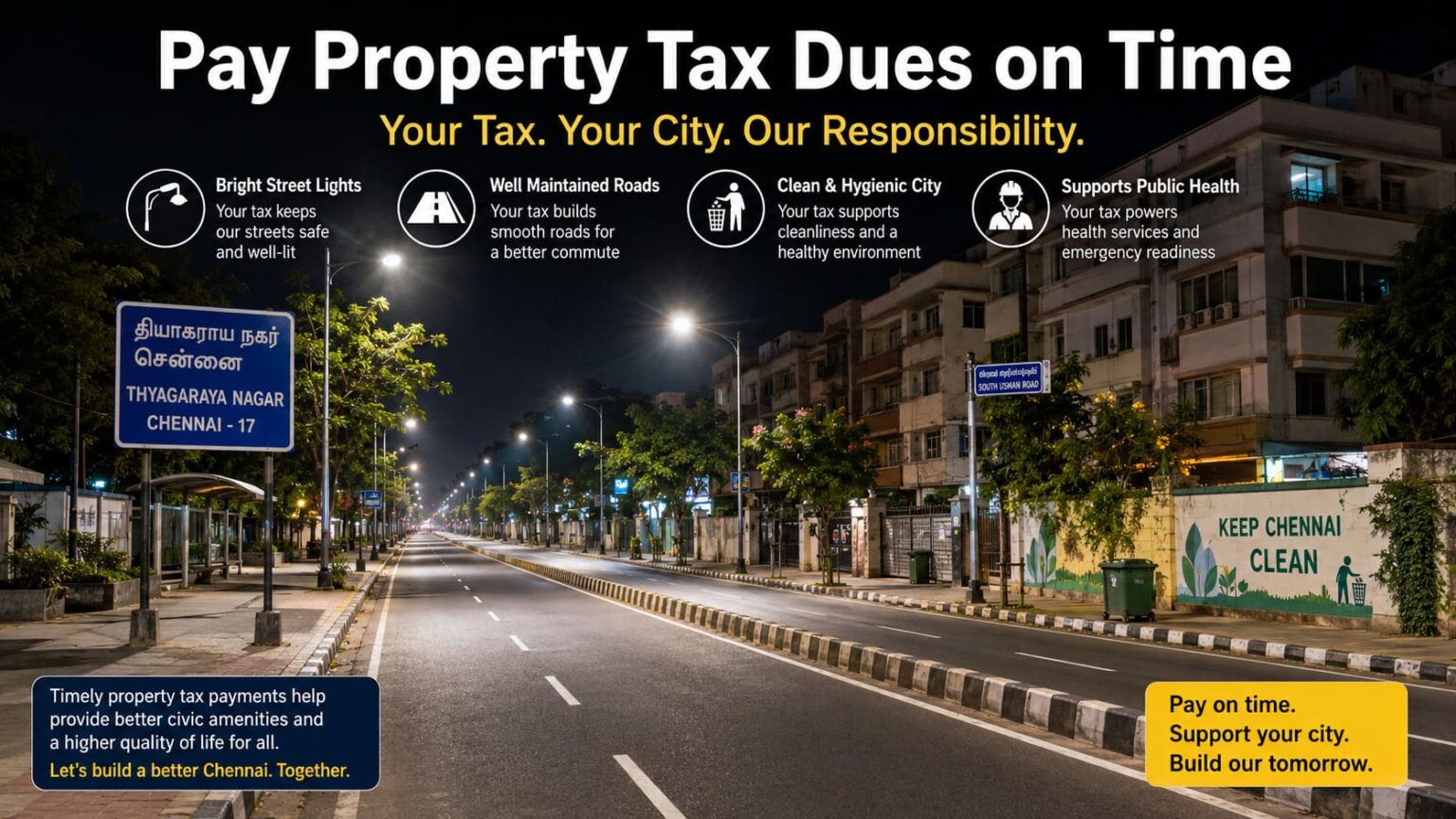
The Greater Chennai Corporation (GCC) is organizing special property tax collection camps across Chennai from July 3 to July 17, 2026. Property owners can visit any zonal or ward office between 8:00 AM and 6:00 PM to clear their pending dues.
Paying your tax on time is crucial. The GCC has warned that delaying payments further can result in financial penalties, interest charges, or legal action.
Why Your Property Tax Matters
Property tax is the primary source of revenue for the Chennai Corporation. The money collected during these camps goes directly toward funding everyday civic services that keep the city running, including:
- Regular garbage collection and waste management.
- Repairing roads and maintaining stormwater drains.
- Operating streetlights and public parks.
- Funding public health initiatives and disease control.
How Chennai Property Tax is Calculated
GCC officially classifies properties into different categories such as residential, non-residential, industrial, educational institutions, cell phone towers, vacant land, and combined vacant land/building properties. This classification is important because the tax amount changes based on how the property is used.
Your property tax is determined by four main factors: your property’s built-up area, its location, the specific street rate, and how the building is used (residential vs. commercial).
GCC applies a fixed Basic Street Rate (BSR) per square foot for every street. The standard formula used is:
Half-yearly property tax = Plinth Area × Basic Street Rate × 135.408%
So, if the area or Basic Street Rate is higher, the tax will also be higher.
Residential Property Tax Example in Chennai
Let us take a simple example of a 1,000 sq.ft residential property in T. Nagar. In many T. Nagar streets, GCC’s revised residential Basic Street Rate for the 601–1,200 sq.ft slab is shown as ₹2.19 per sq.ft.
Calculation:
1,000 × 2.19 × 1.35408 = ₹2,965 approx. per half-year
So, the yearly property tax will be around:
₹2,965 × 2 = ₹5,930 approx. per year
Before the 2022 revision, the same type of property had a pre-revision residential BSR of about ₹1.25 per sq.ft in the same table. That would have been:
1,000 × 1.25 × 1.35408 = ₹1,693 approx. per half-year
That means the residential tax for this example increased from around ₹1,693 to ₹2,965 per half-year, which is roughly a 75% increase.
Commercial Property Tax Example in Chennai
Now take a 1,000 sq.ft commercial shop in T. Nagar, for example Prakasam Street. GCC’s BSR table shows the revised non-residential BSR as ₹15 per sq.ft, while the pre-revision non-residential BSR was ₹6 per sq.ft.
Current calculation:
1,000 × 15 × 1.35408 = ₹20,311 approx. per half-year
Yearly tax:
₹20,311 × 2 = ₹40,622 approx. per year
Before revision:
1,000 × 6 × 1.35408 = ₹8,124 approx. per half-year
So, in this example, commercial property tax increased from around ₹8,124 to ₹20,311 per half-year, which is a 150% increase.
Why Have Tax Rates Gone Up?
The major hike came through the 2022 general revision because they had remained unchanged for many years while city maintenance expenses grew. .
For residential properties
| Residential Property Size | Increase Factor | Meaning |
|---|---|---|
| Up to 600 sq.ft | 1.5 times | 50% increase |
| 601–1,200 sq.ft | 1.75 times | 75% increase |
| 1,201–1,800 sq.ft | 2 times | 100% increase |
| Above 1,800 sq.ft | 2.5 times | 150% increase |
For non-residential properties,
| Property Category | Increase / Treatment |
|---|
| Commercial buildings in GCC core city areas | Increased by 2.5 times |
| Industrial properties | Increased by 2 times |
| Hotels, hospitals, cinema theatres and kalyana mandapams | Treated on par with commercial properties |
The 2022 order also referred to economic indicators like inflation, Cost Inflation Index and GSDP growth, and linked the revision to conditions for urban local body grants.
The Annual 6% Increase
To prevent massive sudden jumps in the future, the Tamil Nadu Urban Local Bodies Rules allow an annual 6% increase (or a rate tied to the state’s economic growth growth, whichever is higher) in years when a major general revision does not take place.
What Chennai Residents Are Saying: Public Reaction and Social Media Sentiment
Public sentiment surrounding the property tax updates remains highly vocal, with discussions frequently trending across social media platforms like X (formerly Twitter) and local Facebook community groups. While most residents acknowledge that property taxes are a necessary civic obligation, the primary frustration stems from the compounding effect of the steep 2022 general revision followed by the mandatory annual 6% increments.
Many middle-class property owners and resident welfare associations (RWAs) express concern over the sudden strain on household budgets, particularly highlighting instances of measurement disputes and area mismatches in newly assessed apartment complexes.
A recurring theme across online reviews is a demand for greater transparency; citizens frequently voice the opinion that higher tax brackets should visibly translate to better local infrastructure, pointing out lingering civic issues like waterlogging during the monsoons, delayed road relaying, and inadequate garbage clearance in peripheral zones.
Conversely, the implementation of digital payment conveniences—such as WhatsApp reminders integrated with quick payment links—has received positive nods for reducing red tape and eliminating the need to navigate crowded local ward offices.
Final Takeaway
While a tax hike is never welcome news for your wallet, these funds directly improve your neighborhood’s infrastructure. To avoid penalties, check your exact dues on the official GCC portal or drop by your nearest ward office special camp before July 17.