



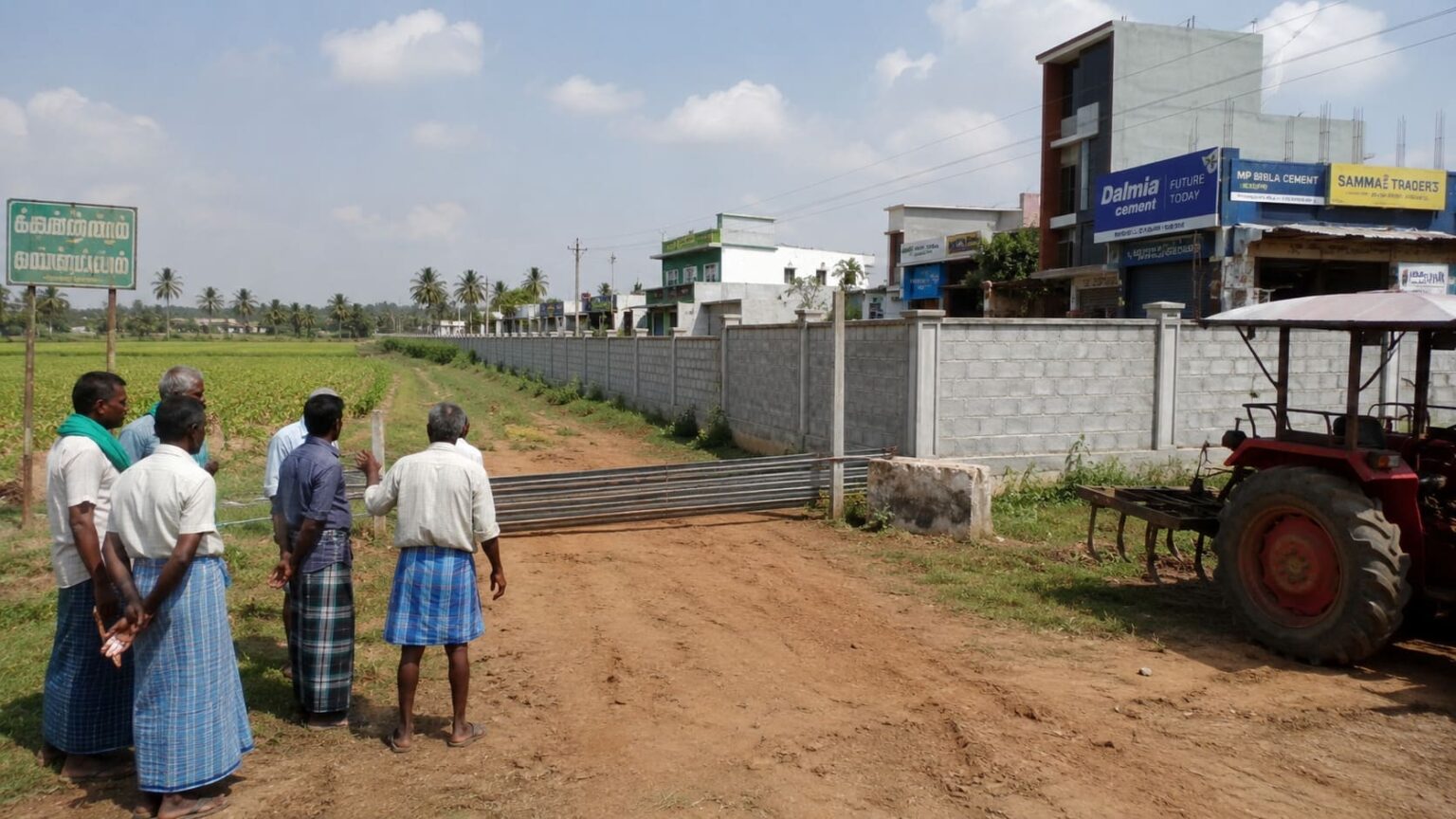
Farmers in Dindigul Raise Concerns Over Vanishing Agricultural Access Roads
A growing issue is emerging in parts of Dindigul district, Tamil Nadu, where farmers say long-used agricultural access roads are disappearing after roadside farmlands are sold for commercial development.
According to recent local reports, agricultural lands located near highways and major roads are increasingly being converted into:
- commercial plots,
- shops,
- warehouses,
- layouts,
- fuel stations,
- and other non-agricultural developments.
While such conversion may be legally permitted through planning approvals, farmers argue that interior agricultural lands are losing the access routes needed for cultivation and transportation activities.
How Interior Agricultural Lands Are Getting Isolated
In many villages, agricultural lands located behind roadside properties depend on small internal pathways or cart tracks for access.
Historically, these pathways were:
- shared informally,
- used by mutual understanding,
- and rarely documented in official land records.
When roadside lands are sold and fenced for commercial use:
- tractors cannot enter rear fields,
- harvesting vehicles lose access,
- transportation of crops becomes difficult,
- and some agricultural lands risk becoming economically isolated.
Farmers say the issue directly affects:
- cultivation activities,
- irrigation movement,
- labour access,
- and transportation of agricultural produce.
Why Commercial Conversion Is Increasing in Tamil Nadu
Roadside agricultural lands have become highly valuable due to:
- highway expansion,
- urban growth,
- industrial corridor development,
- logistics infrastructure demand,
- and rising real estate activity.
Districts such as Dindigul are witnessing increased demand for roadside properties because of:
- strong transport connectivity,
- expanding town limits,
- agricultural trade movement,
- and commercial development opportunities.
This has accelerated the conversion of agricultural lands into residential and commercial properties across several rural regions.
The Major Legal Problem: Missing Pathway Records
One of the biggest reasons behind these disputes is the absence of officially recorded access routes.
In several rural areas:
- pathways were never formally surveyed,
- easement rights were not documented in sale deeds, subdivision records.
- and cart tracks were not clearly marked in revenue records or FMB sketches.
As a result, when land ownership changes:
- new owners may legally fence the property,
- existing access gets blocked,
- and neighbouring farmers struggle to prove historical usage rights.
This leads to disputes involving:
- right of way,
- easement claims,
- pathway access,
- and land-use conflicts.
Legal Questions Arise Over Traditional Farm Access Rights
Legal experts point out that owners of interior agricultural lands may, in certain situations, seek relief through the concept of an “easement of necessity” under Indian property law.
This principle may apply when:
- a property becomes effectively landlocked,
- and access is possible only through neighbouring land.
Courts may examine:
- long-term historical usage,
- witness testimony,
- village maps,
- physical signs of old cart tracks,
- satellite imagery,
- and historical land subdivision patterns.
However, such claims are highly fact-dependent. Courts generally assess whether:
- the rear land genuinely lacks practical alternative access,
- the pathway existed historically,
- and the claim involves genuine necessity rather than convenience.
If alternate access routes are available, courts may refuse easement claims even if the route is less convenient.
Tamil Nadu Land Conversion Rules and Planning Concerns
Tamil Nadu permits agricultural land conversion through approved Change of Land Use procedures and planning regulations.
However, experts often warn that rapid commercial development without preserving:
- agricultural access routes,
- drainage systems,
- irrigation channels,
- and internal connectivity
can create long-term rural infrastructure problems.
In many cases, interior agricultural lands become isolated after commercial projects emerge along main roads.
Why This Issue Matters Beyond Dindigul
The problem is not limited to one district.
Similar concerns have emerged across multiple parts of Tamil Nadu involving:
- disappearing agricultural pathways,
- shrinking farm access,
- loss of water channels,
- and unplanned peripheral urbanisation.
As land values continue to rise, disputes involving: pathway rights, easement claims, agricultural access and land subdivision are becoming increasingly common in rapidly developing regions.
What Landowners Should Verify Before Buying or Converting Land
Before purchasing, subdividing, or converting land, property owners should verify:
- access pathways,
- easement rights,
- FMB sketches,
- survey boundaries,
- and planning approvals.
Verified.RealEstate can help review pathway access, survey records, subdivision layouts, and possible easement-related risks to help prevent future disputes involving blocked agricultural access roads that are situated in and around Chennai.