

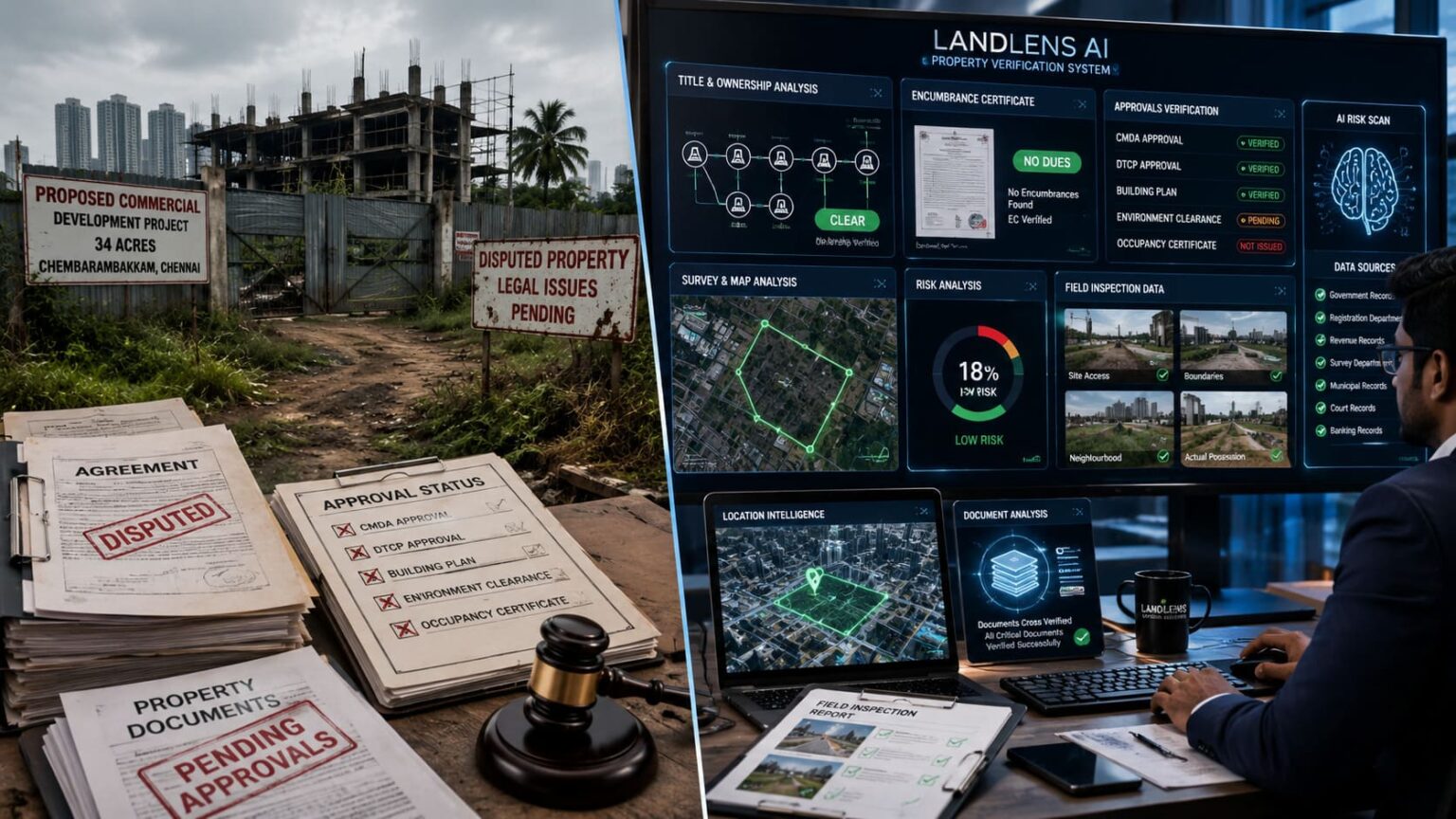
EVP Chennai Property Dispute and the Questions It Raised
The recent EVP-linked property dispute in Chennai became a major talking point after allegations surfaced regarding a large commercial land and development agreement connected to property near Chembarambakkam.
The EVP Chennai case is mainly an alleged ₹21.75–23 crore cheating case involving EVP Santhosa/Santhosh Reddy, his associate V. Vinod, and Vels Film International Ltd.
According to reports, the issue started from an MoU signed in June 2025 to develop an entertainment hub / amusement park and cinema halls on about 34–34.75 acres in Chembarambakkam/Sembarambakkam, linked to the EVP family/property. Vels allegedly paid around ₹21.75 crore, but later claimed the deal was not honoured and that the contract was illegally cancelled.
The complaint also alleged problems such as lack of proper completion certificates and approvals, and also financial liabilities such as a LIC Housing Finance loan, and threatened Vels executives to vacate the premises.
While the final legal outcome will ultimately be determined through judicial proceedings, the case has once again highlighted an important reality within the real estate sector — even high-value commercial projects involving known business entities can become legally complicated if proper due diligence is not performed before agreements are signed or funds are transferred.
Why This Case Is a Serious Lesson for Property Buyers and Investors
One of the biggest misconceptions in real estate is that an existing building, running business, reputed brand name, or premium project automatically guarantees legal safety. In reality, disputes often arise when buyers check only the visible aspects of a transaction while missing deeper legal, financial, and regulatory risks.
Before entering into any sale agreement, development agreement, joint venture, lease arrangement, or investment partnership, buyers must first verify whether the person signing the agreement has proper authority to represent the landowner, company, or development entity involved in the project.
They should also carefully examine parent documents, title chain continuity, Encumbrance Certificates (EC), pending mortgages, existing financial liabilities, court disputes, land classification, and the actual ownership rights of the seller. Many of these issues may not be obvious during initial discussions or site visits.
Approval verification is equally important. Buyers must independently cross-check CMDA approval, DTCP approval, RERA registration, planning permissions, completion certificates, occupancy certificates, and zoning compliance. This is especially critical for commercial properties, where missing approvals or violations can later affect operations, financing, resale, or redevelopment.
The EVP case also shows why physical field verification cannot be ignored. In large-scale investments involving multiple parties, investors, and development rights, digital records alone may not reveal encroachments, access issues, third-party occupation, boundary disputes, or neighbourhood-level conflicts. Ground-level inspection often exposes realities that registered documents do not show.
Modern property risks can also include improper power of attorney usage, temple or waqf-related claims, acquisition notifications, revenue record mismatches, and unapproved construction deviations that may surface much later.
Ultimately, the EVP dispute is a reminder that property transactions should be approached through structured due diligence, not assumptions, reputation, or verbal assurances.
The larger the investment value, the deeper the verification process must be.process must become.
How LandLens Help Create Safer Transactions
To reduce such risks, Verified.RealEstate offers property due diligence and verification support through LandLens, an AI-assisted verification ecosystem that combines digital analysis with offline field investigation. The platform helps cross-check approvals, ownership records, encumbrances, legal risks, survey details, and regulatory data while also supporting physical verification wherever required.
By combining AI-powered online verification with real-world field investigation and legal scrutiny, Verified.RealEstate aims to help create safer and smoother transactions for both buyers and sellers in today’s increasingly complex real estate environment.