

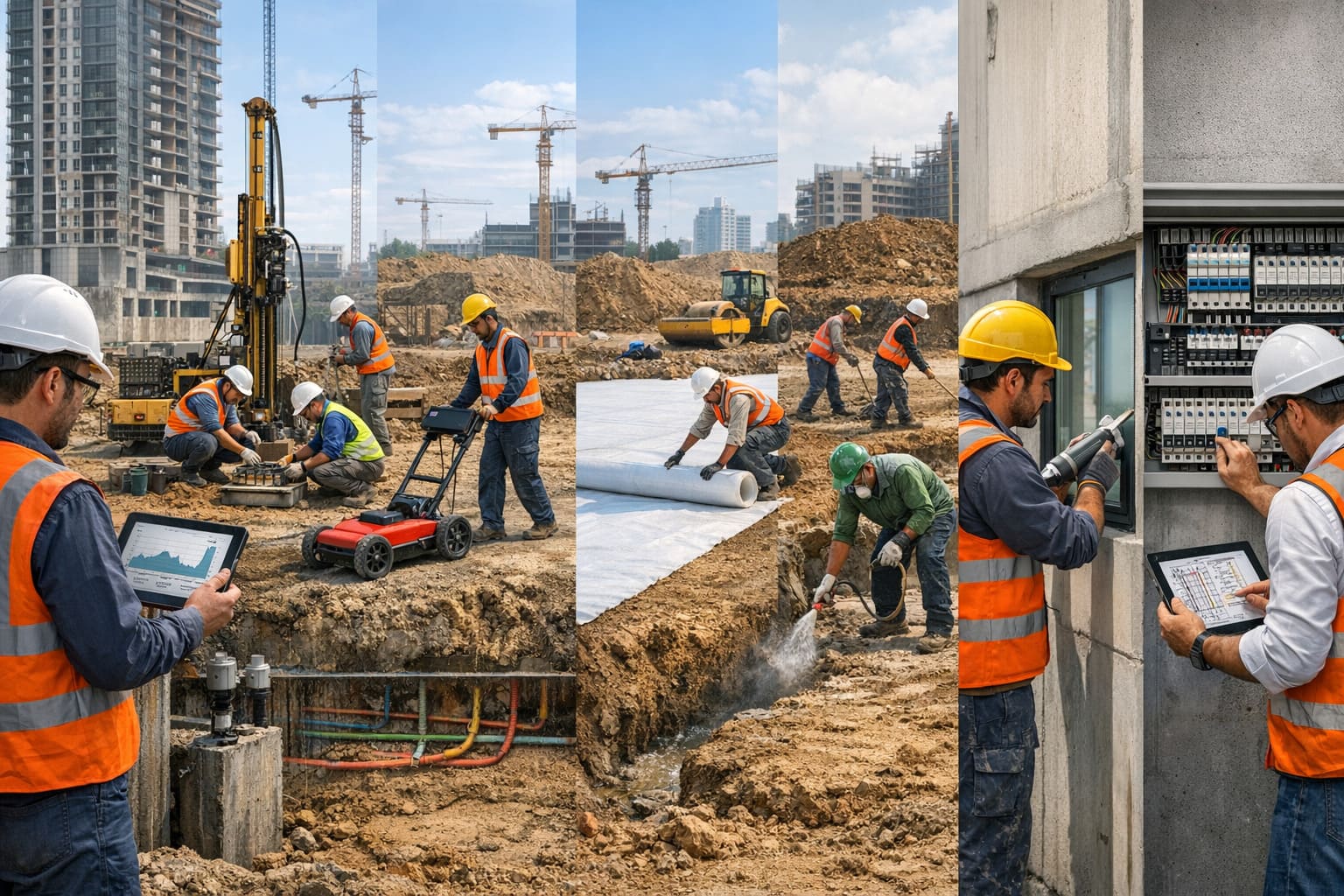
Modern buildings fail not because of poor design alone, but because critical pre-construction and execution-stage safeguards are skipped. From invisible vibrations to weak soil, hidden utilities, termites, leakages, electrical overloads, and wasteful workflows—most problems begin long before a structure is occupied.
At Verified.RealEstate, we focus on preventive construction intelligence—because fixing mistakes after completion is expensive, disruptive, and often irreversible.
This article explains the core construction risks and the systems that prevent them, in a way every property owner, developer, and engineer must understand.
1. Vibration Control in High-Rise Construction: The Invisible Structural Risk
A high-rise building may appear structurally perfect on drawings, but without proper vibration control, the entire structure faces an invisible long-term risk.
During construction, heavy machinery, piling, drilling, rock breaking, and continuous equipment movement generate ground vibrations. These vibrations travel through soil and structural elements and may not show immediate damage—but over time they cause:
- Tile lifting and floor displacement
- Hairline and progressive wall cracks
- Reduced concrete durability
- Stress on beam–column joints
- Damage to nearby structures and properties
The most dangerous aspect is that vibration damage is cumulative and silent.
How vibration control systems prevent damage
- Vibration sensors measure vibration intensity (PPV levels)
- Monitoring software tracks site data in real time
- Controlled piling techniques regulate piling speed and impact force
By controlling vibration pressure and transmission:
- Structural stability improves
- Worker safety increases
- Disturbance and legal risk to neighboring buildings reduces
If vibrations are not measured, they are not controlled.
And uncontrolled vibrations always appear later as cracks, failures, or disputes.
2. Foundation Safety Begins Before Concrete Is Poured
A building’s safety depends entirely on its foundation. Compromising early groundwork directly compromises the life of the structure.
Skipping soil testing
Starting foundation work without testing soil strength leads to:
- Differential settlement
- Cracks in walls and slabs
- Tilting and uneven sinking
Soil conditions vary even within the same plot. Assuming soil strength is a gamble—and buildings always lose that gamble.
Wrong plot leveling and drainage slope
Improper leveling causes rainwater stagnation around the foundation. Water weakens soil, reduces bearing capacity, and accelerates settlement and cracking.
Skipping pre-construction pest control
Termites usually enter from below ground level. Without early treatment:
- Wooden doors, frames, and interiors are destroyed silently
- Repairs later require breaking floors and walls
These are basic construction steps, not optional add-ons.
Skipping them saves money today and guarantees expense tomorrow.
3. GPR Utility Mapping: Why Digging Blind Is a Costly Mistake
Excavation without knowing what lies underground is one of the biggest causes of construction delays, accidents, and cost overruns.
Buried utilities commonly include:
- Water pipelines
- Electrical cables
- Telecom and fibre-optic lines
- Gas pipelines
- Old abandoned service lines
Why drawings cannot be trusted
- As-built drawings are outdated
- Utilities shift over decades
- Unauthorized connections are common
- Old services are undocumented
How GPR solves this
Ground Penetrating Radar (GPR) sends electromagnetic waves into the ground. Subsurface objects reflect these signals, allowing software to map:
- Exact location
- Depth
- Alignment of utilities
Benefits of GPR-based utility mapping
- Non-destructive scanning before excavation
- Identifies depth, alignment, and type of utilities
- Helps redesign foundations, pile locations, and trench paths
- Avoids rework and emergency repairs
- Improves worker safety
- Prevents accidental damage
- Prevents surprise shutdowns and accidents
Today, GPR is not an optional tool—it is essential construction intelligence.
4. Pre-Construction Soil Stabilization: Strength Starts Below Ground
Strong buildings are not supported by concrete alone—they are supported by stable soil.
Pre-construction soil stabilization involves checking:
- Soil density
- Load-bearing capacity
If construction begins on weak or inconsistent soil, future problems are guaranteed:
- Cracks
- Settlement
- Structural distress
- Load transfer failure
Soil stabilization methods include
- Lime or cement treatment
- Chemical stabilization
- Geotextile reinforcement
- Compaction
- Grouting
- Stone columns
These treatments:
- Convert weak soil into a uniform high-strength base
- Reduce foundation stress
- Prevent uneven settlement
- Allow heavy loads to be carried safely
Soil correction after construction is nearly impossible.
Correction before construction is smart engineering.
5. Anti-Termite Treatment: Why One-Time Treatment Fails
Anti-termite treatment is not a single activity—it is a staged protection system.
Stage 1: Pre-construction
- Soil surface
- Column pits
- Foundation bottom
Blocks termite entry from ground level.
Stage 2: During construction
- Plumbing lines
- Electrical conduits
- Expansion joints
Stops termites from entering through hidden gaps.
Stage 3: Post-construction
- Wall edges and skirting
- Door frames
- Wooden joineries
Eliminates existing infestations.
Skipping stages leaves permanent access points.
Termite damage is structural, not cosmetic.
6. Leakage and Seepage: Small Gaps, Major Damage
Leakage usually occurs not because of large cracks, but because joints are poorly sealed.
Common leakage points:
- Expansion joints
- Bathrooms
- Terraces
- Basements
- Windows and façade joints
The common mistake
Using rigid or incorrect sealants where flexibility is required. These shrink, peel, and crack—allowing water to enter.
The correct solution
- Flexible, high-quality elastomeric sealants
- Proper surface preparation
- Correct joint design and thickness
Flexible sealants accommodate:
- Temperature changes
- Structural movement
- Vibrations
They block:
- Water
- Moisture
- Dust
- Fungus and mold growth
Water doesn’t need big holes—just one badly sealed joint.
7. Electrical Load Calculation: Safety Is Decided on Paper
Even perfectly installed wiring becomes dangerous if electrical load calculation is wrong.
Electrical load calculation determines:
- Power requirement per room
- Appliance loads (ACs, heaters, motors, refrigerators)
- Correct wire size
- Proper MCB ratings
- Balanced circuit distribution
If ignored, results include
- Overheating
- Frequent MCB tripping
- Short circuits
- Fire hazards
- Appliance damage
When done correctly:
- Circuits are evenly distributed
- Wiring remains safe
- Future expansion becomes easy
Safe circuits always start with correct load calculation.
8. Lean Construction Principles: Building Smarter, Not Harder
Lean construction focuses on maximizing value while minimizing waste.
It improves four critical areas:
- Removing unnecessary steps
- Avoiding delays
- Optimizing manpower and materials
- Maintaining steady workflow
Benefits of lean construction
- Reduced material waste
- Lower labor inefficiency
- Better coordination
- Faster project delivery
- Higher quality outcomes
Lean construction ensures every activity adds value—not cost.
The Verified.RealEstate Perspective
Most construction failures are not accidents.
They are the result of skipped planning, ignored data, and shortcuts taken too early.
Smart construction means:
- Measure before you dig
- Test before you build
- Control before damage happens
- Treat protection as a system—not a one-time task
At Verified.RealEstate, we believe prevention is the most valuable construction service.