

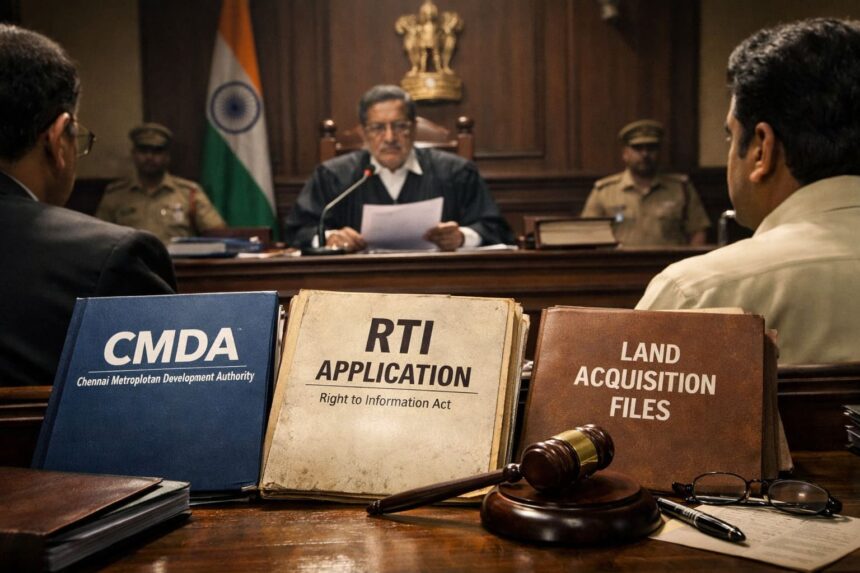
A Wake-Up Call on CMDA Transparency
The Chennai Metropolitan Development Authority (CMDA), the primary urban planning body governing Chennai’s development, has come under scrutiny after a significant ruling by the Tamil Nadu State Information Commission.
In a notable decision, CMDA was directed to pay compensation for failing to provide critical land acquisition information under the Right to Information framework—raising serious concerns about procedural delays and transparency in urban governance.
⚖️ Case Background: What Exactly Happened?
An RTI applicant, a resident of Old Pallavaram, sought land acquisition details relating to certain survey numbers from the Special Tahsildar—information crucial for verifying property legality and ownership history.
However:
- CMDA failed to provide the requested information for nearly 2 years
- The delay was deemed unjustified and excessive
- The applicant was deprived of timely access to public records
This led to escalation before the Tamil Nadu State Information Commission.
🧑⚖️ The Ruling: Compensation for Administrative Failure
The Commission ruled that:
- CMDA must pay ₹20,000 as compensation to the applicant
- The delay constituted a clear violation of RTI obligations
- Public authorities are accountable for timely disclosure of information
This reinforces the legal strength of the Right to Information Act, 2005 in ensuring government accountability.
📜 Legal Significance of the Case
1. RTI is Not Optional
Authorities like CMDA are legally bound to respond within statutory timelines (typically 30 days).
2. Delay = Liability
This case establishes that:
- Delays are not just procedural lapses
- They can result in financial penalties and compensation
3. Strengthening Citizen Rights
The ruling empowers:
- Property buyers
- Developers
- Legal professionals
to actively use RTI for due diligence.
🏗️ Why This Matters in Real Estate
📌 1. Land Acquisition Clarity is Critical
Land acquisition records directly affect:
- Title validity
- Encumbrances
- Government claims over land
A delay in accessing such data can lead to high-risk property decisions.
📌 2. CMDA’s Role in Approvals
CMDA governs:
- Layout approvals
- Planning permissions
- Land use classification
Lack of transparency can impact:
- Project approvals
- Investment confidence
📌 3. Due Diligence Becomes Stronger
This case sends a clear message:
Buyers and investors can legally demand accountability and timely information.
⚠️ Practical Risk Insight for Buyers
If information is delayed or withheld:
- Do not proceed with property purchase blindly
- Use RTI to verify:
- Land acquisition status
- Planning approvals
- Reservation or acquisition notifications
👉 Delays themselves can be a red flag.
Even if authorities like the Chennai Metropolitan Development Authority (CMDA) delay responses or legal disclosures, you don’t have to put your property decision on hold—Verified.RealEstate (VRE) services enable faster, structured legal verification of land records, approvals, and ownership history, helping you make quicker, safer, and well-informed investment decisions without depending solely on delayed official inputs.
🧠 Expert Take: A Structural Shift in Accountability
This is not just an isolated case—it reflects a broader shift toward:
- Data transparency in urban planning
- Increased legal exposure for authorities
- Stronger compliance expectations
For a market like Chennai, where documentation complexity is high, this ruling improves institutional credibility—if enforced consistently.