

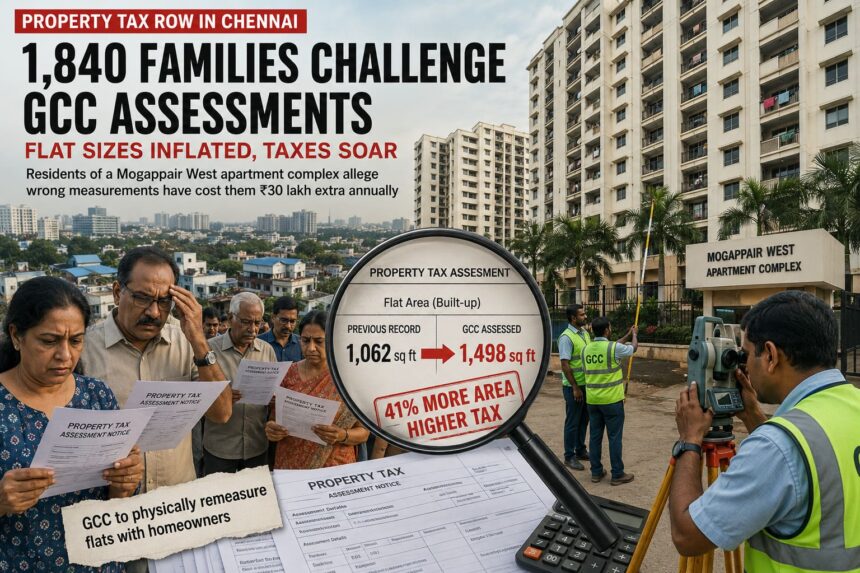
Property Tax Shock for 1,840 Families in Chennai
A major property tax dispute has erupted in Chennai’s Mogappair West, where residents of a large apartment complex have alleged that the Greater Chennai Corporation (GCC) incorrectly recorded the sizes of their flats, resulting in significantly higher property tax assessments.
According to the residents, the discrepancies came to light when homeowners compared their latest property tax assessment notices with the measurements mentioned in their registered sale deeds and builder documents.
The issue affects around 1,840 apartments, with residents estimating that the incorrect assessments are collectively costing them an additional ₹30 lakh every year in property taxes.
Flats Allegedly Measured Much Larger Than Their Actual Size
One of the examples highlighted by residents involved a flat with an actual size of 1,062 sq ft, which was reportedly assessed by the Corporation as 1,498 sq ft.
| Particulars | Area |
|---|---|
| Actual Flat Size | 1,062 sq ft |
| Assessed by GCC | 1,498 sq ft |
| Difference | 436 sq ft |
The recorded area was nearly 41% larger than the actual size of the apartment.
Residents claim that several flats in the complex were similarly overestimated, leading to substantially higher tax demands.
Why Does an Increase in Square Footage Matter?
In Chennai, property tax is calculated based on several factors, including:
- Built-up or plinth area;
- Location of the property;
- Nature of usage (residential or commercial); and
- Classification of the building.
Since the built-up area is one of the primary components in determining the property’s annual value, any increase in the recorded square footage directly increases the tax payable.
Even a few hundred extra square feet reflected in municipal records can substantially increase the annual tax burden on homeowners.
How Did the Discrepancy Come to Light?
Residents reportedly discovered the issue after comparing:
✔ Registered sale deeds
✔ Builder agreements and floor plans
✔ Existing property tax records
✔ Recent assessment notices issued by GCC
The mismatch prompted residents to raise objections with the civic body, arguing that the Corporation’s records did not reflect the actual dimensions of their apartments.
GCC Agrees to Physically Remeasure the Flats
Following complaints and public backlash, the Greater Chennai Corporation has agreed to conduct a physical remeasurement of the properties in the presence of homeowners.
The exercise is expected to:
- Verify the actual built-up area of each flat;
- Correct any erroneous entries in municipal records;
- Revise property tax assessments where necessary; and
- Consider adjustments or refunds if excess tax has already been collected.
The decision has been welcomed by residents, who have been seeking corrections to what they describe as an unjustified increase in their property tax liability.
What Could Have Caused the Error?
While GCC has not publicly disclosed the exact reason behind the discrepancies, experts point to several possible causes:
1. Data Entry Errors
Incorrect information may have been entered during digitisation of property records.
2. Confusion Between Different Area Measurements
There is often confusion between:
- Carpet Area
- Built-up Area
- Super Built-up Area
Recording the wrong type of measurement can significantly alter the tax calculation.
3. Migration of Legacy Records
Errors may have occurred while transferring older records into newer digital assessment systems.
4. Survey and Measurement Mistakes
Incorrect measurements during previous inspections or assessments could also have contributed to the issue.
What Should Property Owners Learn From This?
The Mogappair incident serves as an important reminder for property owners across Chennai to periodically verify their municipal records.
Homeowners should compare the area recorded in their property tax assessment with:
- The registered sale deed;
- Approved building plans;
- Builder documents; and
- Previous assessment records.
Any discrepancy should be immediately brought to the attention of the Corporation to avoid paying excess taxes.
Can Homeowners Challenge Incorrect Property Tax Assessments?
Yes. Property owners can submit representations and supporting documents to the concerned Corporation authorities if they believe their assessments contain errors.
Documents that can help establish the correct area include:
- Registered Sale Deed;
- Approved Building Plan;
- Completion Certificate;
- Previous Property Tax Assessment Orders; and
- Builder’s Allocation Statement.
The Mogappair case demonstrates the importance of maintaining accurate property records and regularly reviewing tax assessments, especially as civic bodies increasingly rely on digitised data.