

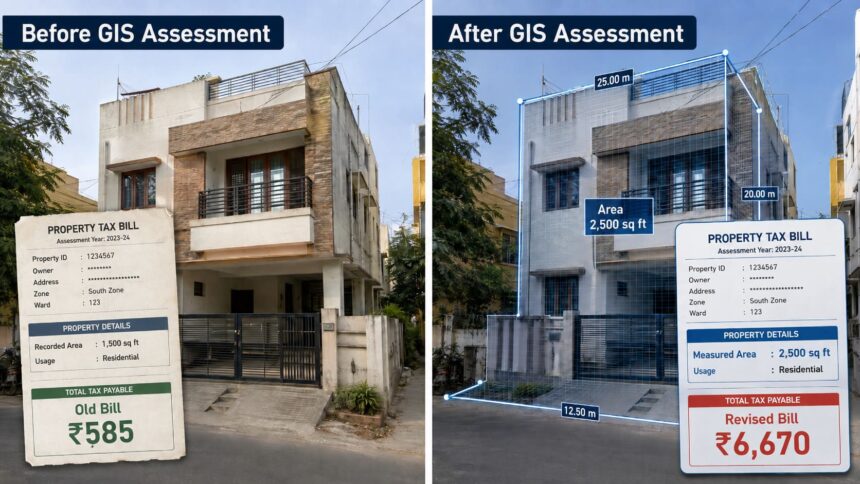
Chennai property owners are seeing a surprise in their property-tax accounts. In some cases, the half-yearly demand has increased several times over, leading to confusion and anger among residents.
But there is an important point to understand:
Greater Chennai Corporation (GCC) says it has not increased the general property-tax rate.
Instead, GCC says it is reassessing properties that were earlier under-assessed or incorrectly assessed.
🏠 Why are some property-tax bills suddenly so high?
GCC has been comparing existing property-tax records with information collected through sources such as:
- GIS and satellite-based property mapping
- Property-owner self-declarations
- Government databases
- Actual building dimensions and usage
If GCC finds that the property recorded in its tax system is smaller than the actual building, or that its usage has changed, the tax assessment can be revised.
For example, if GCC’s records show a building as 1,000 sq ft, but verification finds that the taxable built-up area is actually much larger, the owner may receive a substantially higher demand.
The same can happen if a property recorded as residential is being used commercially.
So the higher bill is not necessarily because the tax rate increased. It can be because GCC has changed the property details on which the tax is calculated.
📈 Some owners report huge increases
Reports from Chennai show very different levels of increase.
One Anna Nagar property owner reportedly saw the half-yearly demand rise from around ₹5,000 to ₹28,000.
Another Chennai resident publicly questioned an increase from ₹585 to ₹6,670 per half-year and asked GCC to explain how the revised annual value had been calculated.
Residents’ groups have also reported cases where taxes increased by 50%, 100%, 200% and even more than 300%.
This has led to a simple demand from many owners:
“Show us exactly what changed in our property assessment and how the new tax was calculated.”
🗣️ Why are Chennai residents upset?
The anger is not only about paying more.
Many residents say they want greater clarity about:
- what difference GCC found in their property
- what built-up area GCC has now recorded
- whether the usage classification has changed
- how the revised annual value was calculated
- why neighbouring flats or similar properties may have received different revisions
Residents’ associations have also questioned why such large changes appeared without owners first receiving an easy-to-understand explanation.
⏳ Is GCC collecting old tax for many previous years?
This is where there is some relief for affected owners.
GCC’s general rules can allow an unassessed or under-assessed property to be assessed for up to 13 previous half-years — potentially going back about 6½ years in some situations.
However, according to current reporting, GCC has applied these revised assessments only from the second half of FY 2025–26, even where the difference in the property may have existed earlier.
In simple words:
GCC may have the power to go much further back, but for this reassessment exercise it appears to be charging the revised amount only from a more recent period.
⚠️ Received a revised demand? Don’t ignore it
GCC has said owners who disagree with the revised assessment can approach the concerned Regional Deputy Commissioner within 15 days of receiving the notice.
GCC has also said these appeals will be decided within 30 days.
Before appealing, owners should compare the revised demand with:
- previous property-tax assessment
- actual built-up or plinth area
- sanctioned building plan
- residential or commercial usage
- additional floors or extensions
- sale deed and property documents
- the area and annual value shown in GCC records
If there is an error, supporting documents will be important.
Verified.RealEstate can help property owners verify whether the measurements mentioned in a revised property-tax assessment match the actual property. Through on-site property survey, measurement verification and comparison with approved plans and existing records, the VRE team can identify discrepancies and provide documented findings that owners can use as supporting evidence while questioning or appealing an incorrect assessment.

The recent image posted by GCC in its instagram official page.
🔍 A major lesson for Chennai property buyers
This reassessment drive also exposes an important risk during property purchase.
A seller may say:
“All property tax has been paid. There are no dues.”
That may be true — but the property itself could still be under-assessed.
For example, the owner may have paid every tax demand issued by GCC, while GCC records show only 1,500 sq ft even though the actual construction is 2,500 sq ft.
A future reassessment could then leave the new owner with a much larger recurring tax bill.
That is why buyers should not check only whether property tax is paid.
They should also compare:
Sanctioned building area → Actual constructed area → GCC property-tax assessment
This should form part of proper property due diligence before purchase.
🏢 More properties could come under scrutiny
The current reassessment exercise has focused significantly on commercial properties, with thousands of commercial-building assessments reportedly still under review.
GCC is also expected to expand verification further into residential properties.
That means more Chennai owners could receive revised assessments as GCC continues matching physical property data with its existing tax records.
✅ The key takeaway
The current controversy should not simply be described as a “300% or 400% Chennai property-tax hike.”
GCC’s position is that the tax rate itself has not been generally increased.
The real story is that Chennai is using property data and GIS-based verification to identify buildings that it believes were under-assessed earlier — and correcting those assessments can produce dramatically higher bills.
For property owners, the lesson is to verify the revised calculation quickly.
For property buyers, the lesson is even more important:
A paid property-tax receipt does not automatically mean the property has been correctly assessed.