

Introduction
Chennai Metro Rail Limited is working on two important developments that will improve the city’s metro network.
🚄 One is is the beginning of underground tunnel work under Phase 2 Corridor 4, especially from Thirumayilai towards Boat Club through Alwarpet.
🚄 The other is the restoration and improvement of existing Phase 1 and Phase 1 extension stations.
These projects show that CMRL is not only expanding the metro network through Phase 2, but also improving the older operational stations under Phase 1. Together, these works are expected to improve passenger movement, station quality, metro access and the overall public transport experience in Chennai.
What CMRL Is Planning to Do
CMRL is currently focusing on two major areas.
First, CMRL is moving ahead with Phase 2 underground work on Corridor 4. After completing the tunnel stretch between Light House and Thirumayilai, the next major work is expected to be the tunnelling from Thirumayilai towards Boat Club via Alwarpet.
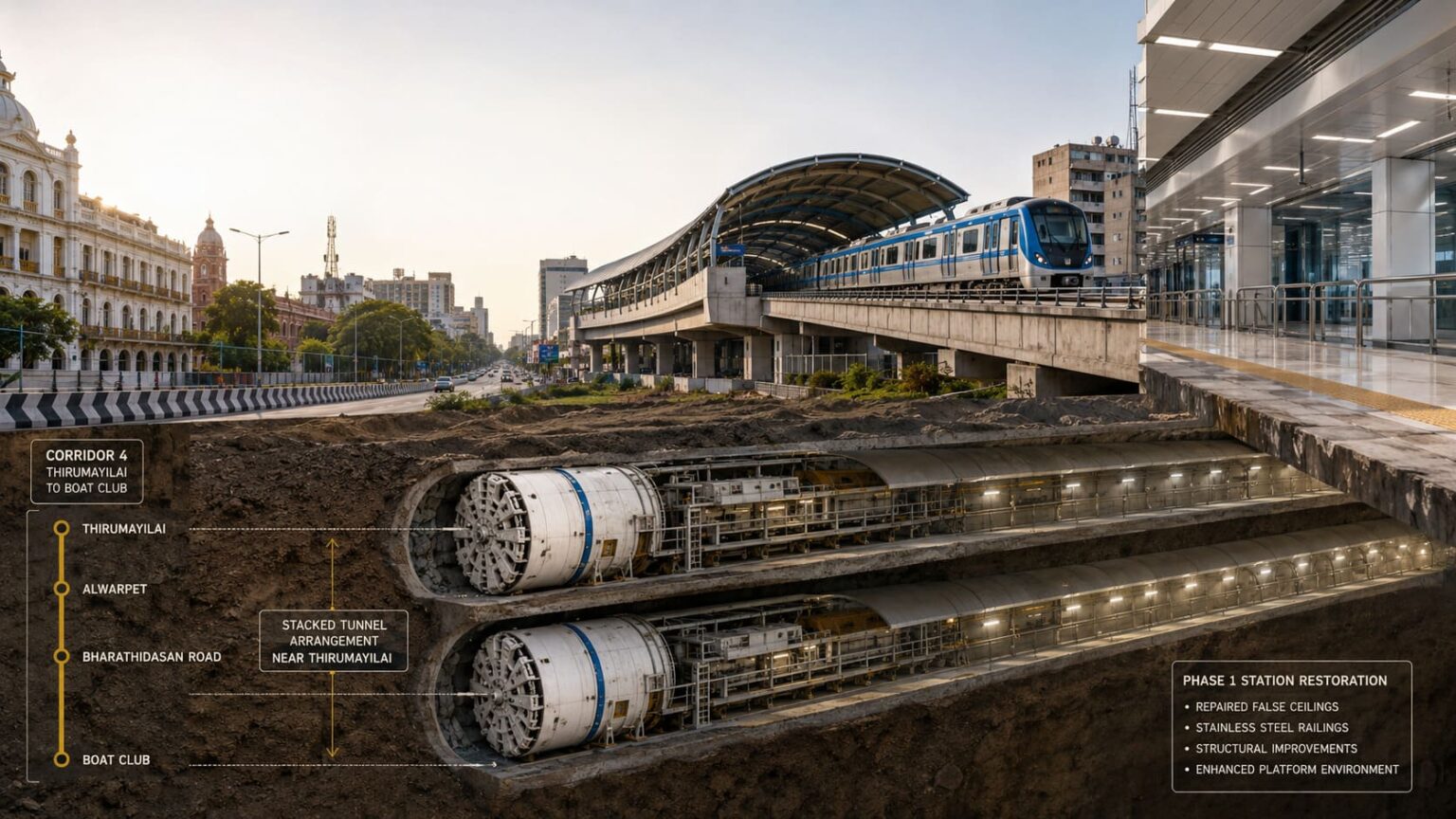
Second, it is preparing to carry out restoration and architectural improvement works across the operational Phase 1 network. This includes repairs to damaged station interiors, false ceilings, railings, structural steel works and other architectural finishes
In simple terms, CMRL is doing both expansion and maintenance at the same time. The new corridors will improve future connectivity, while restoration of existing stations will improve the quality and safety of the present metro network.
Chennai Metro Phase 2 Corridors
Chennai Metro Phase 2 is one of the largest urban transport expansion projects in the city. The project covers about 118.9 km and includes 128 stations across three corridors.
The three Phase 2 corridors are:
- Corridor 3: Madhavaram to SIPCOT
- Corridor 4: Light House to Poonamallee Bypass
- Corridor 5: Madhavaram to Sholinganallur
Among these, Corridor 4 is especially important because it connects the Marina side of the city with key central and western Chennai locations. The corridor runs from Light House to Poonamallee Bypass and covers about 26.1 km.
This corridor passes through or connects important areas such as Light House, Thirumayilai, Alwarpet, Boat Club, Nandanam, T. Nagar, Kodambakkam, Porur and Poonamallee. Once completed, it is expected to reduce travel time across some of Chennai’s busiest road stretches.
Corridor 4: Light House to Poonamallee Bypass
Corridor 4 is part of Chennai Metro Phase 2 and is designed to connect the coastal side of the city with the western suburbs. The corridor begins at Light House and extends towards Poonamallee Bypass.
A key feature of this corridor is that important central city stretches are underground. This is necessary because areas such as Mylapore, Alwarpet, Nandanam and T. Nagar are already densely built, heavily used and difficult to modify at road level.
Tunnelling is therefore a major part of the project. Instead of disturbing surface roads and existing buildings extensively, CMRL is using tunnel boring machines to create underground tunnels through these congested parts of the city.
Completed Tunnel Work Between Light House and Thirumayilai
CMRL has already completed tunnelling between Light House and Thirumayilai on Corridor 4. This was a major milestone because the stretch passed beneath some of the most sensitive and congested parts of Chennai.
The Light House–Thirumayilai tunnel stretch is about 1.98 km long. The tunnel work passed beneath important locations such as the Light House area, All India Radio campus, Russian Embassy zone, Our Lady of the Rosary Church, MRTS bridge and Buckingham Canal.
The work was technically challenging because the tunnel boring machines had to pass through rocky strata, shallow overburden, stacked tunnel conditions and unexpected gas pockets. Despite these challenges, both the upline and downline tunnels on this stretch were completed.
The two tunnel boring machines involved in this work are named Eagle and Flamingo.
Thirumayilai to Boat Club Tunnel Work
After completing the Light House–Thirumayilai tunnel section, CMRL is now preparing for the next major underground stretch from Thirumayilai to Boat Club under Corridor 4. The 2.2-km section will pass through Alwarpet and Bharathidasan Road before reaching Boat Club station.
Two tunnel boring machines, Eagle and Flamingo, are being lowered and assembled at Thirumayilai station for this work. Once launched, the downline machine will begin drilling first, followed by the upline machine. This sequence is being followed because the tunnel alignment from Thirumayilai to Bharathidasan Road has been planned in a stacked pattern, where one tunnel runs above the other instead of side by side. This method is usually adopted in areas where underground space is limited.
The early phase of tunnelling could progress at a slower pace, as the machines will need to navigate through a mix of hard rock and clayey soil. Working through hard rock may require frequent changes of the TBM cutter discs used for excavation. Beyond Bharathidasan Road, the ground conditions are expected to be predominantly clayey, which should help speed up the tunnelling process.
Thirumayilai is also an important interchange station in Phase 2, connecting Corridor 3 and Corridor 4. Once completed, this stretch will improve metro access for areas such as Mylapore, Alwarpet, Bharathidasan Road and Boat Club. CMRL expects the tunnelling from Thirumayilai to Boat Club to take nearly 18 months.
Phase 1 Station Restoration Work
Along with Phase 2 expansion, CMRL is also planning restoration work across its existing Phase 1 and Phase 1 extension stations.
CMRL has floated a tender to restore architectural finishes across the operational Phase 1 network.
The planned work includes
- dismantling damaged false ceilings,
- installing new GI clip-in metal ceiling systems,
- replacing worn stainless steel railings, carrying out structural steel works,
- repairing architectural finishes and
- restoring station interiors wherever needed.
This work is being planned because some Phase 1 stations have started showing signs of ageing. Commuters have raised issues such as loose ceiling panels, water seepage, roof leaks, puddles during monsoon and deteriorating finishes at some stations.
The restoration work is expected to be carried out without disrupting metro services or passenger movement.
The tender mentions that the work must be completed within 200 days, followed by a one-year defect liability period during which the contractor will have to rectify any deficiencies.
Commercial Space Development at Phase 1 Stations
CMRL has also identified 12 stations for additional property development. These include Chennai Central, Teynampet and Shenoy Nagar.
The estimated cost for this additional property development work is around ₹2.5 crore. The main idea is to create more commercial space at selected metro stations and improve non-fare revenue.
This means CMRL is not looking at metro stations only as transport points. It is also planning to use selected stations for commercial activity, which can include retail spaces and other revenue-generating facilities.
This approach can help CMRL earn additional income apart from ticket revenue. It can also make stations more useful for commuters by adding convenience-based commercial facilities.
Real Estate Impact
Metro connectivity has a strong impact on real estate, especially in areas where access, travel time and public transport convenience improve. Locations around Thirumayilai, Alwarpet, Boat Club, Teynampet, Chennai Central and Shenoy Nagar will definitely benefit because metro access usually increases demand for residential, commercial and rental properties.
However, buyers should not look at metro connectivity alone. Before purchasing any property near a metro corridor or station, it is still important to verify the title, approvals, patta, EC, access, road width and any possible acquisition or development restrictions.
Conclusion
CMRL’s current plans include both the restoration of existing Phase 1 stations and the continuation of Phase 2 Corridor 4 tunnel work from Thirumayilai towards Boat Club via Alwarpet.
The Phase 1 works will improve station interiors, false ceilings, railings, architectural finishes and commercial space at selected stations. The Corridor 4 tunnel work will expand underground metro connectivity through some of Chennai’s most important and congested localities.
Together, these developments are expected to strengthen Chennai’s metro infrastructure, improve passenger convenience and support better connectivity across the city.