

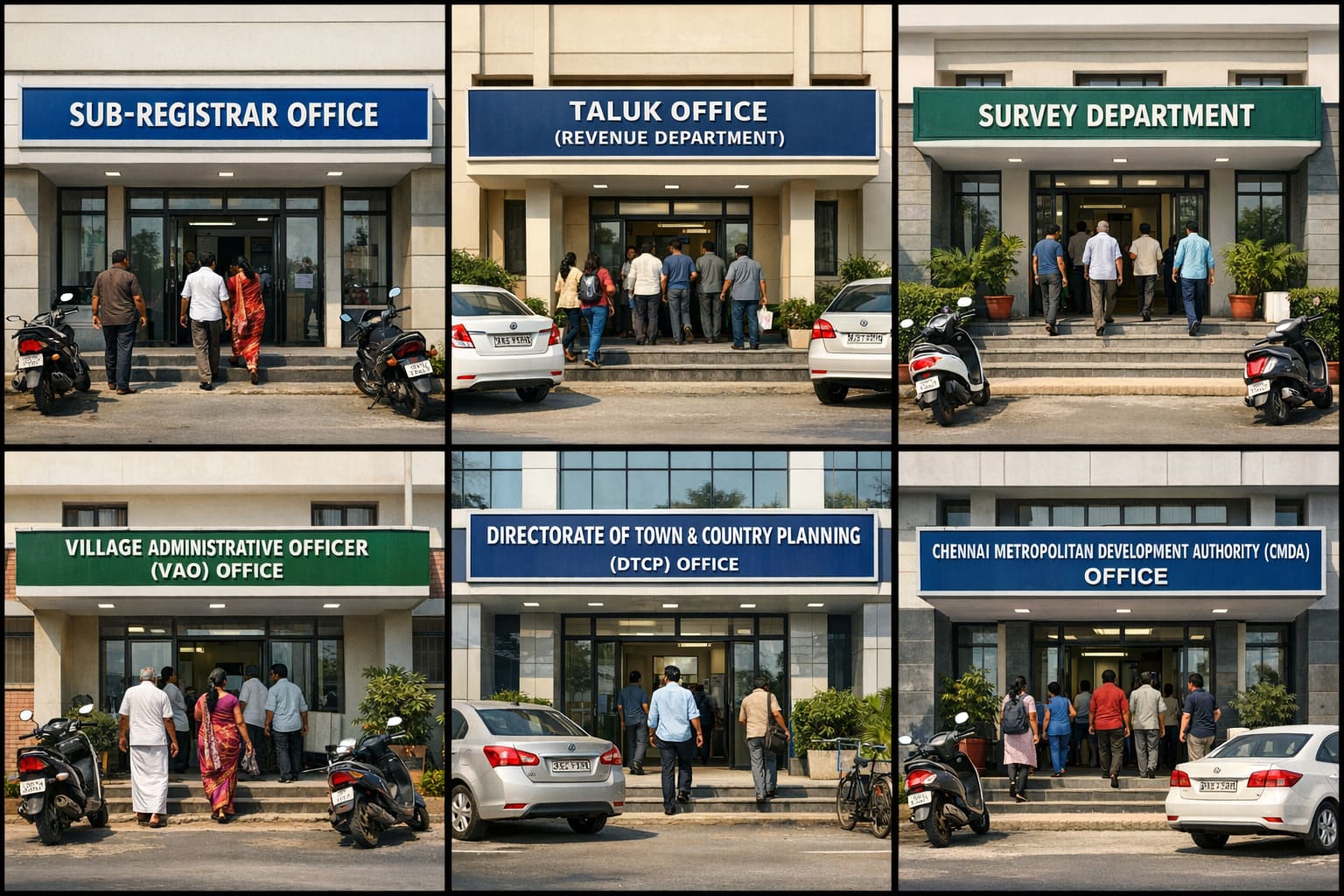
Buying land in Tamil Nadu requires careful verification of multiple records. Many buyers check a few documents online, but experienced property lawyers still recommend verifying key records directly with the relevant government departments.
Each government office maintains a specific set of property records. Knowing where to verify what helps buyers confirm ownership, boundaries, approvals, and legal status before purchasing land.
Below is a clear guide explaining which office verifies each type of property record in Tamil Nadu.
If You Want to Verify Ownership
Ownership of a property is verified through the Sub-Registrar Office (SRO) under the Registration Department.
The Sub-Registrar office maintains records of all registered property transactions, including:
- Sale deeds
- Settlement deeds
- Gift deeds
- Mortgage registrations
Buyers can request a certified copy of the registered sale deed to confirm that the seller legally owns the property.
It is also recommended to verify the parent document chain for at least 30 years to ensure the property title has no gaps.
If You Want to Verify Encumbrance or Transaction History
The Encumbrance Certificate (EC) is also issued through the Sub-Registrar Office.
The EC shows:
- Previous sale transactions
- Mortgage records
- Legal attachments
- Financial liabilities linked to the property
Checking the EC helps buyers confirm that the land is free from loans or legal disputes.
Property lawyers usually recommend checking the Encumbrance Certificate for at least 30 years.
If You Want to Verify Patta and Land Classification
The Taluk Office under the Revenue Department maintains official land ownership records.
Here buyers can verify:
- Patta
- Chitta
- A-Register
These records confirm:
- The registered owner of the land
- Survey number and extent
- Land classification
Land classification is important because some lands are not legally suitable for residential construction.
Examples include:
- Government land
- Water body land
- Agricultural land that has not been converted
If You Want to Verify Survey Numbers and Property Boundaries
The Survey Department maintains official land measurement records.
The key record used for boundary verification is the Field Measurement Book (FMB).
The FMB sketch shows:
- Exact land boundaries
- Length and width measurements
- Neighboring survey numbers
- Road access details
If there is any doubt regarding land extent or encroachment, buyers can request an official land survey measurement.
If You Want to Verify Local Land Status or Disputes
The Village Administrative Officer (VAO) plays an important role in verifying local land details.
The VAO can confirm:
- Actual possession of land
- Local boundary disputes
- Government land classification
- Encroachments
- Water body restrictions
This local verification step is often useful in suburban or rural areas where unofficial layouts may exist.
If You Want to Verify Layout Approval
Layout approval must be verified with planning authorities.
In Tamil Nadu, the key authorities include:
- CMDA (Chennai Metropolitan Development Authority) – for properties within the Chennai metropolitan area
- DTCP (Directorate of Town and Country Planning) – for areas outside CMDA jurisdiction
These authorities approve:
- Residential layouts
- Road access planning
- Infrastructure provisions
- Open Space Reservation (OSR) areas
Buying land in unapproved layouts can result in legal complications and restrictions on construction.
Common Red Flags Buyers Should Watch For
While verifying property records, buyers should be cautious if they notice:
- Missing parent documents
- Patta not matching the seller’s name
- Survey number mismatches
- Government land classification
- Unapproved layouts
- Encumbrance entries showing loans or disputes
Identifying these issues early can prevent serious financial and legal risks.
How Verified.RealEstate Helps with On-Ground Property Verification
Verified.RealEstate also provides on-ground property verification services across Tamil Nadu. In addition to digital tools, the VRE team physically visits relevant government offices such as the Sub-Registrar Office, Taluk Office, Survey Department, and Village Administrative Officer (VAO) office to verify critical records related to a property.
This includes checking the ownership chain, Encumbrance Certificate records, Patta details, land classification, Field Measurement Book (FMB) sketches, survey boundaries, and layout approvals from planning authorities such as CMDA or DTCP. By combining field verification with document analysis, VRE helps buyers obtain a clearer picture of the property’s legal status before making a purchase decision.
You can contact them –
- By calling the number +91 9996 12 9996 or
How Technology Can Simplify Property Verification
Verified.RealEstate also offers digital tools that help buyers review basic property details such as survey information, ownership records, land classification, and transaction history before visiting government offices. These tools support the on-ground verification process by helping buyers approach property checks with better clarity.
You can access the Verified real estate online services by
- Sending a “Hi” to the WhatsApp number 81888 69996 and or
- By visiting https://verified.realestate
Final Thoughts
Before purchasing land, buyers should try to identify and visit the relevant government offices in their locality to verify property records directly. These offices maintain the official records needed to confirm ownership, boundaries, approvals, and legal status of the land. Reaching out to the correct department can help you obtain accurate information and avoid potential legal issues.
In most areas of Tamil Nadu, the offices responsible for property verification are typically located in the following places:
- Sub-Registrar Office (SRO) – Usually located in the main town area, often near courts or administrative zones.
- Taluk Office (Revenue Department) – Typically situated in the Taluk headquarters or main government administrative complex.
- Survey Department / Taluk Survey Office – Often located inside the Taluk Office campus or in a nearby government building.
- Village Administrative Officer (VAO) Office – Usually located within the respective village or local administrative area.
- Planning Authorities (CMDA / DTCP Offices) – Generally found in regional planning offices in major towns or district headquarters.
The locations above are common but may vary by district. Buyers should confirm the exact office locations through Google Maps, local inquiries, or official sources, or consider using Verified.RealEstate (VRE), whose team can handle the verification process directly.