

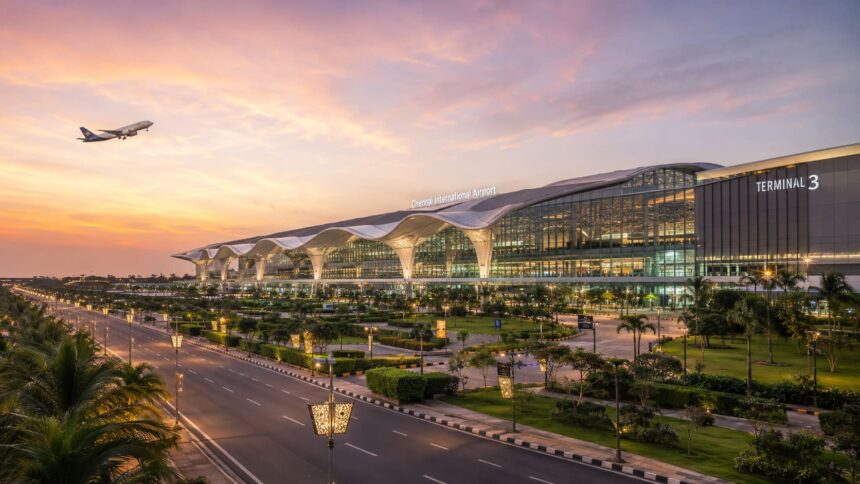
Chennai’s aviation and urban landscape is undergoing a massive transformation. With the Union Government revising the deadline for Chennai International Airport’s Phase 2 modernisation to December 2026, a combination of terminal upgrades, airside enhancements, a new satellite facility, and a city beautification drive will completely reimagine the passenger experience.
Here is a complete breakdown of everything happening at and around Chennai International Airport.
🛫 1. Main Terminal Modernisation (Phase II)
The Airports Authority of India (AAI) is executing a ₹2,467-crore revamp to modernise infrastructure and keep up with rising air traffic. Over ₹1,762 crore has already been spent.
- Target Completion: December 2026 (T3 opening expected around November 2026 to early 2027).
- Capacity Increase:
- Phase I (Completed 2023): Built the integrated terminal, expanding handling capacity from 23 million to 30 million passengers per year.
- Phase II (Underway): Constructing the new Terminal 3 (T3), which will boost total capacity to 35 million passengers annually.
- New Terminal 3 Features: 8 entry gates, 60 check-in counters, 10 X-ray scanning channels, 8 aerobridges, and 9 remote boarding gates.
- Monsoon & Flood Safety: A dedicated stormwater drainage project (designed to route rainwater straight into the Adyar River) is underway to prevent runway flooding during heavy monsoons.
✈️ 2. Airside Upgrades (Faster Flights & Runway Efficiency)
To keep operations running on time, AAI invested ₹236.75 crore over the past five years in airside upgrades.
- Rapid Exit Taxiways: Added to allow landing aircraft to vacate the main runway at higher speeds.
- New Taxi Tracks & Link Taxiways: Built to reduce plane idling times, cut down runway congestion, and increase overall hourly flight movements.
🏢 3. Proposed Satellite Facility (Terminal 5)
To prevent future bottlenecks and extend the main airport’s operational life, AAI is planning a Satellite Terminal (Terminal 5) within the existing airport grounds.
- Dual-Purpose Operations: Designed to handle passenger overflow as well as dedicated cargo handling.
- Internal Passenger Transfer: Passengers moving between terminals will use smooth transit features such as underground walkalators/walkways.
- Public Access Road Connection: Instead of a closed-off corridor, AAI accepted a proposal from CUMTA to build a shared public road connecting the satellite terminal to nearby networks (such as NH32). This will ease traffic on GST Road and improve access for neighboring areas like Kolapakkam and Tharapakkam.
- Adyar Riverfront Synergy: A study by IIT Madras concluded that the satellite layout along the riverbanks double-functions as a riverfront project, helping control flooding while unlocking additional infrastructure possibilities.
🌴 4. ‘Gateway of Chennai’ Corridor Makeover (GCC Project)
Outside the terminal gates, the Greater Chennai Corporation (GCC) is spending over ₹10.5 crore to revamp the highway stretch from Kathipara Junction to the Airport.
- ₹5.65 Crore: Allocated for redeveloping footpaths, entry points, and green corridors along the main road.
- ₹4.92 Crore: Dedicated to transforming the VIP Park near the airport into a scenic spot.
- Beautification Highlights: Paved footpaths, ornamental gardens, avenue trees, artistic cultural showcases celebrating Tamil Nadu, and decorative street lighting.
📊 Summary Table
| Project Scope | Budget | Main Objectives |
| Airport Modernisation (Phase II) | ₹2,467 Crore | Build Terminal 3; scale capacity to 35M passengers/yr |
| Airside Enhancements | ₹236.75 Crore | Rapid Exit Taxiways & tracks for faster turnaround |
| Satellite Terminal (Terminal 5) | TBD | Dedicated passenger/cargo spillover facility with public road access |
| Gateway of Chennai Roadwork | ₹10.5+ Crore | Beautify Kathipara–Airport drive with gardens, lights, and walkability |
Investing in Surrounding Airport Areas: Understanding Colour-Coded Zones
As infrastructure upgrades around Meenambakkam, Pallavaram, Pammal, and Guindy continue to drive up real estate interest, investors and property developers must exercise due diligence regarding building height restrictions.
The Airports Authority of India (AAI) enforces strict Obstacle Limitation Surfaces (OLS) mapped out through Colour-Coded Zoning Maps (CCZM). Surrounding real estate is categorized into distinct color zones—ranging from Red (critical approach funnels where strict height caps apply and direct AAI NOC clearance is mandatory) to Orange, Yellow, and Green zones where permissible building heights gradually increase.
Before purchasing land or committing to vertical developments around the airport corridor, investors should verify the exact site elevation against the CCZM grid to ensure their building plans comply with civil aviation height limits and avoid regulatory delays.