

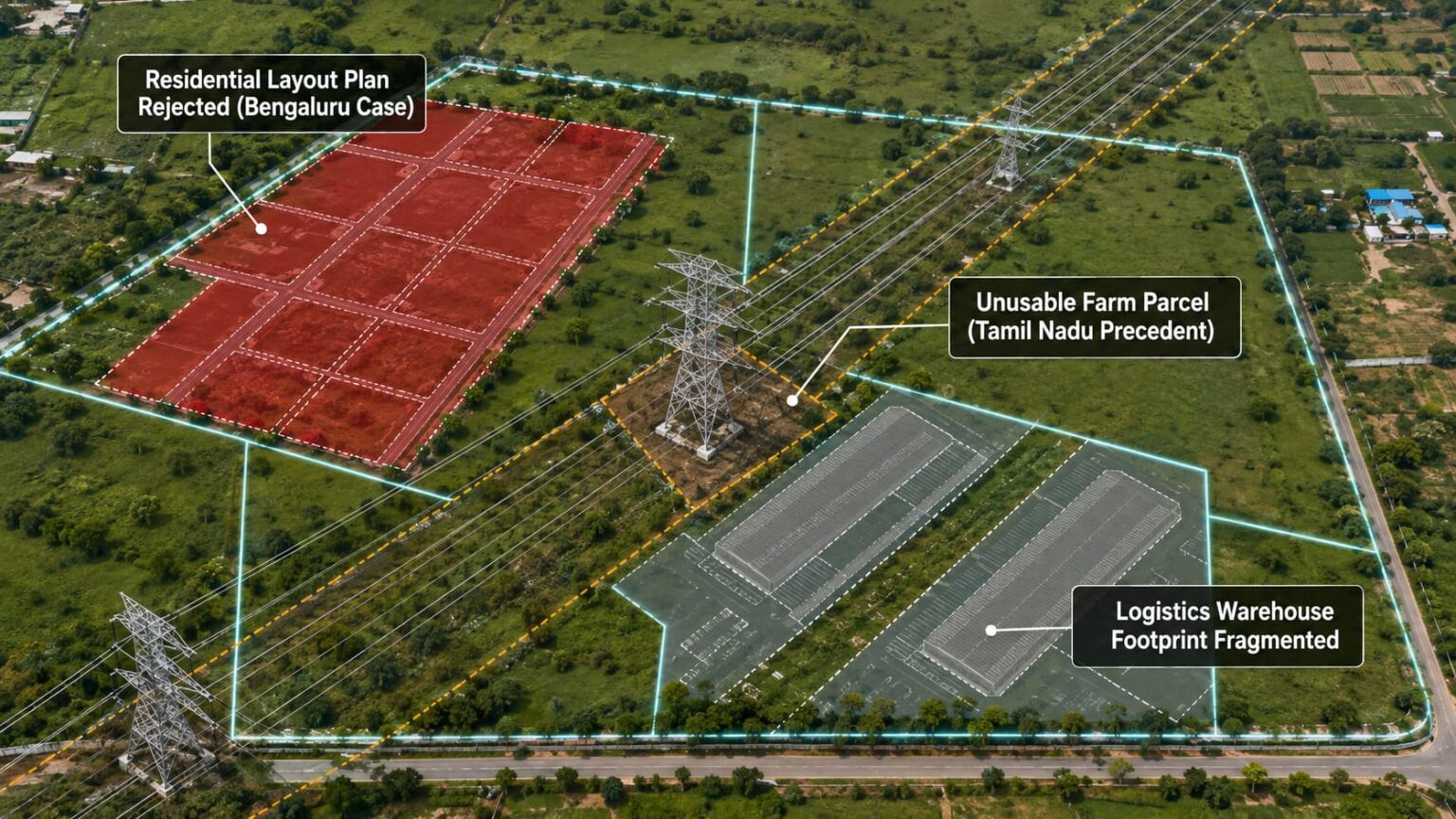
A prime piece of land on paper can quickly become a multi-crore legal and financial headache in reality. Across India’s rapidly growing urban corridors, landowners and real estate developers frequently face the harsh reality of “*land sterilization“—a situation where high-voltage electricity transmission infrastructure renders land legally and physically unbuildable.
Examining landmark legal disputes and industry scenarios illustrates how high-tension (HT) power lines strip away land value and how Indian courts handle these conflicts.
*Land sterilization occurs when legal, physical, or utility restrictions permanently ban construction on a plot, rendering its market value close to zero.
Real-World Scenarios and Legal Precedents in India
1. The Approved Layout Trapped Under Grid Expansion (Bengaluru, Karnataka)
- The Scenario: A real estate developer purchased over 5 acres of land near Bengaluru to construct an approved residential layout. Shortly after the purchase, the Power Grid Corporation of India Limited (PGCIL) laid the Dharmapuri-Somanahalli 400 kV Quad Line straight across the plot.
- The Conflict: Overhead high-voltage wires bisected the land parcel. Because statutory clearance corridors and height limits applied to almost the entire plot, the layout plan was completely ruined. The developer sued, demanding that the power board either dismantle and move the line or pay full land compensation for the whole 5-acre property.
- The Court’s Stance: In Power Grid Corporation of India Ltd. vs. M/S Abhishek Developers, the High Court reaffirmed that power companies cannot easily be forced to remove or reroute already-established lines, leaving the landowner with the complex task of seeking financial compensation rather than reclaiming their unencumbered buildable layout.
2. The Unusable Agricultural Plot & No Land Ownership Transfer (Tamil Nadu)
- The Scenario: In R. Saraswathi v. TANTRANSCO, a small landowner found state power authorities erecting a 400 kV extra-high-voltage tower right in the middle of her agricultural land to evacuate wind energy.
- The Conflict: The landowner argued that the tower and lines permanently destroyed the usability of her land and constituted unlawful trespass without prior consent.
- The Legal Precedent: The High Court ruled that under Section 10 of the Indian Telegraph Act, 1885, state transmission bodies have the legal power to enter private land and construct lines in the public interest without prior owner consent or formal land acquisition. The court confirmed that while the owner retains the deed, the state holds the “Aerial Right-of-Way”—limiting the owner’s remedy strictly to claiming cash compensation for crop and land devaluation.
3. The “Aerial Right-of-Way” Compensation Deadlock (Jammu & Kashmir)
- The Scenario: A landowner had a 220 kV transmission line installed across the center of his property. The power company paid compensation only for the 5-marla ground footprint actually occupied by the tower base.
- The Conflict: The owner appealed to the High Court, arguing that even though the tower legs occupied only a tiny spot, the overhead lines running across the middle rendered the entire remaining parcel uncultivable and unbuildable.
- The Legal Precedent: In Ghulam Mohi-Uddin Sheikh v. UT of J&K, the court reiterated that individual landowners cannot claim full land acquisition payouts or assert absolute rights over aerial space. Because aerial right-of-way legally vests with the State, owners are generally restricted to standard statutory tower-base and corridor compensation rather than a complete buyout of the surrounding land.
Common Developer Scenarios: How HT Lines Destroy Project Liquidity
Beyond formal court battles, several recurring real estate scenarios play out in industrial and residential belts across India:
+-----------------------------------------------------------------------+
|                       THE STERILIZATION CASCADE                       |
|                                                                       |
|  [ HT Lines Installed ] ---> [ Statutory RoW Setbacks Applied ]      |
|                                             |                         |
|                                             v                         |
|  [ Bank Finance Rejected ] <-- [ Layout Footprints Fragmented ]       |
|             |                                                         |
|             v                                                         |
|  [ Complete Liquidity Loss & 60-85% Haircut in Market Price ]        |
+-----------------------------------------------------------------------+
- The Fragmented Logistics Hub (Warehousing): Modern Grade-A logistics parks require vast, uninterrupted covered areas for continuous floor slabs and container truck movement. When two or three 132 kV or 220 kV lines cross a 20-acre plot diagonally, the required 27-to-35-meter safety buffers split the parcel into small, disconnected buildable strips. Standard warehouse layouts become physically impossible to construct.
- The Rejected Home Loan & Mortgage Trap: A landowner attempts to sell individual residential plots in a newly sub-divided layout. However, when prospective buyers apply for home loans, institutional banks and housing finance companies (HFCs) reject loan applications for plots within 20 meters of high-voltage lines due to safety and collateral risks, causing retail buyer demand to vanish overnight.
- The Rerouting Cost Shock: A commercial land buyer attempts to get an HT line shifted to the boundary edge of their property. State electricity boards often agree in principle, but under statutory rules, the landowner must bear 100% of the rerouting expenses—which can run into crores of rupees for line diversions, double-circuit monopoles, and new right-of-way acquisitions.
Key Takeaway for Property Buyers and Developers
These real-world cases highlight a vital legal reality in India: Public infrastructure utility rights almost always override private land development rights.
Once high-tension power lines or transmission towers are installed on a land parcel:
- You cannot legally force the utility company to remove them without paying massive rerouting costs yourself.
- The government will not buy the entire land deed from you; they only compensate for the utility easement.
- Market liquidity drops instantly because institutional buyers, banks, and developers will avoid encumbered layouts.
Conducting upfront spatial checks and verifying High Tension (HT) corridors before finalizing any purchase remains the only effective protection against land sterilization.
Recommended Reading: For a complete breakdown of mandatory Right-of-Way (RoW) buffer widths, risk zone classifications, and compensation formulas under Indian utility laws, refer to our comprehensive guide: High-Tension Power Lines on Private Land: Rules, Land Value Loss, and Landowner Rights. It covers how line voltages directly dictate buildable setbacks, how statutory clearance rules are calculated, and how landowners can claim compensation for loss of land utility.