


Suppose you file a property case, produce your documents and win before the trial court. However, the opposite party challenges the decision in the High Court. During the appeal, you realise that some important documents were not submitted earlier.
Can you now produce those documents and ask the court to reconsider the case?
The answer is not always yes.
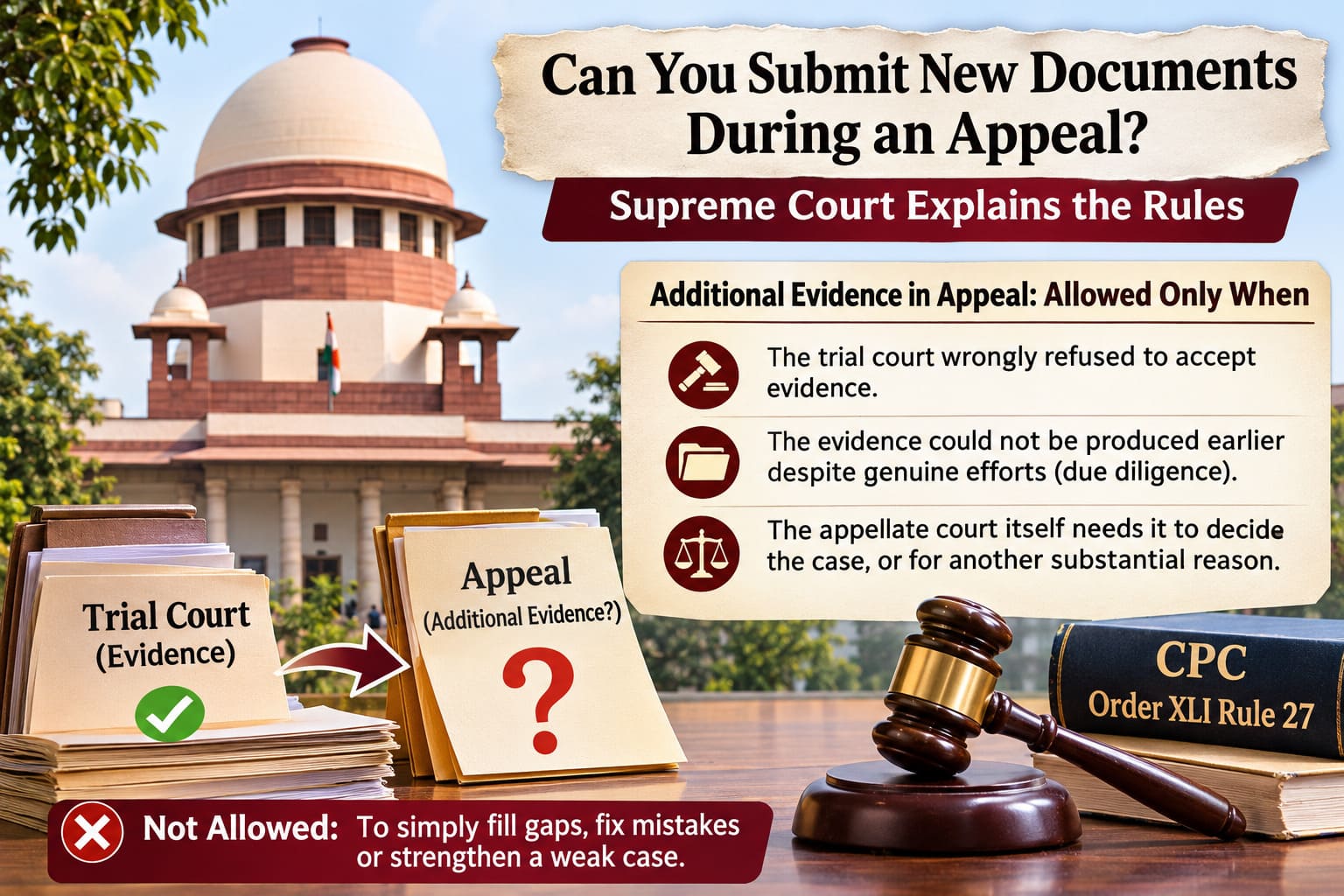
Under Order XLI Rule 27 of the Code of Civil Procedure (CPC), additional evidence can be submitted during an appeal only in specific circumstances. A party cannot introduce new documents simply because they may strengthen its case or correct mistakes made during the trial.
In a judgment dated 9 March 2026, the Supreme Court of India reiterated these restrictions in Gobind Singh and Others v. Union of India and Others (Civil Appeal Nos. 5168–5169 of 2011).
When Can Additional Evidence Be Submitted During an Appeal?
Order XLI Rule 27 allows additional evidence in only three circumstances.
1. When the trial court wrongly rejected evidence
If you submitted a document during the trial but the court wrongly refused to accept it, you can request permission to produce it during the appeal.
Example: You submitted a registered sale deed to establish ownership, but the trial court wrongly refused to accept it.
2. When the document could not be obtained earlier despite genuine efforts
If a document was not within your knowledge or could not be produced despite taking reasonable steps to obtain it, you may request permission to submit it during the appeal.
This is known as due diligence, which simply means making genuine efforts to obtain and produce the evidence at the proper time.
Example: You had requested an important government land record during the trial, but the concerned authority supplied it only after the judgment.
However, forgetting to submit an available document is not sufficient.
3. When the appellate court itself needs additional evidence
Sometimes, the appellate court may find that it needs a particular document or witness to decide the case properly. It may then permit additional evidence.
The law also allows admission for another substantial cause, meaning a genuinely important reason recognised by the court.
Important: The appellate court must record its reasons for admitting additional evidence. It cannot accept documents casually.
Can You Introduce Documents Just to Strengthen Your Case?
No. This is the central principle reiterated by the Supreme Court.
An appeal is not a fresh trial. It is an opportunity to challenge the earlier decision based on the existing evidence, subject to the limited exceptions under Order XLI Rule 27.
A party cannot wait until the trial is over, identify weaknesses in its case and then introduce additional documents simply to fill those gaps.
If the appellate court can decide the dispute satisfactorily using the existing evidence, additional documents are generally unnecessary.
What Happened in the Supreme Court Case?
The case concerned a family claiming ownership of land measuring 8 Bighas and 10 Biswas at Murar, Gwalior, Madhya Pradesh.
The family claimed that the property was ancestral land and relied on an earlier court decree obtained by their predecessors.
However, the Union Government disputed their ownership, stating that the land had vested in it and that the earlier decree could not bind the Union Government because it was not a party to that case.
What happened in the courts?
- Trial Court (1996): Ruled in favour of the family and recognised its ownership claim.
- Madhya Pradesh High Court (2009): Reversed the decision and dismissed the family’s suit because it had not adequately established its title against the Union Government.
- Review proceedings (2011): The High Court rejected the family’s request to introduce additional General Land Register (GLR) records. These are government-maintained records containing land-related details.
- Supreme Court (9 March 2026): Dismissed the family’s appeals and upheld the High Court’s decisions.
Why did the family want to submit additional records?
The family wanted to produce certified copies of General Land Register records to support its claim that the disputed land was private property.
However, the Supreme Court observed that even if these records were accepted, they would not establish that the family actually owned the property.
In simple terms, a government record describing land as private property does not automatically prove that a particular person owns it.
The family still had to establish how it legally acquired ownership.
The Supreme Court therefore found no reason to interfere with the High Court’s decisions.
What Should Property Owners and Litigants Learn?
This judgment offers two important lessons:
- Submit your evidence during the trial: Do not wait until an appeal to produce documents that were already available to you. Additional evidence is permitted only under specific legal conditions.
- Do not confuse land records with proof of ownership: Patta, revenue records and other government entries may provide useful property information, but they do not automatically establish a person’s legal title.
Conclusion
The Supreme Court has reiterated that additional evidence during an appeal is an exception, not a right. Parties must present their available evidence during the trial and cannot use an appeal merely to repair weaknesses in their case.
For anyone involved in property litigation, the lesson is simple: Build your case with proper documents and evidence from the beginning. Do not expect the appeal process to give you another opportunity to complete it.
Legal reference: Order XLI Rule 27, Code of Civil Procedure, 1908.
Case: Gobind Singh and Others v. Union of India and Others, Civil Appeal Nos. 5168–5169 of 2011, decided on 9 March 2026 (2026 INSC 211).
Disclaimer: This article is for general legal awareness and educational purposes and should not be treated as individual legal advice.