

A Will Cannot Cure Every Property Problem
A Will is often seen as a strong document in property disputes. But can a Will be used to claim a property that was allegedly purchased in someone else’s name?
The Supreme Court’s decision in Manjula and Others v. D.A. Srinivas answers this question clearly. The case also raised serious issues under Sections 25, 27 and 30 of the Hindu Succession Act, especially on whether a person accused of murder can claim property through a Will. Those succession-law aspects have been discussed separately. In this article, we focus on the benami angle — whether a Will can validate or revive a property claim that is barred under the Benami law.
Case Name and Basic Details
The case was Manjula and Others v. D.A. Srinivas before the Supreme Court of India. The decision was delivered on 8 May 2026, with the neutral citation 2026 INSC 465. The judgment was delivered by a Bench of Justice J.B. Pardiwala and Justice R. Mahadevan.
The deceased person was K. Raghunath. His wife was Manjula, who became one of the appellants before the Supreme Court.
Simple Background of the Dispute
D.A. Srinivas filed a civil suit claiming that he was the owner of certain properties. His claim was based on a Will dated 20 April 2018, allegedly executed by K. Raghunath in his favour. Raghunath died on 4 May 2019. Srinivas wanted the court to declare him the owner of the properties based on that Will.
Manjula and her children opposed this claim. Their case was that Raghunath had earlier executed a registered Will dated 28 January 2016 in favour of his wife, Manjula. Based on that, they had already mutated the revenue records in their favour.
So, on the surface, this looked like a dispute between two competing Will-based claims.
But the real issue was much deeper.
Where the Benami Issue Comes In
Srinivas’s own pleadings created the legal problem for him.
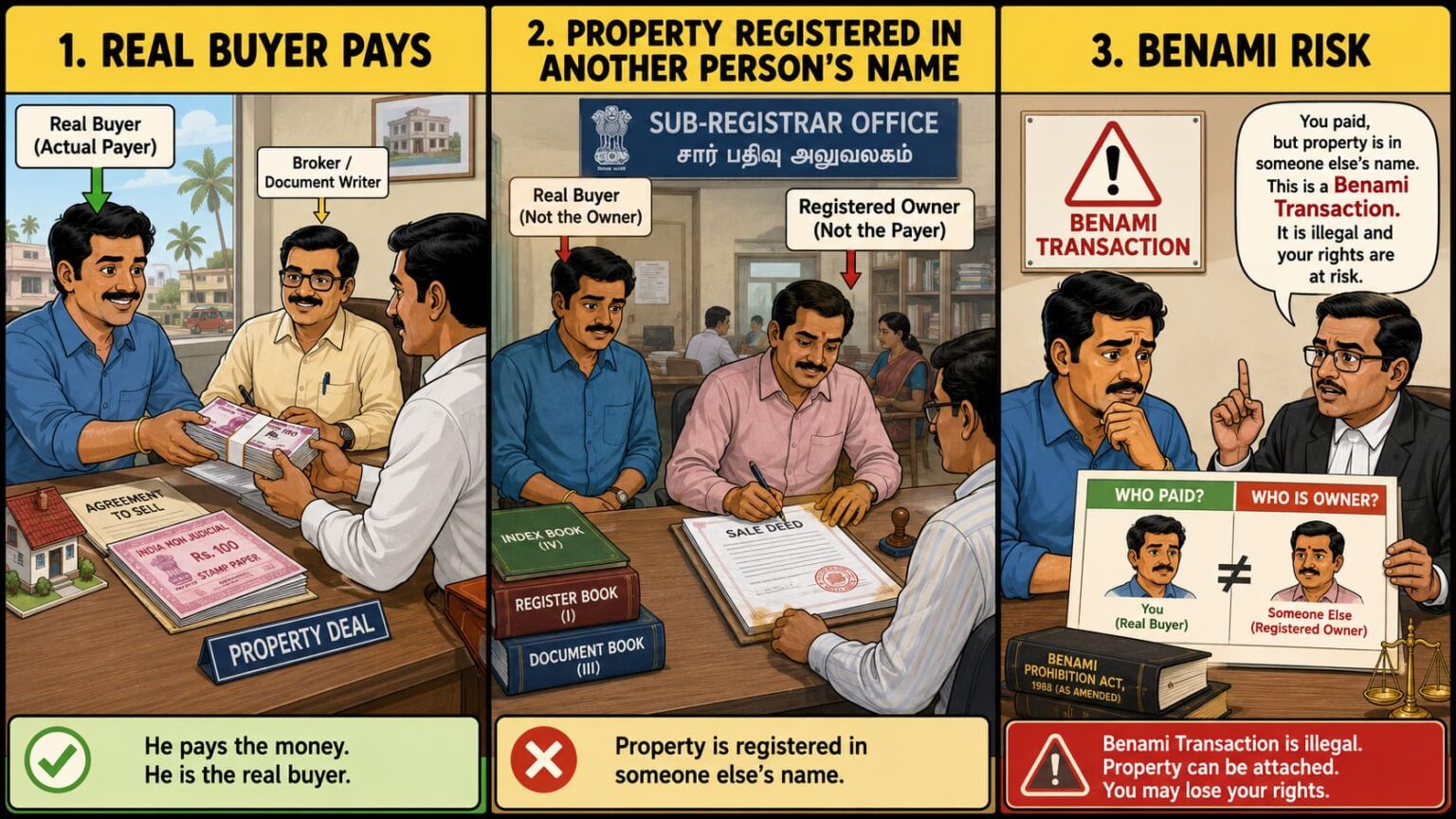
He claimed that the properties were bought using his money, but they were purchased in the name of K. Raghunath. He also said this was done because he or his company could not directly purchase agricultural lands due to restrictions under the Karnataka Land Reforms Act.
In simple words, Srinivas was saying:
“I paid the money, but the property was kept in Raghunath’s name.”
That is exactly where the Benami Act becomes important.
A benami transaction generally involves a property being held in the name of one person, while another person claims to have paid for it or to be the real beneficial owner. The law does not allow such hidden ownership claims to be freely enforced, especially when the arrangement was created to bypass legal restrictions.
Why the Court Did Not Treat This as a Normal Will Case
The Supreme Court said courts should not be fooled by clever drafting.
Even though Srinivas presented the case as a Will-based ownership claim, the real foundation of the suit was that the properties were allegedly purchased in Raghunath’s name for Srinivas’s benefit. The Court said that the substance of the claim matters more than the label used in the plaint.
This is the heart of the judgment.
A person cannot first say, “The property was bought with my money but kept in another person’s name,” and later try to recover that property by saying, “That person made a Will in my favour.”
If the original arrangement itself is benami, the Will cannot be used as a shortcut to defeat the Benami law.
What the Supreme Court Said About Clever Drafting
The Supreme Court also discussed the role of courts under Order VII Rule 11 of the Code of Civil Procedure. This provision allows a court to reject a plaint at the initial stage if the suit is barred by law.
The Court said that while deciding such an application, courts should not mechanically read the plaint line by line in a narrow way. They must meaningfully examine the plaint and identify the real nature of the claim. If a legal bar is hidden behind careful wording, the court can still reject the case.
In this case, the Court found that the Will was being used to give legal shape to what was essentially a benami claim.
Why the Will Did Not Help Srinivas
A Will can transfer only a valid and legally transferable interest. It cannot legalise an illegal or prohibited ownership structure.
The Supreme Court’s message was direct:
Property purchased in a benami transaction cannot be claimed by the alleged real owner merely on the basis of a Will executed by the benamidar.
Here, Raghunath was the person in whose name the property stood. Srinivas claimed that he had funded the purchase. The Will allegedly executed by Raghunath was therefore treated as a mechanism used to recover property that, according to Srinivas’s own case, had been kept in another person’s name.
The Court did not allow that.
Employer–Employee Relationship Did Not Save the Claim
Another important point was the relationship between Srinivas and Raghunath.
Srinivas tried to rely on the nature of their relationship to escape the Benami Act. But the Supreme Court made it clear that an ordinary employer–employee or commercial relationship does not automatically become a fiduciary relationship.
This matters because the Benami law contains certain exceptions for property held in a fiduciary capacity. But every business, employment, or trust-like arrangement cannot be casually called fiduciary. The Court rejected that attempt in this case.
The Murder Accused Angle of this Case
The case also had a serious criminal-law and succession-law layer.
Srinivas was stated to be an accused in connection with the murder of Raghunath, the very person through whom he claimed the property. The Supreme Court discussed the principle that a person who murders or abets the murder of another cannot inherit the victim’s property. This issue relates to Section 25 of the Hindu Succession Act.
However, that is not the main focus of this article. The key point here is the benami issue:
Even before the succession disqualification issue, Srinivas’s property claim faced a serious legal bar because it was rooted in an alleged benami arrangement.
What Happened in the Courts?
The trial court rejected Srinivas’s plaint under Order VII Rule 11 CPC, holding that the suit was barred by law.
The Karnataka High Court reversed the trial court’s decision and allowed the suit to continue.
The Supreme Court disagreed with the High Court. It restored the rejection of the plaint and held that the claim could not proceed because it was essentially an attempt to enforce a benami transaction.
The Supreme Court also directed the Central Government to appoint an Administrator and take over the suit properties within eight weeks for confiscation under the Benami law.
Why This Judgment Matters for Property Buyers
- A property bought in another person’s name is not always illegal, but it must fall within a lawful exception.
- Buyers should be careful if one person paid the money but another person is shown as the owner in the documents.
- Always verify whether the registered owner is the real and lawful owner of the property.
- A Will, agreement, or family explanation cannot automatically fix a benami transaction or defective title.
- Before buying, check the title history, payment trail, ownership records, and possible benami risk.
Verified.RealEstate Perspective
At Verified.RealEstate, property verification is not just about checking whether a Will, sale deed, patta, or encumbrance certificate exists. The real question is whether all documents together show a clean and lawful ownership history.
A property may look valid on paper, but hidden risks can arise from benami arrangements, suspicious funding, family disputes, competing Wills, pending litigation, revenue record mismatches, or claims by persons who say they funded the purchase.
Tools and services like LandLens by Verified.RealEstate, Verify My Land, Encumbrance Certificate checks, Patta verification, and legal due diligence can help buyers identify such risks before entering into a transaction.
Final Takeaway
The Manjula case is not only about succession law or murder-related disqualification. It is also a strong Supreme Court warning on benami property claims.
The core message is simple:
A Will can transfer valid property rights. It cannot legalise a benami transaction.
If a property claim is rooted in the idea that one person paid the money while another person held the title, courts will examine the real substance of the transaction. Clever drafting, emotional claims, or a later Will cannot be used to bypass the Benami law.