



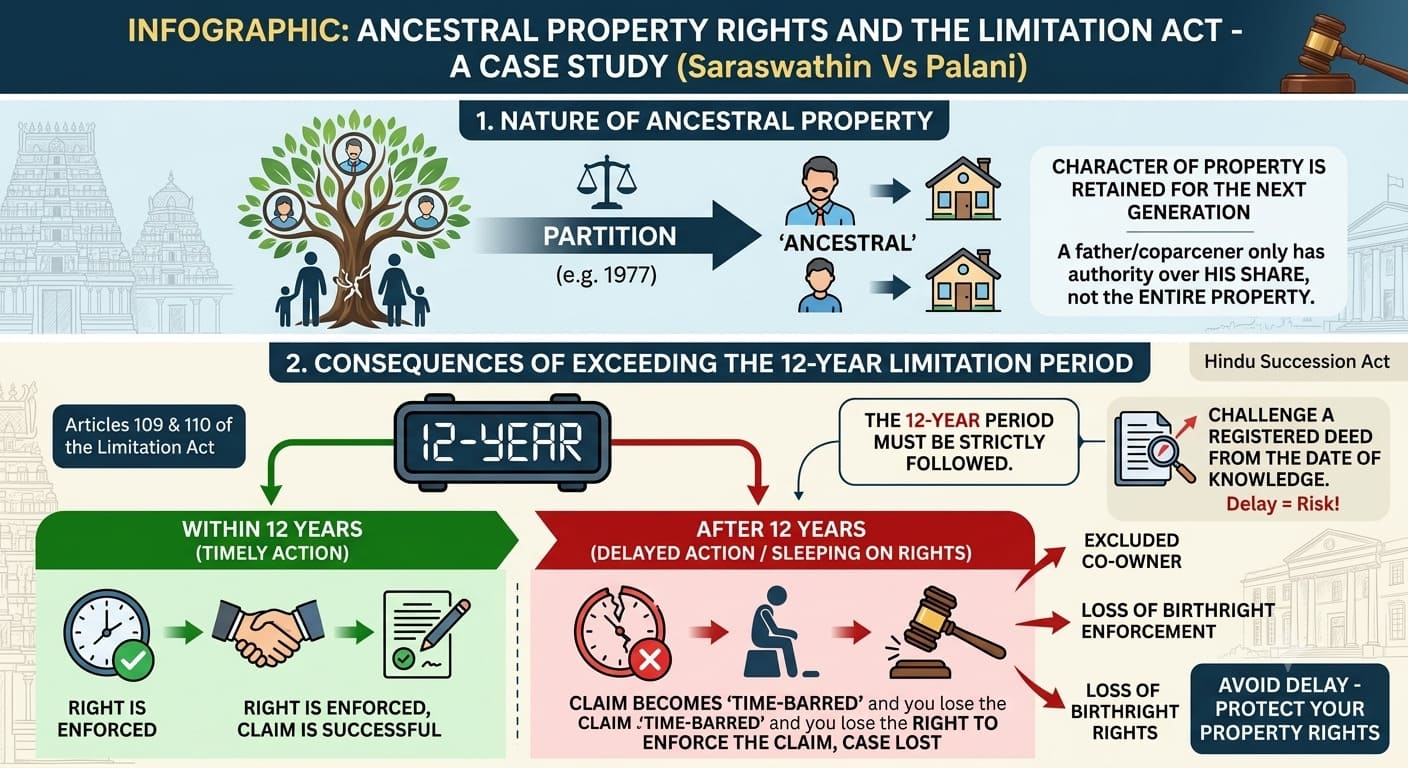
When it comes to family property disputes in India, the intersection of Hindu Succession Law and the Limitation Act often creates complex legal battles. A landmark judgment by the Madras High Court in the case of Saraswathi (Died) / Thirunavukarasu vs Palani (2026) addresses a critical question: Can a son challenge an ancestral property settlement deed made by his father in favor of his daughter after remaining silent for 16 years?
This comprehensive analysis breaks down the case details, the legal standing of ancestral properties, and how the Law of Limitation can completely alter the outcome of a partition suit.
The Core Legal Dispute
The crux of this case involves a classic conflict between a family member’s birthright to ancestral property and their obligation to assert that right within the legally mandated timeframe.
The primary questions before the Court were:
- Does an ancestral property lose its character after a family partition?
- Can a Hindu father execute a settlement deed gifting the entirety of joint family property to his daughter?
- Can a partition suit be maintained if it is filed well past the 12-year statutory limitation period?
Factual Background & Timeline of the Case
To understand how the Madras High Court arrived at its definitive ruling, we must look at the chronological order of events:
- March 5, 1977 (The First Partition): The properties originally belonged to the grandfather, Ponnusamy. Following his demise, a registered partition deed was executed among his heirs. Under this deed, the suit properties were explicitly allotted to his son, Kullan @ Sachidanandam (the father), as ancestral property.
- The Heirs: Kullan had two children: a son named Palani (the plaintiff) and a daughter named Saraswathi (the defendant).
- April 12, 2002 (The Settlement Deed): Asserting that his daughter was the one caring for him, Kullan executed a registered settlement deed transferring the entirety of these joint family properties to Saraswathi.
- 2003 (Active Knowledge of the Deed): Anticipating opposition from her brother, Saraswathi filed a lawsuit (O.S.No.161 of 2003) to assert her title. Though this particular suit was later dismissed for non-appearance, it legally established that the son, Palani, had active knowledge of the settlement deed as early as 2002–2003.
- August 8, 2007: The father, Kullan, passed away.
- April 10, 2018: Saraswathi executed multiple sale deeds, transferring and selling parts of the property to her children and third-party buyers.
- 2018 / 2019 (The Partition Suit): Objecting to the sale of the lands, Palani filed a partition suit (O.S.No.141 of 2019) demanding his 50% share and asking the court to declare his father’s 2002 settlement deed and his sister’s subsequent sales null and void.
The Lower Court vs. The Madras High Court Verdict
The Trial Court’s Verdict: Victory for the Son
The Additional District Judge of Dharmapuri initially ruled in favor of the son, Palani. The trial court noted that because the property was ancestral, the father lacked the sole authority to settle the whole property onto the daughter. It declared the settlement deed invalid and granted the son his half-share.
Saraswathi passed away during the litigation, prompting her legal heirs to appeal the decision to the Madras High Court.
The Madras High Court Ruling: The Law of Limitation Wins
Presided over by Justice P.B. Balaji, the Madras High Court set aside the trial court’s order. While the High Court agreed with the legal status of the property, it ultimately dismissed the son’s claim based entirely on the Law of Limitation.
Key Legal Principles Established by the High Court
1. Character of Ancestral Property
Citing landmark Supreme Court rulings such as Arshnoor Singh Vs Harpal Kaur and Shyam Narayan Prasad Vs Krishna Prasad, the High Court reiterated that when a coparcener obtains property through a partition, it retains its ancestral character concerning his own male/female issues. Therefore, the father did not have the right to gift the entire property away; he could legally settle only his specific undivided share.
2. The 12-Year Clock Under the Limitation Act
Despite the father’s error in settling the whole property, the High Court held that the law does not protect those who sleep on their rights.
- Under Articles 109 and 110 of the Limitation Act, any lawsuit challenging the alienation of joint family property or seeking a share by an excluded co-owner must be filed within 12 years.
- Because the settlement deed was a registered public document and the 2003 lawsuit proved Palani knew about it, the 12-year clock began ticking in 2002–2003.
- Palani’s argument that the limitation period should start from 2014 (when the revenue Patta names were updated) was outright rejected. The court held that a delay in revenue name changes does not stall the statutory period of limitation.
3. Long Silence Equals Loss of Rights
By waiting 16 years (from 2002 to 2018) to take formal legal action, the son became an “excluded co-owner.” His prolonged silence and inaction legally barred him from claiming his share, rendering his suit completely time-barred.
Key Takeaway for Property Owners
The judgment reinforces a vital lesson in Indian property litigation: Rights must be enforced dynamically. Even if a family property transaction or settlement deed is technically illegal under Hindu Law, waiting too long to dispute it can result in total loss of your property rights. If you intend to challenge a fraudulent or unauthorized property settlement, you must approach the court within the strict 12-year window provided by the Limitation Act.