

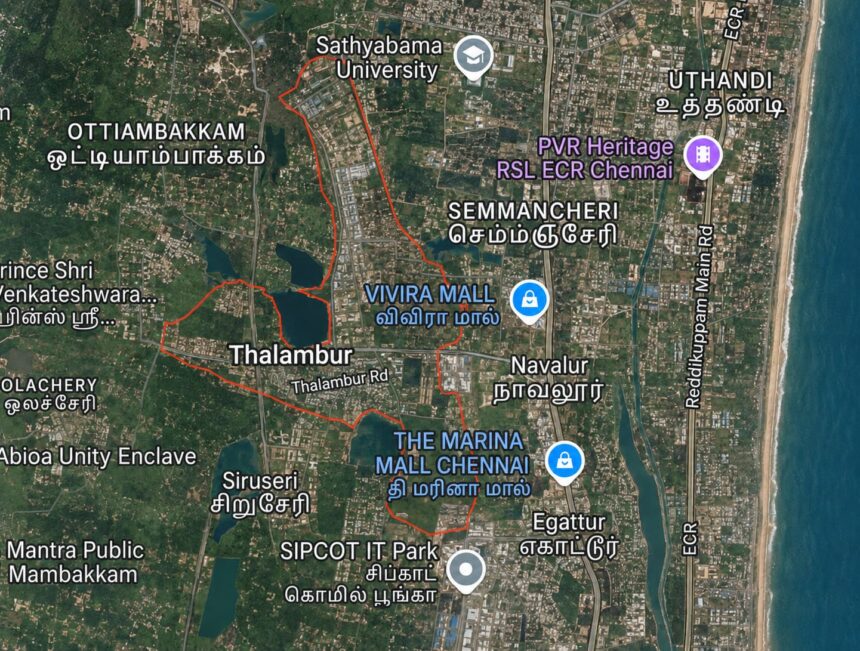
Thalambur, also written as Thazhambur, is a fast-growing residential area located close to Siruseri SIPCOT and Navalur on OMR. Located in a rapidly developing corridor, Thalambur has attracted strong interest from builders, developers and property buyers. However, beneath this growth lies a complicated land history that every buyer should understand before investing.
Thalambur has seen increasing attention due to:
- a long-standing land classification and title uncertainty issue
- its historical inam village status
- certain survey numbers being classified as anadheenam
- resulting disputes and cancellation of pattas
- verification challenges for buyers
This makes due diligence especially important before purchasing property in the area.
Was Thalambur an Inam Village?
Yes. The Madras High Court has recorded that Thalambur was historically an inam village. After the Government took over the estate, a ryotwari settlement was introduced and pattas were granted for eligible lands.
However, this does not mean that every property in Thalambur has a defective title. The risk depends on the particular survey number, original settlement records and history of the patta.
Inam Village: A village where land was historically granted by a ruler or government to individuals or institutions, often for service or religious purposes.What Caused the Land Controversy?
The major problem involved certain lands classified as anadheenam in the old revenue records. Authorities alleged that some of these lands were irregularly converted or assigned to private individuals through questionable pattas.
Previous reports revealed that:
- ⚠️ More than 100 acres were investigated by the Chengalpattu administration.
- ⚠️ Registration of several affected properties was frozen.
- ⚠️ Around 1,500 pattas were reportedly cancelled.
- ⚠️ Hundreds of families who had purchased houses were caught in the dispute.
The controversy involved several survey numbers and affected
- vacant plots,
- villas,
- apartments,
- educational institutions and
- an Army Welfare Housing Organisation project.
Anadheenam Land: Unoccupied or abandoned land where no individual holds a clear, legally recognized private title or has paid revenue taxes for a long time. Often arising after historical estate abolition or land reforms, these parcels are managed or held by the government until rightful ownership is legally claimed or assignedWhat Did the Supreme Court Decide?
The Secretary, Government of Tamil Nadu v. S. Raja, 2026 INSC 407,
The case pertained to disputed land allotments and subsequent real estate development in Thazhambur Village, Kancheepuram District, Tamil Nadu.
- The Origin: In 2018, S. Raja filed a Public Interest Litigation (PIL) in the Madras High Court alleging that large tracts of government land—originally assigned decades ago (including allotments to freedom fighters in 1966 and an individual allotment in 1988)—were illegally transferred, encroached upon, and sold in excess to private builders like Casagrand Builder Pvt. Ltd.
- The Escalation: Over several decades, third-party transactions multiplied, and thousands of innocent buyers purchased apartments and built homes on these lands.
- The Interim Order: In October 2019, the Supreme Court imposed an order of status quo on the subject land. This stalled development, title transfers, and even basic municipal infrastructure (water and sewerage connections) for over 450 flat buyers and residents.
The Supreme Court vacated the status-quo order that had remained in force since 2019. The Court decided that the State Government cannot suddenly step in decades later to take away land or property from innocent people who spent their hard-earned money buying homes in good faith.
For years, a court freeze (status quo) prevented around 450 flat owners from getting basic civic amenities. The Court lifted this freeze and ordered the Tamil Nadu government to immediately provide essential services like water and sewerage connections.
The Court criticised the Government for delaying its final decision and said that the interests of innocent homebuyers could not be ignored.
✡However, the Court did not declare every disputed property legally clear. The Government-appointed committee was allowed to examine the irregularities and recommend further action.
Is Buying Property in Thalambur Risky?
Thalambur should not be rejected completely. Many properties may have valid titles. But buyers must treat it as an area where survey-number-level verification is essential.
Before purchasing, verify:
- ✅ Original settlement and ryotwari patta records
- ✅ A-Register, Chitta, Adangal and FMB sketch
- ✅ Old and new survey-number correlation
- ✅ Government order or proceeding through which the patta originated
- ✅ Whether the patta was cancelled, restored or placed under restriction
- ✅ Whether the survey number forms part of any court case or government inquiry
- ✅ Complete parent-document and Encumbrance Certificate history
A current patta, registered sale deed, planning approval or bank loan does not automatically prove that the original title is valid.
The Bottom Line
Thalambur’s proximity to Siruseri gives it good real estate potential. But its historical inam status and the anadheenam land controversy make detailed due diligence necessary. Buyers should verify the origin of the title—not merely the seller’s latest documents—before paying an advance.
The Verified.RealEstate due-diligence team can examine revenue records, title documents, survey details and physical land conditions before a buyer proceeds with the purchase.