

Bengaluru’s Bullet Train Plans Take Shape
The bullet train plans connecting Bengaluru with Chennai and Bengaluru with Hyderabad have moved one step forward. The alignment plans for both high-speed rail corridors have now been released by Indian Railways.
These corridors were announced in the Union Budget around three months ago. With the alignment plans now available, more details have emerged about the proposed routes, stations, tunnel sections, land requirements, surveys and expected travel time.
If completed, these projects could bring a major change in travel between Bengaluru, Chennai and Hyderabad.
Bengaluru–Chennai Bullet Train Route
The proposed Bengaluru–Chennai bullet train corridor will be around 306 km long.
The route is expected to start from Baiyappanahalli in Bengaluru and pass through:
Whitefield, Kodihalli near Hoskote, Kolar, Chittoor, Parandur and Poonamallee, before ending at Chennai Central.
This corridor is important because it will connect two major South Indian cities that already have strong business, technology, industrial and travel links.
Parandur Included in the Chennai Route
One of the important updates in the Bengaluru–Chennai alignment is the inclusion of Parandur.
Parandur is significant because Tamil Nadu’s second airport for Chennai has been planned in this region. It was not part of the initial alignment, but it has now been included in the proposed route.
This means the high-speed rail corridor may also improve future connectivity to Chennai’s proposed second airport zone.
Land Requirement for Bengaluru–Chennai Corridor
Within Karnataka, the Bengaluru–Chennai bullet train corridor is expected to run for about 100.7 km.
For this Karnataka section, around 1,358.96 hectares of land may be required.
The project will therefore involve detailed land identification, acquisition planning, engineering studies and coordination with local authorities.
Bengaluru May Get a 15.94-km Tunnel Section
A major feature of the Bengaluru–Chennai corridor is the proposed 15.94-km tunnel section inside Bengaluru.
This underground section is likely planned because Bengaluru is a dense urban city where creating a surface-level high-speed rail line may be difficult.
Outside the main city area, the corridor is expected to use a mix of elevated tracks and at-grade tracks in other parts of Karnataka.
Bengaluru–Hyderabad Bullet Train Route
The proposed Bengaluru–Hyderabad bullet train corridor will be around 607.03 km long.
In Karnataka, the proposed stations are expected at:
Kodihalli, Devanahalli near Kempegowda International Airport, and Alipur in Chikkaballapur district.
After Karnataka, the route is expected to pass through:
Hindupur, Duddebanda near Penukonda, Anantapur, Gooty, Dhone, Kurnool, Mannanur in Nagarkurnool, Bharat City near Hyderabad, and Hyderabad airport at Shamshabad, before ending at Hyderabad.
This corridor could become a major fast-travel link between Bengaluru and Hyderabad.
Land Requirement for Bengaluru–Hyderabad Corridor
Within Karnataka, the Bengaluru–Hyderabad corridor is expected to run for about 101.03 km.
For this section, around 237.5 hectares of land may be required.
Like the Chennai corridor, this project will also need surveys, land identification, approvals and detailed technical planning before construction can begin.
Bengaluru–Mysuru Bullet Train Alignment Also Shared
Although the Bengaluru–Mysuru high-speed rail route was not included in the Union Budget announcement, an approximate alignment has also been shared.
The proposed Bengaluru–Mysuru route may be around 157.34 km long.
Possible station points include:
Mandya, Ramanagara, Kengeri and Electronics City near Huskur.
Ramanagara was reportedly not part of the initial alignment but has now been included in the approximate plan.
As per the current proposal, the Bengaluru–Mysuru line may join the Bengaluru–Chennai line at Kodihalli.
Request to Extend High-Speed Corridor to Mysuru
Mysuru-Kodagu MP Yaduveer Krishnadatta Chamaraja Wadiyar has said that he has requested the Railway Minister to extend the high-speed rail corridor to Mysuru.
He also mentioned that earlier studies, including one by a German firm, had supported Mysuru’s inclusion in the high-speed rail network.
If Mysuru is added to the network in the future, the high-speed rail system could further improve connectivity between Bengaluru, Mysuru and other important towns along the route.
Expected Travel Time
One of the biggest advantages of bullet train connectivity is reduced travel time.
It is expected that the proposed Bengaluru–Chennai high-speed rail corridor could reduce travel time to around 1 hour and 13 minutes.
The proposed Bengaluru–Hyderabad journey could take around 2 hours.
If achieved, this would be a major change compared to present travel times by road, regular train or air.
Bharat-Made Bullet Trainsets
The proposed corridors are expected to use B-28 trainsets, described as Bharat-made bullet trainsets.
These trainsets are being manufactured by BEML, the Bengaluru-based public sector company, at a specialised complex.
This is important because it shows India’s attempt to build domestic capacity for high-speed rail technology and train manufacturing.
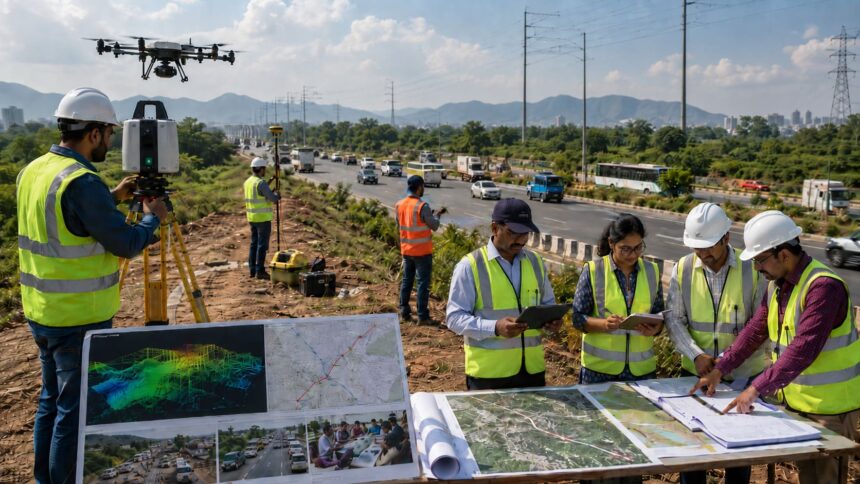
Surveys and Studies Underway
Officials from the National High Speed Rail Corporation Limited have said that surveys are currently underway for the proposed high-speed rail lines.
In Kolar district, it is said that several important studies have already been completed, including:
LiDAR surveys, topographic data collection, traffic studies, social impact assessments and environmental impact assessments.
He also said that the required properties have been identified, Kolar will get one station, and groundwork may begin around 2027–28.
Important Reality Check
Although the alignment plans are promising, bullet train projects usually take many years to complete.
They require land acquisition, funding, environmental approvals, safety studies, technical design, station planning, construction, testing and final clearances.
India’s first bullet train project, the Mumbai–Ahmedabad high-speed rail corridor, was approved in May 2014 and is expected to fully open only by December 2029.
So, while the Bengaluru–Chennai and Bengaluru–Hyderabad bullet train plans are important, they should be seen as long-term infrastructure projects.
Final Takeaway
The release of alignment plans for the Bengaluru–Chennai and Bengaluru–Hyderabad bullet train corridors is a major step in South India’s high-speed rail plans.
The Bengaluru–Chennai corridor is expected to pass through Baiyappanahalli, Whitefield, Kodihalli, Kolar, Chittoor, Parandur, Poonamallee and Chennai Central.
The Bengaluru–Hyderabad corridor is expected to pass through Kodihalli, Devanahalli, Alipur, Hindupur, Anantapur, Gooty, Dhone, Kurnool, Shamshabad and Hyderabad.
A possible Bengaluru–Mysuru corridor has also been discussed, with station points such as Mandya, Ramanagara, Kengeri and Electronics City near Huskur.
If implemented successfully, these corridors could reduce travel time sharply and improve long-distance connectivity across South India. However, the projects are still in the planning and survey stages, and actual completion will depend on land acquisition, approvals, funding and construction progress.
Abbreviations Used
NHSRCL: National High Speed Rail Corporation Limited; the agency responsible for implementing high-speed rail projects in India.
BEML: Bharat Earth Movers Limited; a Bengaluru-based public sector company involved in manufacturing rail and defence equipment.
LiDAR: Light Detection and Ranging; a surveying technology used to collect accurate land and surface data.
KIA: Kempegowda International Airport; Bengaluru’s international airport located near Devanahalli.