

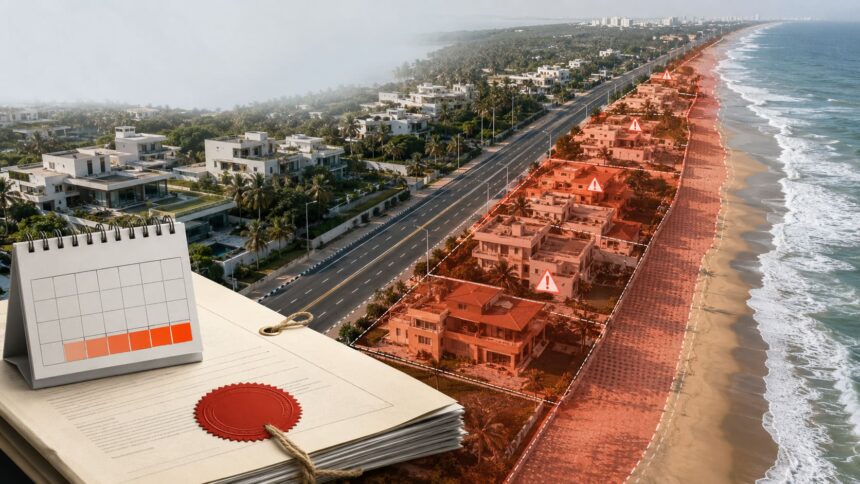
Property owners in Neelankarai, Injambakkam and Uthandi face sealing and possible demolition as Chennai intensifies action against coastal violations.
The Greater Chennai Corporation has directed occupants of 21 sea-facing bungalows, houses and other buildings along Chennai’s East Coast Road to vacate within 15 days over alleged Coastal Regulation Zone violations.
The affected buildings are located in Neelankarai, Injambakkam and Uthandi, falling within GCC wards 192, 194 and 197. Once the deadline ends, the Corporation reportedly plans to lock and seal the buildings. Demolition could follow.
Why Is GCC Taking Action Now?
The cases are not new. Some had reportedly remained pending for nearly 10–15 years.
The immediate development is that the Tamil Nadu Housing and Urban Development Department has rejected appeals or revisions filed by some owners. Once an appeal is rejected and there is no court order stopping enforcement, GCC can proceed according to law.
GCC has also reportedly instructed owners of another three houses to correct excess FSI and other building deviations.
Madras High Court Ordered Action in July 2026
A major Madras High Ciurt order Dated July 6, 2026, provides the legal background to the latest action.
The government informed the court that approximately 798 buildings had been identified in the ECR belt for construction without approval, deviations from sanctioned plans or CRZ violations.
Of the 482 revision petitions examined:
- 42 had been disposed of.
- 440 were still pending at that time.
- At least 300 buildings were reportedly constructed without permission.
- These 300 owners had not filed an appeal or revision.
The court directed the authorities to proceed against owners whose appeals had reached a final decision and those who had not appealed at all.
The present 21 eviction notices appear to be part of this wider enforcement process.
Why Are Neelankarai and Injambakkam Highly Restricted?
LandLens analysis published earlier by Verified.RealEstate examined thousands of ECR land parcels affected by CRZ and Aquifer Recharge Area restrictions.
According to the analysis:
| Area | Total area studied | Restricted area | Percentage affected |
|---|---|---|---|
| Injambakkam | 356 hectares | 350 hectares | 98.4% |
| Neelankarai | 221 hectares | 217 hectares | 98.3% |
“Restricted” does not mean that every property is completely unbuildable. It means the land is affected by at least one restriction that can limit the building’s location, FSI, coverage, height or permitted use.
Uthandi is also included in Chennai’s notified Aquifer Recharge Area, while its coastal portions can additionally fall within CRZ.
CRZ and Aquifer Restrictions Are Different
A coastal ECR property can be affected by two separate sets of rules.
CRZ rules decide whether construction is permitted based on the property’s coastal classification, High Tide Line, approved Coastal Zone Management Plan and position in relation to the legally relevant road or authorised structure.
Aquifer Recharge Area rules control how much can be constructed to protect Chennai’s underground freshwater resources.
For many ordinary plots in the ECR Aquifer Recharge Area, the local development controls include:
- Maximum FSI of 0.8
- Maximum plot coverage of 40%
- Maximum height of 9 metres
- No premium FSI
- No high-rise construction
The 0.8 FSI is therefore not a universal CRZ-II rule. It comes from the local planning controls applicable to many Aquifer Recharge Area plots.
A property falling under both CRZ and Aquifer restrictions must satisfy both.
What Is the CRZ-II Landward-Side Rule?
For cases governed by the 1991 CRZ framework, construction in CRZ-II was generally permitted only on the landward side of an existing road, an approved road shown in the Coastal Zone Management Plan or an existing authorised structure.
In simple words, a building situated between the sea and the legally recognised road or authorised structure may face serious approval problems.
The exact rule applicable to a property depends on its location, approval date, construction date, CRZ classification and approved coastal map.
Do Property Tax and EB Connections Prove CRZ Approval?
No.
A property may have:
- A registered sale deed
- Patta
- Property-tax assessment
- Electricity connection
- Water connection
- An approved layout
But these documents do not automatically prove that the building complies with CRZ and planning laws.
A property-tax receipt only shows that tax is being collected. An EB connection only provides electricity. Neither document legalises an unauthorised building.
Even an old layout approval does not automatically permit the owner to construct any type of building. The actual structure must match the sanctioned building plan and comply with the coastal restrictions applicable to the property.
Are All Old ECR Buildings Illegal?
No.
The Madras High Court has recognised that some owners claim their buildings existed before the CRZ rules came into force on February 19, 1991 and were constructed with local-body permission. The court said such cases should be examined separately.
However, the owner must prove the building’s age and approval using reliable records. Merely claiming that the house is old will not be enough.
22 Muttukadu Buildings Faced Similar CRZ Action in 2025
This is not the first recent CRZ enforcement action along ECR. In June 2025, the Chengalpattu district administration identified 22 sea-facing buildings in Muttukadu as alleged CRZ-III violations. GPS-tagged inspections were conducted and the findings were placed before the National Green Tribunal. Those buildings faced possible demolition, but available reports did not confirm that their occupants were evacuated. The present action is more immediate because GCC has expressly directed occupants of 21 buildings in Neelankarai, Injambakkam and Uthandi to vacate within 15 days.
What Should ECR Buyers Check?
Before buying coastal property along ECR, verify the survey details, CRZ classification, approved plans, construction history, required clearances, and pending notices or cases.
An old building, sale deed, tax receipt or electricity connection does not legalize CRZ or planning violations. Due diligence must confirm ownership, approvals, location, construction date and compliance.
Verified.RealEstate has your back if you own land in these areas. Its detailed checks can help determine whether your property falls within a legally permissible zone, identify CRZ, Aquifer Recharge Area or building-approval issues, and guide you on possible corrective steps where the rules allow them.
For buyers and developers, LandLens One offers a one-click check of CRZ, Aquifer Recharge Area, zoning and other major land restrictions. It acts as an early safety net, helping identify potential risks before proceeding with a purchase or development.
Disclaimer: This article is for general awareness and is based on available news reports, court records and government regulations. Not every property in the mentioned areas is illegal or facing action. The legal status of a coastal property must be verified using its survey number, approved plans, construction history and applicable Coastal Zone Management Plan.