

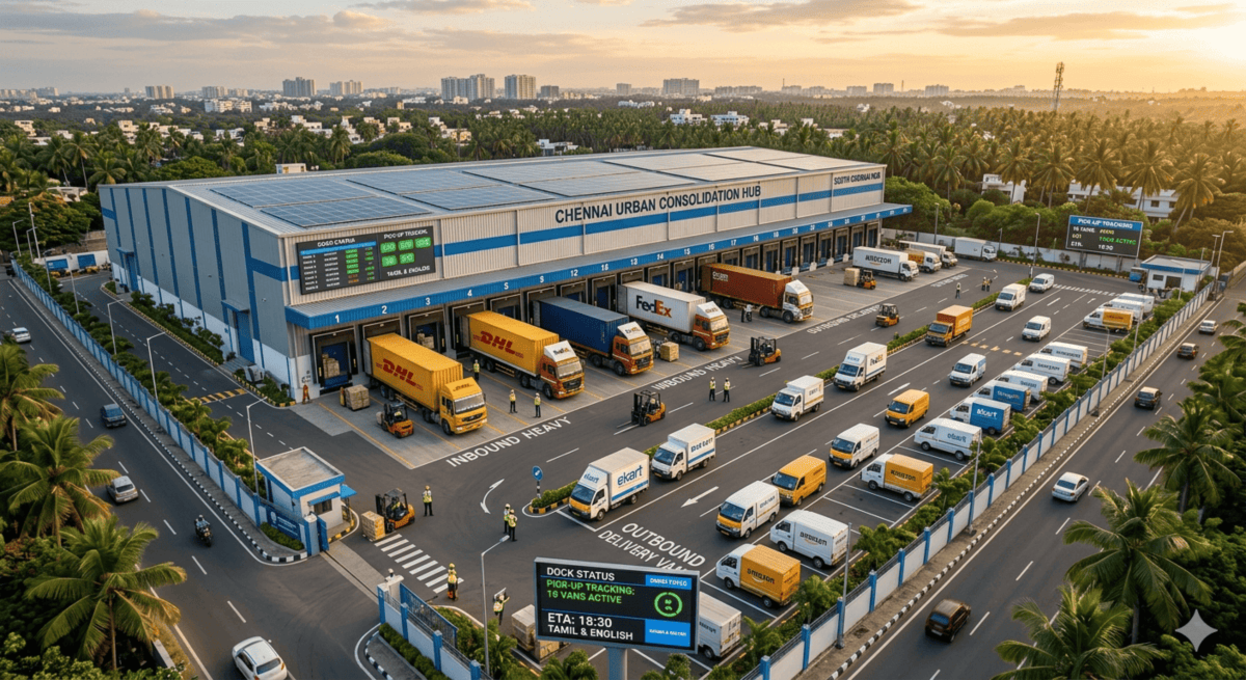
📦 Tamil Nadu’s New Logistics Strategy for South Chennai
The Tamil Nadu government is planning to establish Urban Logistics Consolidation Centres (ULCCs) in South Chennai, particularly along the Siruseri–Kelambakkam corridor, to address growing logistics pressure in the region.
These hubs are designed to streamline mid-mile and last-mile delivery operations, especially in fast-growing residential and IT zones along the OMR–ECR belt.
📍 Where Will These Logistics Hubs Come Up?
The proposed hubs will be located in South Chennai clusters, with each facility expected to serve a radius of around 10 km.
Key focus areas:
- Siruseri
- Kelambakkam
- Surrounding OMR–ECR belt
This region has seen rapid expansion in:
- IT parks and employment hubs
- Residential developments
- Consumption-driven urban growth
🚚 Capacity and Operational Model
Each Urban Logistics Consolidation Centre is expected to handle:
- 1,000–1,500 tonnes of cargo
- 80–100 heavy vehicles (inbound logistics)
- 300–400 light commercial vehicles (last-mile delivery)
This reflects a shift toward high-frequency, urban distribution systems, rather than traditional large-scale warehousing.
⚠️ Why This Move Was Necessary
Currently, logistics infrastructure in Chennai is concentrated in:
- North Chennai
- Central zones
- South-West corridors like Guindy and Tambaram
The Problem:
- Delivery vehicles travel up to 60 km daily to serve South Chennai
- Around 100–120 vehicles operate daily for these routes
This leads to:
- Increased fuel costs
- Traffic congestion
- Delivery delays
📉 Expected Benefits of the New Hubs
The planned ULCCs aim to deliver measurable improvements:
- 🚗 Reduction of ~4,000 vehicle-km per day
- 🌱 Lower emissions by 3–3.5 tonnes daily
- ⏱️ Reduced delivery distance by 15–20 km per trip
- 📦 Faster and more efficient last-mile delivery
These hubs are positioned as both an efficiency upgrade and an environmental intervention.
🔄 Shift in Urban Logistics Model
This initiative reflects a broader transition in how cities handle logistics:
Traditional Model:
- Centralized large warehouses
- Long-distance distribution
Emerging Model:
- Decentralized urban hubs
- Cluster-based delivery systems
- Faster last-mile connectivity
This aligns with the increasing demand from:
- E-commerce platforms
- Quick-commerce delivery systems
- Urban consumption clusters
🏢 Real Estate Impact: What This Means
While the primary focus is logistics efficiency, the move has clear real estate implications, especially in South Chennai.
1. Demand for Small Logistics Spaces
There is likely to be increased demand for:
- Smaller land parcels suitable for logistics use
- Mid-scale storage and distribution facilities
- Last-mile delivery hubs
2. Shift in Land Use Patterns
Areas near the proposed hubs may see:
- Gradual transition from peripheral residential use to mixed-use logistics-commercial activity
- Higher demand for land with road connectivity
3. Rental and Commercial Activity Potential
Properties suited for:
- Warehousing
- Fleet parking
- Delivery operations
may see increased leasing demand, especially from logistics operators.
4. Strategic Importance of OMR Belt
The Siruseri–Kelambakkam region continues to strengthen as:
- A residential hub
- An employment corridor
- A growing consumption zone
The addition of logistics infrastructure enhances its overall urban ecosystem value.
🌱 Environmental and Urban Planning Significance
The reduction in vehicle movement and emissions highlights the government’s focus on:
- Sustainable urban logistics
- Reduced congestion
- Improved traffic flow in key corridors
This could also support future initiatives such as:
- Electric delivery fleets
- Green logistics infrastructure
🧩 Conclusion
Tamil Nadu’s plan to develop Urban Logistics Consolidation Centres in South Chennai marks a strategic shift toward efficient, decentralized urban logistics.
By bringing logistics infrastructure closer to demand centers, the government aims to:
- Reduce travel distances
- Improve delivery timelines
- Lower environmental impact
At the same time, this development strengthens the real estate potential of South Chennai, particularly along the OMR corridor, by increasing demand for logistics-compatible spaces.
For buyers, investors, and landowners evaluating opportunities in these emerging zones, factors such as clear land titles, zoning compliance, and infrastructure alignment will play a critical role in decision-making. Access to structured property insights, due diligence support, and transaction coordination can help navigate these evolving micro-markets more efficiently.