

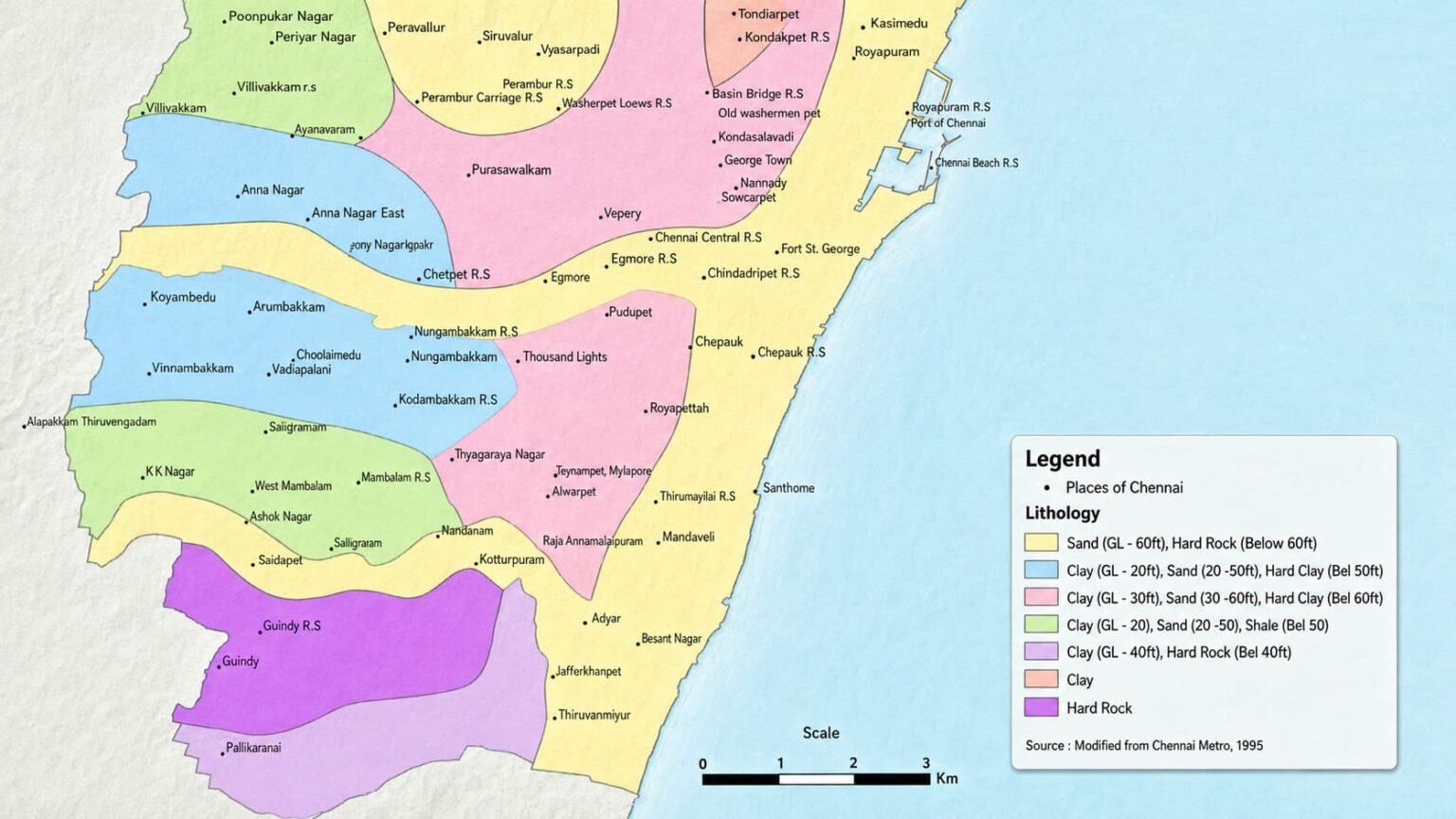
When buying land or building a home in the Chennai Metropolitan Area, inspecting the soil is one of the most critical steps. Soil properties dictate the kind of foundation your building needs, how much excavation will cost, and how safe the building will be over time.
The Soil Type Detector tool by Verified.RealEstate helps property buyers, builders, and developers instantly check soil characteristics for any location across Chennai.
What is the Soil Type Detector?
The Soil Type Detector is an interactive digital map tool that allows you to click on any location in Chennai to analyze its ground conditions. It provides instant insights on:
- Soil classification & technical properties
- Bearing capacity (how much weight the soil can hold)
- Recommended foundation types
- Excavation difficulty & drainage quality
- Construction guidelines tailored to your building plan
Major Soil Types in Chennai
The geology of Chennai varies significantly depending on the area. Here is a breakdown of the six main soil types found across the region:
| Soil Type | Bearing Capacity (tons/sq.m) | Recommended Foundation | Typical Depth | Cost Factor |
|---|---|---|---|---|
| Hard Rock | 30–100+ | Shallow / Strip | 0.5–1.5m | High (due to tough excavation) |
| Shale | 2–10 | Deep / Pile | 3–10m | Moderate |
| Clay | 1–4 | Pile / Raft | 6–15m | High (expensive foundation work) |
| Sand | 1.5–5 | Deep / Pile | 6–12m | Moderate |
| Clay & Shale | 1.5–7 | Deep / Combined | 4–12m | Moderate to High |
| Laterite & Sandstone | 5–20 | Shallow–Medium | 1.5–3m | Low to Moderate |
Construction Guidelines by Soil Type
1. Hard Rock Areas
- Pros: Excellent support for high-rise buildings and heavy structures with minimal risk of ground sinking (settlement).
- Challenges: Difficult and costly to dig. May require specialized rock breaking or blasting.
- Tips: Great for basements (with proper waterproofing) and uses rock anchors on slopes.
2. Clay Soil Areas
- Pros: Common across several Chennai sub-markets.
- Challenges: Clay expands when wet and shrinks when dry (shrink-swell behavior), which can crack poorly designed foundations.
- Tips: Deep pile foundations are mandatory for buildings above G+1. Moisture barriers, flexible utility pipes, and perimeter drains are required.
3. Sandy Soil Areas
- Pros: Offers good water drainage.
- Challenges: High risk of soil movement under weight, as well as erosion during monsoons and risk of liquefaction near water bodies during earthquakes.
- Tips: Multi-story buildings require deep foundations. Soil erosion protection is necessary during rainy seasons.
4. Shale Areas
- Pros: Stable when kept covered and dry.
- Challenges: Weathers quickly when exposed to air and water, leading to pressure on basement walls.
- Tips: Immediate protection of exposed surfaces during digging. Chemical soil stabilization or slope cuts may be required.
Recommended Foundations by Building Type
Different structures place different levels of weight on the ground. Here is how soil type determines your foundation choice:
| Building Type | Hard Rock | Clay | Sand | Shale |
|---|---|---|---|---|
| Individual House (G+1) | Strip footing | Under-reamed piles | Isolated footing with tie beams | Raft foundation |
| Apartment (G+4) | Isolated footing | Pile foundation | Pile foundation | Pile with grade beams |
| High-Rise (G+10+) | Mat / Raft foundation | Deep piles with pile cap | Deep piles with raft | Caisson foundation |
| Industrial Building | Combined footing | Pile with tie beams | Vibro-compaction + raft | Deep foundation |
Foundation Cost Breakdown
Foundation expenses usually take up a noticeable portion of your total construction budget depending on the soil underneath:
- Hard Rock: 5% – 8% (High excavation cost, but low foundation cost)
- Laterite / Sandstone: 8% – 12% (Balanced digging and building costs)
- Sand: 12% – 18% (Requires deeper foundations and water removal)
- Shale: 15% – 20% (Requires deep foundations and wall protection)
- Clay: 18% – 25% (Highest cost due to expensive piling and ground treatments)
Best Seasons for Construction Work in Chennai
- Summer (March – May): Clay soil dries out fully, making this the best time for excavation in clay and shale areas.
- Southwest Monsoon (June – September): Moderate rains; dewatering systems might be needed in sandy regions.
- Northeast Monsoon (October – December): Heavy rainfall period; avoid foundation digging in clay zones and keep dewatering equipment ready.
- Winter (January – February): Ideal conditions for all types of building work due to dry, stable weather.
Site Investigation Recommendations
While online tools give a great overview, performing physical soil testing on-site before building is mandatory for structural safety and government permits:
- Borehole Testing: Test soil samples every 3 meters down to hard rock or 1.5 times the width of the proposed building.
- Standard Penetration Test (SPT): Used to measure strength in sandy/silty soils.
- Unconfined Compression Test: Measures the strength of clay soils.
- Plate Load Test: Checks rock strength for shallow foundations.
- Groundwater & Chemical Monitoring: Tests water table depth and screens for chemicals that could corrode underground concrete.
How the Tool Helps Property Owners
Using the Soil Type Detector on Verified.RealEstate gives you an instant advantage:
- Identify soil conditions on any map plot before handing over an advance payment for land.
- Plan foundation budgets early to avoid costly surprises later.
- Reduce structural risks by knowing what foundation design your architect should use.
Expert Construction Services by Verified.RealEstate: Building Long-Lasting Properties
Understanding your soil type is step one; executing the right construction plan is step two. Verified.RealEstate offers an end-to-end, hassle-free construction service in Chennai designed to build strong, durable properties that stand the test of time.
Key Features of Their Construction Service:
- 10-Year Structural Warranty: Full protection covering structural integrity and workmanship to ensure long-term stability with no unexpected repair costs.
- 15+ Years of Industry Expertise: Seasoned engineers, skilled laborers, and top-tier construction materials suited to your budget and specific soil requirements.
- On-Time Delivery Guarantee: Clear project timelines with a financial commitment: if delays occur from their end, they pay 0.5% of the construction value per month as rent.
- Live CCTV Site Progress Tracking: Monitor your building site in real-time from anywhere via live video feeds on their website and weekly WhatsApp budget/progress reports.
- Full Process Management: Complete handling of building plan approvals, authority permissions, architectural designs, and regular quality inspection checks.
Note & Disclaimer: The online detector uses geological survey data to give broad guidance. Because ground conditions can shift within a few meters, always hire a licensed geotechnical engineer to perform physical soil testing on your site before finalizing architectural plans.