



1. Introduction
When verifying land ownership in urban Tamil Nadu—especially in areas under town panchayats, municipalities, and corporations—Patta and Chitta are not enough. Instead, the relevant document is the Town Survey Land Register (TSLR).
Often overlooked, the TSLR is the urban counterpart of the Patta. It helps confirm ownership, classification, and land boundaries in town limits. If you’re buying land in places like Tambaram, Madipakkam, or Coimbatore city, understanding the TSLR is essential.
This article explains what the TSLR is, what information it contains, how to verify it online, and why it matters.
2. What is TSLR?

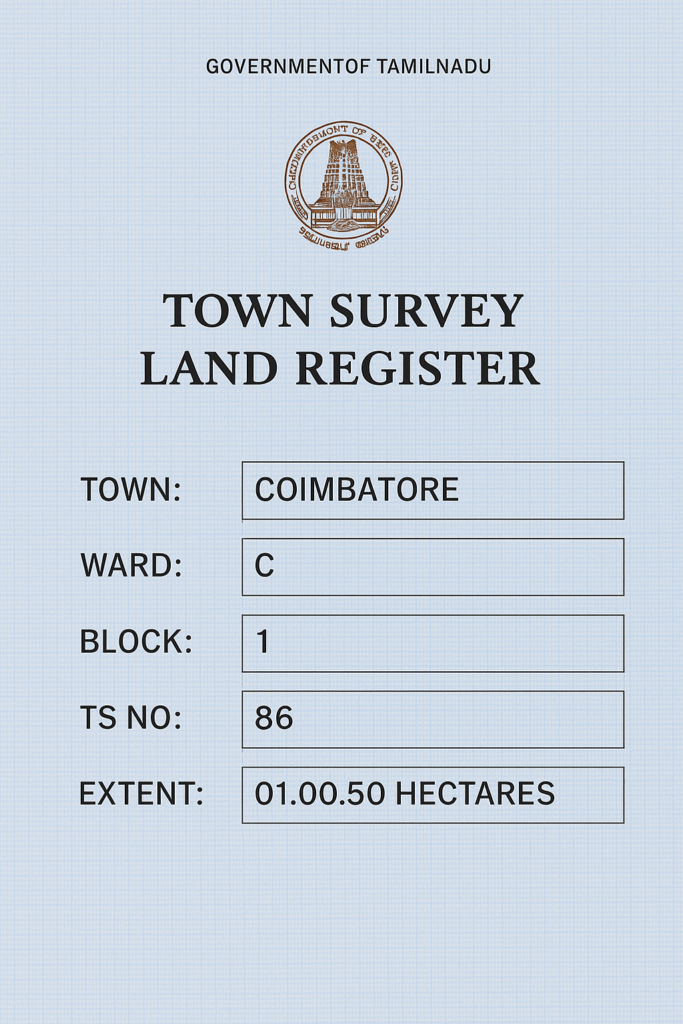
The Town Survey Land Register (TSLR) is an official urban land record maintained by the Tamil Nadu Revenue Department and Survey Department.
It replaces or supplements the Patta in municipal and urbanised areas by providing:
- Ownership details
- Property boundaries
- Building type (residential/commercial)
- Survey information
- Legal classification of land
The TSLR is based on the Town Survey conducted in the 1980s–90s, and remains an authoritative reference for ownership, sub-division, and mutation tracking.
3. Where is TSLR Applicable?
TSLR applies to:
- Municipal Corporations (like Chennai, Coimbatore, Madurai)
- Municipalities and Town Panchayats
- Urban areas formerly under rural administration but later merged into city limits
If your property falls under “Town Survey Land,” then TSLR is the valid record—not rural Patta.
4. What Information Does a TSLR Contain?
The TSLR Extract typically includes:
| Field | Description |
|---|---|
| Town Survey Number | Unique number assigned to the plot |
| Block and Ward | Urban sub-division details |
| Extent and Boundaries | Plot size and adjacent properties |
| Name of Owner | As per last registered document and mutation entry |
| Land Use Classification | Residential, commercial, industrial, OSR, etc. |
| Encumbrance Info | Notes on claims, roads, public land overlaps (if any) |
| Type of Structure | Whether vacant land or built-up area |
The TSLR helps validate:
- Whether the plot is legally sub-divided
- Whether it overlaps roads, OSR, or government land
- Whether the structure built aligns with recorded classification
5. Importance of TSLR in Property Verification
| Purpose | How TSLR Helps |
|---|---|
| Urban Plot Purchase | Confirms legitimate ownership and extent |
| Apartment or Flat Sale | Verifies land share (UDS) and base survey information |
| CMDA or DTCP Approval | Supports building permission applications |
| Loan or Mortgage Processing | Required by many banks along with EC and Sale Deed |
| Dispute Resolution | Authoritative in urban land title clarification |
6. How to Access TSLR Extract Online
Step 1: Visit TN e-Services Portal
Go to https://eservices.tn.gov.in
Step 2: Click on “View Patta/Chitta/TSLR Extract”
Step 3: Select “Urban” under area type
Step 4: Choose:
- District
- Taluk
- Town
- Ward
- Block
- Town Survey Number
- Sub-division number (if any)
Step 5: Enter Captcha and Verify with OTP


Once validated, you’ll receive a digitally signed TSLR Extract with all the above fields.
7. Difference Between Patta and TSLR
| Feature | Patta (Rural) | TSLR (Urban) |
|---|---|---|
| Area of Applicability | Villages, rural taluks | Towns, municipalities, corporations |
| Survey Type | Field Survey | Town Survey with cadastral overlays |
| Issued By | Tahsildar (Revenue Department) | Jointly by Revenue & Survey Depts |
| Use Case | Agriculture, rural resale | Apartment UDS, urban resale |
| Land Division Style | Survey + Sub-Division Number | Town Survey Number + Ward/Block |
8. Can TSLR Have Errors?
Yes. Common mistakes include:
- Outdated owner names (due to missing mutation)
- Mismatched survey/block numbers
- Plot extent not updated after subdivision
- Government road or OSR overlap not recorded
A wrongly filled TSLR can lead to:
- Delay in approvals
- Legal notices
- Loan rejection
- Mutations being denied
Always cross-check with:
- Encumbrance Certificate
- Sale Deed
- CMDA/DTCP approval
- Parent deed
9. Conclusion
The Town Survey Land Register is a critical document in Tamil Nadu’s urban land ecosystem. It offers precise urban classification and helps identify legal encumbrances, boundaries, and rightful ownership.
Before you buy land or flats in urban areas, make TSLR your starting point for document due diligence.