

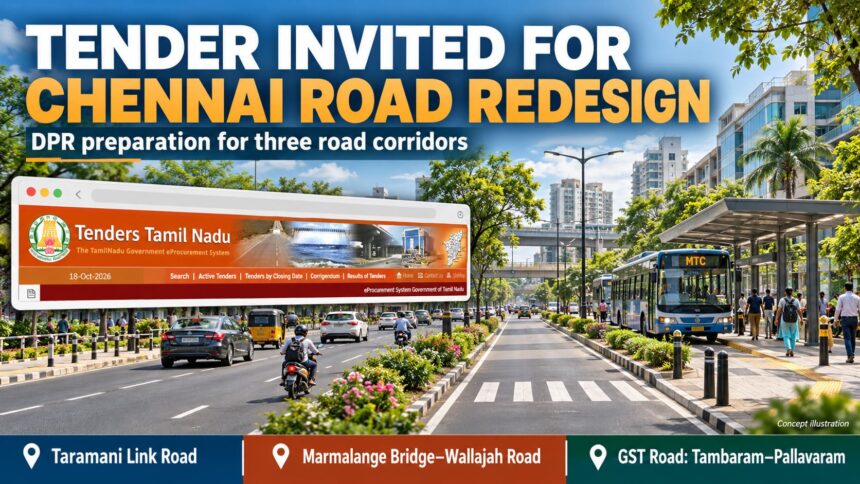
The Chennai Unified Metropolitan Transport Authority (CUMTA) has invited a consultancy tender to prepare plans for three model urban mobility corridors in Chennai. The proposal covers Taramani Link Road, the Marmalange Bridge–Wallajah Road corridor and a section of GST Road.
The project aims to improve walking, public transport access and road safety. It is currently at the Detailed Project Report (DPR) preparation stage.
Which Chennai roads are included?
The Phase II proposal covers:
| Corridor | Proposed coverage |
|---|---|
| Taramani Link Road | Selected stretch of Taramani Link Road |
| Marmalange Bridge–Wallajah Road | Stretch described in the tender as the Velachery–Tambaram Road corridor |
| GST Road | Tambaram–Pallavaram stretch |
The GST Road proposal applies to this selected section, rather than the entire highway.
Better Footpaths, Crossings and Bus Facilities
The designs will examine safer pedestrian crossings, improved footpaths and easier access to bus stops. Cycling facilities are proposed wherever feasible.
Bus-priority arrangements are also being considered. Options include lanes reserved for buses during selected hours or separated lanes where suitable. The DPR will determine the arrangements appropriate for each stretch.
The wider improvement programme includes green medians, more uniform widths for vehicle lanes, service lanes and safer junctions. Culvert and bridge improvements may also be included where required.
Culverts are small tunnels or pipes under a road that allow rainwater or water from streams to flow across without flooding the road.Drainage and Underground Utilities
The proposal includes studying flood-prone sections and designing stormwater drainage with suitable outlets.
Dedicated utility corridors are proposed for water, sewage, electricity and telecom services. Coordinating these networks is intended to reduce repeated road digging and help maintain the upgraded streets.
Easier Connections to Public Transport
The corridors are intended to improve connections to railway stations, MRTS stations, Metro stations and bus facilities. Better walking routes can make it easier for commuters to complete the final part of their public transport journey.
Phase I covers OMR between Madhya Kailash and Kelambakkam and the Pallavaram–Thoraipakkam Radial Road. Phase II would extend the wider mobility improvement programme across additional roads.
Who Will Carry Out the Project?
CUMTA will arrange preparation of the DPRs, while the State Highways Department is expected to execute the road improvements.
The detailed plans will establish the proposed works and designs. The improvements will depend on conditions and available space along each road.
Current Project Status
The Phase II consultancy tender was published on 7 October 2026, with bids scheduled to close on 30 October 2026. It lists a 150-day work period for the consultancy assignment.
This period refers to preparing the plans. It does not mean the road construction will be completed within 150 days. The tender does not establish a confirmed construction completion date.
For nearby residents and property owners, the practical details to watch are the final footpath layouts, crossings, bus stops, parking arrangements and property access points.