

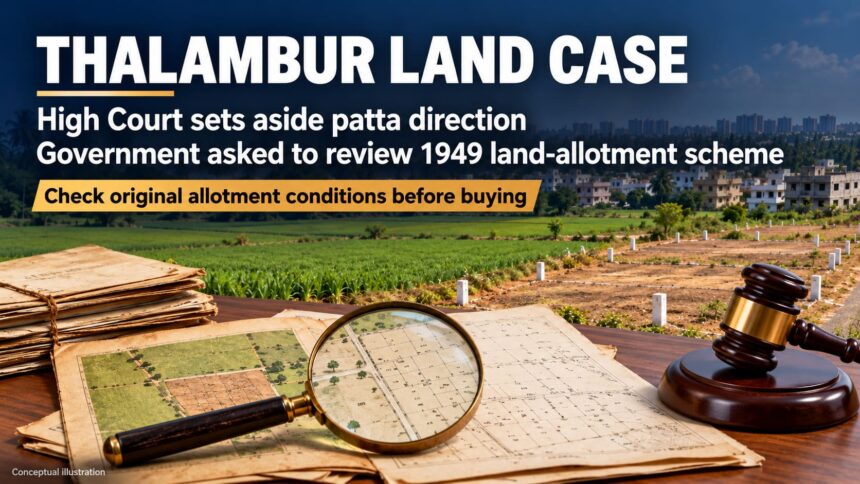
A Thalambur land case has highlighted the need to check how a property was originally allotted before buying it. The Madras High Court has set aside an earlier direction to issue patta and asked the Tamil Nadu government to review its 1949 land-allotment scheme.
The dispute concerns land allotted for cultivation and livelihood support, followed by a proposal to develop part of it into house plots.
What Is the Thalambur Land Case About?
The case involves a 3.89-acre land allotment made to former serviceman Madhavan in 1967. His wife, Nalinisri, approached the High Court seeking patta after an agreement with a private company to develop 72 cents into house plots.
A single judge directed the authorities to issue patta in 2025. The Tamil Nadu government challenged that order.
Why Did the Government Challenge the Patta Direction?
The government told the court that alleged irregularities involving 583.20 acres in Thalambur were under examination.
It referred to an inquiry headed by retired High Court judge K.P. Sivasubramaniam and said a final decision would be taken based on the findings. It therefore sought cancellation of the earlier patta direction.
The inquiry should not be treated as proof that every allotment or property in the area is illegal.
What Did the High Court Decide?
The division bench set aside the earlier order directing the authorities to issue patta.
The court said land allotted to support cultivation and livelihoods should not be used commercially in a way that defeats the scheme’s purpose. It also directed the government to review the 1949 framework to protect the livelihoods of eligible beneficiaries.
The government was asked to take appropriate action based on the inquiry findings.
Setting aside a direction to issue patta is different from cancelling every existing patta in Thalambur. This case should not be presented as a ruling against all properties in the locality.
Why Do Original Allotment Conditions Matter?
Government-allotted land may carry conditions on its use, sale or transfer. Buyers should check the original allotment order to understand those conditions.
An agreement with a developer does not, by itself, establish that the land can legally become a housing project. The title history, allotment conditions and required permissions must be examined together.
How Does This Relate to Our Earlier Thalambur Article?
Our earlier article, Buying Property in Thalambur Near Siruseri? Check the Inam Land Risk First, explains the area’s historical inam background, disputed pattas and the need to check individual survey numbers.
It also discusses the Supreme Court’s April 2026 decision lifting a long-running court freeze and addressing basic services for affected residents. That decision did not give every disputed property a clean title.
The newer case adds a specific concern: whether land allotted for livelihood support can be developed commercially.
What Should Buyers Check Before Paying an Advance?
Verify a land and then ask a property lawyer to examine:
- The original allotment or assignment order and its conditions.
- Settlement records, revenue classification and patta history.
- Parent deeds and the encumbrance certificate.
- Whether the survey number is covered by an inquiry, restriction or court case.
- Whether the proposed sale and development are legally permitted.
A current patta, registered deed, planning approval or bank loan should not replace a full title review. Avoid the purchase if ownership or transfer rights remain unclear.