

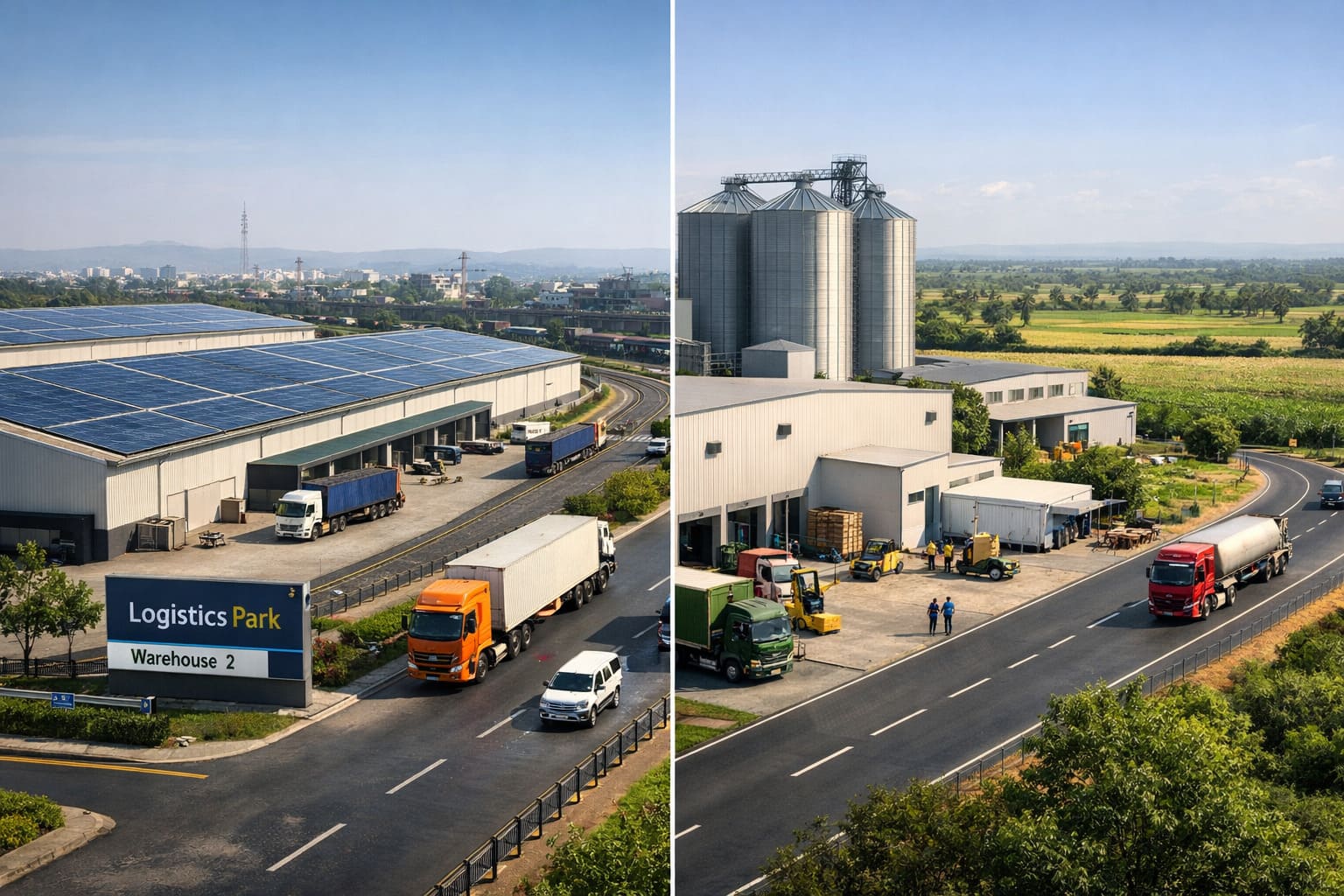
Tamil Nadu has unveiled its Warehousing Policy 2026, a focused policy intervention aimed at expanding logistics and warehousing infrastructure beyond metro-centric hubs and into Tier II, Tier III cities, delta districts, and Category C districts.
The intent is clear: decongest major cities, reduce logistics costs, support agriculture and MSMEs, and build a distributed supply-chain network across the state.
Rather than treating warehousing as passive real estate, the policy recognises it as critical industrial infrastructure under the leadership of the Government of Tamil Nadu.
🏗️Why Tamil Nadu Needed a Warehousing Policy Now
Tamil Nadu already has:
- Strong manufacturing and export base
- High agricultural output
- Major ports and industrial corridors
But warehousing infrastructure has remained clustered around Chennai, Coimbatore, and a few logistics belts, leaving inland regions underserved. This policy corrects that imbalance by pushing planned warehousing deeper into the state.
📌 Who the policy targets
- Tier II & Tier III cities — smaller urban centres that are underserved in logistics infrastructure.
- Delta districts — regions with agricultural significance (e.g., paddy production) needing storage capacity.
- Category C districts — less developed districts prioritized for balanced industrial growth.
This shift means the policy isn’t just about big industrial hubs — it’s focused on inland and rural logistics growth.
💰 Incentives & Support Measures
Policy incentives are designed to attract developers and reduce cost barriers:
🧾 Fiscal incentives
- Fixed capital subsidy: 25 % of eligible investment, capped at ₹2 crore, paid over three years — but only if minimum capacity requirements are met.
- Land cost benefits: Government land in industrial parks (like SIPCOT) offered at 50 % of standard rates.
- Tax breaks: Warehouses ≥1 million sq ft get a five-year electricity tax exemption.
🌱 Green & sustainable add-ons
- Extra rewards for features like rooftop solar and LEED-certified construction to encourage sustainability.
🔗 Strategic integration with logistics corridors
The policy is designed to plug warehouses into larger logistics systems, not just build standalone sheds:
- Rail connections to warehouse clusters in collaboration with the Indian Railways — to reduce transport costs and congestion.
- Warehouses will be connected to multi-modal logistics parks and dry ports, making it easier to move goods smoothly between roads, railways, and seaports without delays.
This helps move goods faster and more cheaply — a critical factor for exports and industrial growth.
🧩The Six Core Themes of Tamil Nadu Warehousing Policy 2026
The policy follows a commodity-driven framework, aligned with Tamil Nadu’s industrial strengths and agricultural landscape, while placing significant emphasis on Ease of Doing Business through streamlined approvals and regulatory reforms.
Its strategic development framework is structured around six core intervention areas:
1. 🌱Integrated Greenfield Development
The policy promotes planned, large-scale warehousing zones developed from scratch in strategic locations.
Key focus areas:
- Proximity to highways, rail corridors, ports, and industrial clusters
- Common infrastructure (roads, power, drainage, fire safety)
- Plug-and-play plots for developers
Impact:
Creates organised logistics parks instead of scattered godowns, especially in Tier II and III regions.
2. 🏗️Brownfield Capacity Expansion
Instead of only building new warehouses, the policy encourages upgrading and expanding existing facilities.
Includes:
- Expansion of old godowns and agri warehouses
- Vertical development and higher clear heights
- Modernisation using racking systems and automation
Impact:
Faster capacity addition in delta and Category C districts where land availability is limited.
3. 🤝Public–Private Partnership (PPP) Promotion
Warehousing projects are encouraged under PPP models to accelerate development.
Structure:
- Government provides land or trunk infrastructure
- Private players build, operate, and maintain facilities
Common use cases:
- Agri-warehousing
- Rail-linked logistics hubs
- District-level commodity clusters
Impact:
Reduces capital burden and speeds up execution.
4. ♻️Sustainable and Smart Warehousing
The policy actively pushes green and tech-enabled warehouses.
Encouraged features:
- Rooftop solar
- Rainwater harvesting
- Energy-efficient lighting and systems
- Automation, IoT, and WMS integration
Impact:
Lower operating costs, faster approvals, and future-ready logistics assets.
5.📦 Commodity-Specific Warehousing
The policy recognises that different commodities require different storage environments.
Examples:
- Agriculture → cold storage and humidity control
- Food grains → scientific silos
- Pharma → temperature-controlled facilities
- Industrial goods → high-load, high-clearance warehouses
Impact:
Reduces post-harvest losses and improves export readiness, especially in delta districts.
6.⚙️ Ease of Doing Business for Warehousing
To attract serious developers, the policy simplifies approvals and compliance.
Key reforms:
- Industry Status granted to all warehousing projects, making them eligible for priority support
- Easier approvals via the State Single Window Clearance system.
- Flexible zoning
- .Plot and building flexibility: higher allowable building height up to 24 m (the earlier limit was 18.3m) and more flexible coverage rules.
- Faster power and utility connections
This is all about cutting red tape and making development faster and cheaper.
Impact:
Shorter project timelines and lower regulatory friction.
📈 Expected economic impact
- Expanded storage capacity for both industrial and agricultural commodities.
- Lower logistics costs through better distribution and last-mile infrastructure.
- Job creation in warehousing, logistics services, and related sectors.
- Growth in exports by improving warehousing connectivity with ports and rail.
📊 Why this matters
- Tamil Nadu already has a large existing logistics base with tens of thousands of factories and significant warehousing demand — but most infrastructure is clustered around a few big cities.
- Smaller cities and agricultural regions have been under-served, causing post-harvest losses and higher supply costs.
- This policy aims to balance growth geographically, reduce dependency on major hubs, and integrate regional economies into statewide supply chains.
What This Policy Means for Real Estate & Land Markets
- Rising demand for industrial and logistics land in Tier II & III cities
- Increased relevance of highway-facing and rail-adjacent parcels
- Stronger valuation support for land near logistics corridors
- Long-term institutional interest in warehousing assets
For buyers and investors, this is a policy-backed demand signal, not speculation.
Bottom Line
Tamil Nadu’s Warehousing Policy 2026 is not about building warehouses everywhere.
It is about building the right warehouses, in the right locations, for the right commodities, while ensuring sustainability and faster execution.
Executed correctly, this policy reshapes:
- Regional industrial growth
- Logistics cost structures
- Land use patterns
- Long-term real estate demand across non-metro Tamil Nadu