

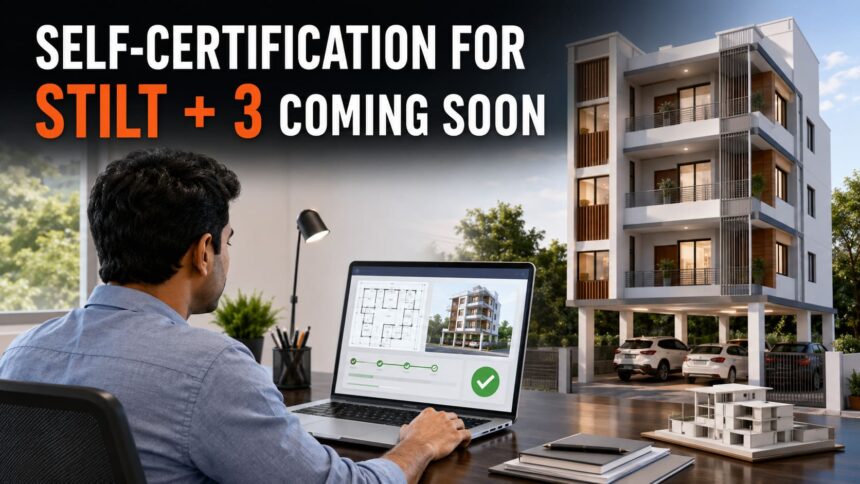
The Tamil Nadu government has announced a major expansion of its Self-Certification Building Approval Scheme. Residential buildings consisting of Ground + 2 floors or Stilt + 3 floors will be brought under the simplified approval system. Housing and Urban Development Minister P. Rajkumar announced the decision in the Tamil Nadu Legislative Assembly.
This could help individual homeowners and small residential developers obtain building approval faster through Tamil Nadu’s online Single Window Portal.
What Has Changed?
Under the currently notified scheme, self-certification is available for eligible residential buildings with an FSI area of up to 3,500 sq ft, comprising Ground + 1 floor or Stilt + 2 floors.
The latest announcement proposes to expand it to:
- Residential construction up to 5,000 sq ft
- Ground + 2 floors
- Stilt + 3 floors
- Faster online approval through self-certification
A stilt floor is generally an open floor used for vehicle parking, with the residential floors constructed above it.
Timeline of Tamil Nadu’s Residential Self-Certification Scheme
February 2024: The government revealed plans to introduce self-certification for small residential buildings. Officials also indicated that the scheme could be expanded after assessing its performance.
July 18, 2024: The Housing and Urban Development Department issued G.O.(Ms) No.133, introducing the residential self-certification system.
July 22, 2024: The scheme was formally launched. It initially covered eligible homes on plots up to 2,500 sq ft, with a built-up area up to 3,500 sq ft, Ground or Ground + 1 floor and a maximum of two dwelling units.
August 8, 2025: Through G.O.(Ms) No.118, the scheme was extended to eligible Stilt + 2 floor buildings up to 10 metres in height.
August 11, 2025: The amendment was published in Tamil Nadu Government Gazette Extraordinary No.459.
September 3, 2025: The online facility for obtaining immediate self-certified approval for Stilt + 2 floor residential buildings became operational.
August 28, 2026: Housing and Urban Development Minister P. Rajkumar announced that the eligible area would be increased from 3,500 sq ft to 5,000 sq ft and that Ground + 2 and Stilt + 3 buildings would be included.
Does This Mean Every Stilt+3 Building Gets Instant Approval?
No. Self-certification does not mean that building rules can be ignored. The property and proposed construction must still comply with applicable land-use classification, FSI, road width, setback, parking, height and safety requirements.
Properties affected by CRZ restrictions, waterbodies, government acquisition, road widening, prohibited land use or other planning restrictions may not qualify.
Detailed Government Order Awaited
The Assembly announcement confirms the government’s decision, but the detailed GO and Gazette notification are still awaited. These documents should clarify:
- Permitted plot size
- Maximum building height
- Number of dwelling units
- Minimum road width
- Required setbacks
- Approval charges
- Completion-certificate conditions
- Effective date on the online portal
Applicants should wait for the official notification and portal update before starting construction based solely on the announcement.
Stay Updated with Verified.RealEstate
Verified.RealEstate will closely track the Government Order, Gazette notification and Single Window Portal update for this expanded scheme. We will keep readers informed as soon as the G+2 and Stilt+3 self-certification facility is officially introduced, along with its eligibility rules, charges and application process.
Why This Matters
The expansion can benefit homeowners who want an additional residential floor while retaining the stilt floor for parking. It may also reduce approval delays for independent houses, villas and small residential developments.
However, the responsibility for providing correct documents and following the sanctioned plan remains with the property owner and the registered professional submitting the application.