



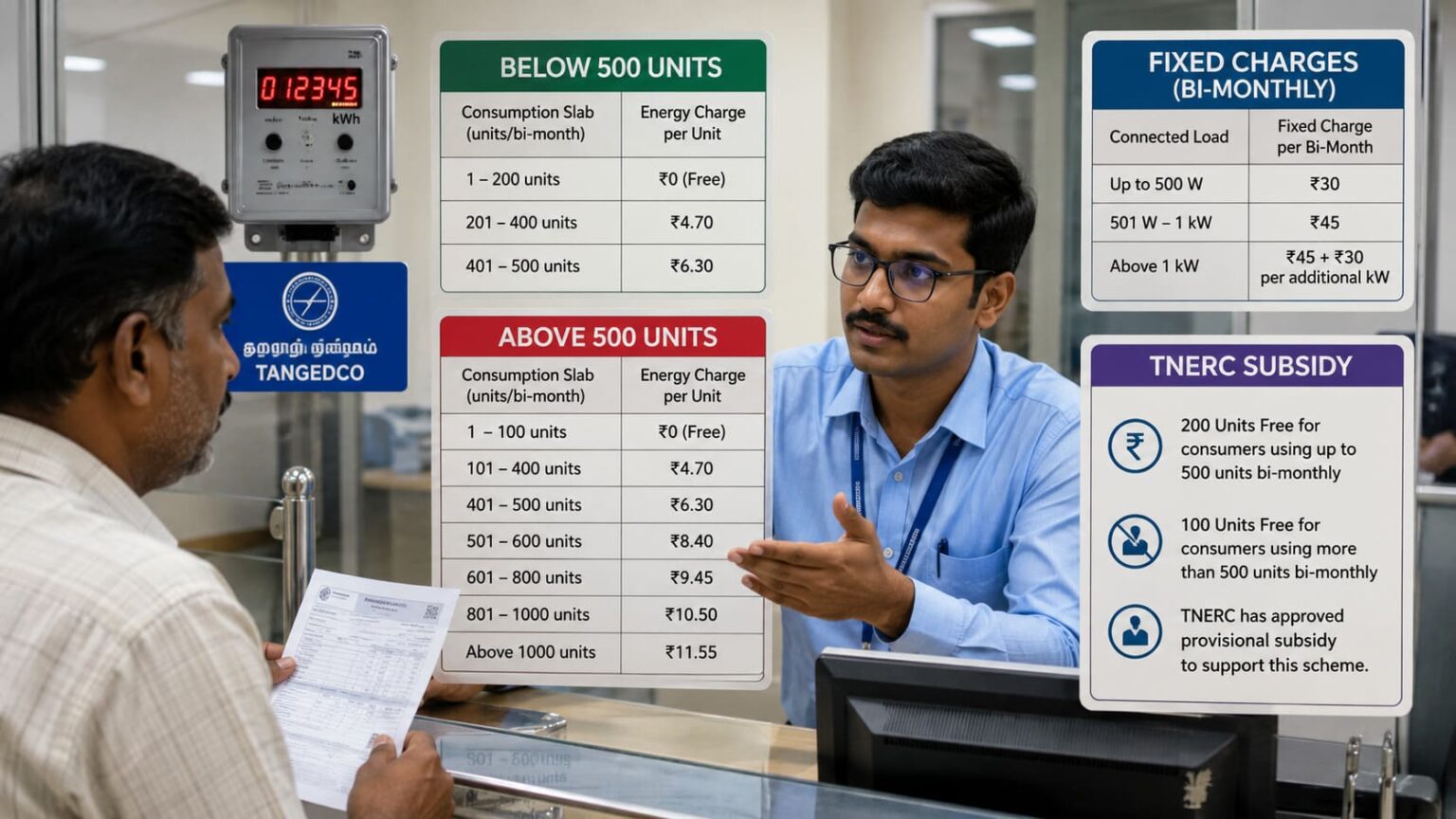
Tamil Nadu’s domestic electricity tariff is now being discussed widely after the State expanded the free electricity benefit for eligible households. Under the latest update, domestic consumers using up to 500 units in a two-month billing cycle can get 200 units free. Those who consume more than 500 units will continue to receive only the earlier 100 units free benefit. TNERC has approved a provisional subsidy of ₹1,545.14 crore to support the implementation of this scheme from May 10, 2026, to March 31, 2027.
How Tamil Nadu’s Domestic Electricity Tariff Works
Tamil Nadu follows a telescopic slab system for domestic electricity billing. This means each slab rate applies only to the units that fall within that slab. For example, if a household uses 500 units, the entire 500 units are not charged at one single rate. Instead, each portion of the consumption is charged according to its slab.
The important point is the 500-unit cut-off. A household using 500 units or less gets 200 units free. But once consumption crosses 500 units, the free benefit drops to 100 units, and higher slab rates begin to apply.
Tariff for Households Using 500 Units or Less
| Consumption slab | Energy charge per unit |
|---|---|
| 1–200 units | ₹0 |
| 201–400 units | ₹4.70 |
| 401–500 units | ₹6.30 |
For example, if a household consumes 500 units in two months, the energy charge is calculated like this:
| Slab calculation | Amount |
|---|---|
| First 200 units | ₹0 |
| Next 200 units × ₹4.70 | ₹940 |
| Next 100 units × ₹6.30 | ₹630 |
| Total energy charge | ₹1,570 |
This is why households staying within the 500-unit limit receive a larger benefit under the revised scheme.
Tariff for Households Using More Than 500 Units
| Consumption slab | Energy charge per unit |
|---|---|
| 1–100 units | ₹0 |
| 101–400 units | ₹4.70 |
| 401–500 units | ₹6.30 |
| 501–600 units | ₹8.40 |
| 601–800 units | ₹9.45 |
| 801–1000 units | ₹10.50 |
| Above 1000 units | ₹11.55 |
For example, if a household consumes 600 units in two months, the energy charge is calculated like this:
| Slab calculation | Amount |
|---|---|
| First 100 units | ₹0 |
| Next 300 units × ₹4.70 | ₹1,410 |
| Next 100 units × ₹6.30 | ₹630 |
| Next 100 units × ₹8.40 | ₹840 |
| Total energy charge | ₹2,880 |
So, although the difference between 500 units and 600 units is only 100 units, the energy charge increases from ₹1,570 to ₹2,880.
Why the 500-Unit Limit Matters
The 500-unit mark is important because it changes the subsidy category. A household consuming 500 units gets 200 units free, but a household consuming 501 units or more gets only 100 units free. This creates a sharp jump in the electricity bill when consumption crosses the eligibility limit.
In simple terms, the higher bill is not caused only by the extra units consumed. It is also caused by the reduction in the free electricity benefit from 200 units to 100 units, along with the application of higher slab rates.
Fixed Charges for Domestic Connections
Apart from energy charges, domestic consumers also have to pay fixed charges based on connected load.
| Connected load | Fixed charge per bi-month |
|---|---|
| Up to 500 W | ₹30 |
| 501 W – 1 kW | ₹45 |
| Above 1 kW | ₹45 + ₹30 per additional kW |
These fixed charges are added separately to the energy charge while calculating the final electricity bill.
Public Reaction to the Tariff Structure
Public response to the revised free electricity benefit has been mixed.
Many households using less than 500 units have welcomed the 200-unit free power scheme as direct relief.
However, consumers who cross the 500-unit limit have raised concerns about the sharp cut-off. Some argue that a household using 501 units loses the expanded benefit even though the usage is only slightly above the limit.
Officials have defended the eligibility rule by saying that extending the 200-unit benefit to all consumers would increase the financial burden significantly. Reports say expanding the benefit to every household would cost an additional ₹700 crore annually and increase expenditure by about 40% for only around 10% more beneficiaries.
Public Opinion in Social Media
The common public mood can be summarised like this:
People below 500 units: “Good relief. This will reduce our bill.”
People slightly above 500 units: “Why should we lose the extra benefit just because we crossed the limit by a small margin?”
Urban consumers: “City usage is naturally higher because of ACs, motors, appliances and work-from-home needs.”
Critics: “The scheme is politically attractive, but it adds to the subsidy burden.”
Government-side argument: “The benefit is meant for eligible and moderate-consumption households, and giving it to everyone would be too costly.”
Why the Subsidy Matters
The free electricity benefit is supported through government subsidy. TNERC approved ₹1,545.14 crore as provisional subsidy to compensate TNPDCL for providing 200 free units to eligible domestic consumers. The final amount will be reconciled later based on actual consumption data submitted by TNPDCL.
Tamil Nadu’s overall power subsidy burden is already large. Reports say the State’s subsidy support to the power distribution sector may continue to rise as welfare commitments, domestic tariff relief and future tariff revisions are reviewed.
Conclusion
Tamil Nadu’s latest domestic electricity tariff update gives a bigger benefit to households that keep their bi-monthly consumption within 500 units. Such consumers can receive 200 units free, while those crossing the limit continue with only 100 units free. The tariff remains telescopic, but the 500-unit cut-off creates a major difference in the final bill. This is why the new structure offers strong relief for moderate-use households, while higher-use consumers may see a sharper rise once they move beyond the eligibility limit.
Abbreviations Used
TNERC: Tamil Nadu Electricity Regulatory Commission, the authority that regulates electricity tariffs in Tamil Nadu.
TNPDCL: Tamil Nadu Power Distribution Corporation Limited, the State power distribution company responsible for electricity supply and billing.
TANGEDCO: Tamil Nadu Generation and Distribution Corporation, the earlier commonly used name for Tamil Nadu’s power utility.
LT: Low Tension, a category of electricity supply used for domestic and smaller consumer connections.