

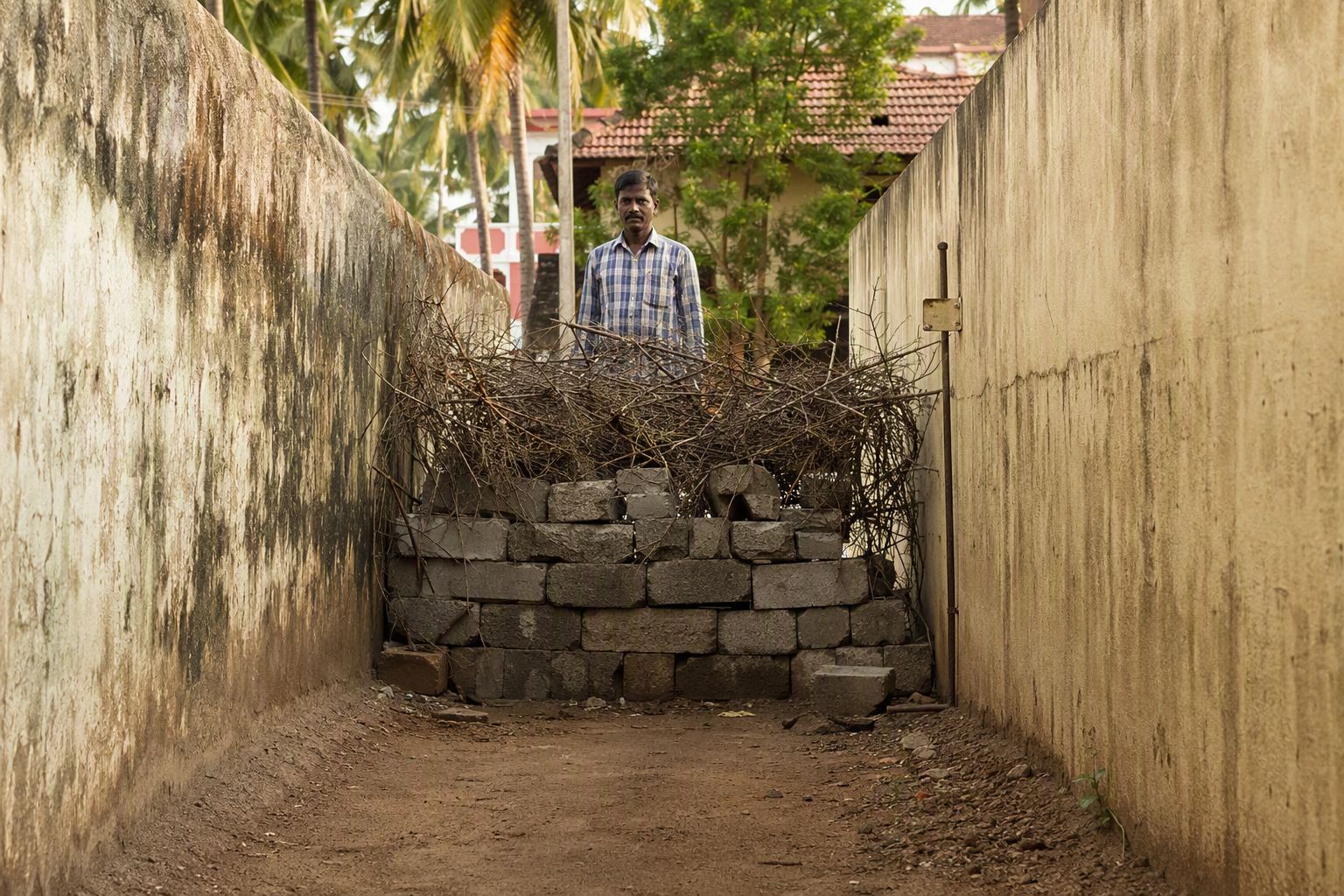
It is extremely common in Tamil Nadu—especially in village layouts, re-surveyed lands, and inherited partitions—to end up with a property that has no proper access road or a pathway blocked by a neighbor. This can completely stop construction, registration, resale, or even basic entry to the land.
The good news: Tamil Nadu law protects your Right to Access.
But HOW your case is handled depends on whether the path is public or private.
What Are Pathway / Access Rights?
In real estate, your right to enter and exit your own land is protected under the Indian Easements Act, 1882.
This is called a Right of Way, and it can arise in three ways:
| Type of Right | When It Applies |
|---|---|
| Easement of Necessity | When no other access exists to reach your land |
| Easement by Prescription | When the path has been used continuously for 20+ years |
| Recorded Public Path | When FMB / Chitta / Town Survey already shows the pathway |
Why Pathway Disputes Happen in Tamil Nadu
- Unapproved layouts sold without proper road allotment
- “Field bunds” and “cart tracks” claimed privately later
- Buyers fail to check FMB Sketch before purchase
- Neighbors block or fence old shared access routes
Before any legal action, you must confirm whether the path exists in Government Records.
✅ Verify your Survey Number Access here: https://verified.realestate/dashboard/utility/survey-number-finder
Step-by-Step Solution Based on the Type of Pathway
Case 1: Pathway Exists in FMB / Chitta / Village Map
→ Blocking this is Encroachment.
This is handled by Revenue Authorities, NOT civil court first.
Where to file:
VAO → Tahsildar → RDO
(Under Tamil Nadu Land Encroachment Act, 1905)
You can request:
- Survey and Boundary Re-fixing
- Obstruction Removal Order
Case 2: Pathway is NOT in Government Records
→ This becomes an Easement Dispute (Civil Case).
You must file:
- Permanent Injunction + Declaration Suit
in District Munsif Court.
Court will check:
- Is it the only access?
- Has it been used openly and continuously?
If yes → Court grants Right of Way.
⚖️ Why CrPC Section 133 Applies Only Sometimes
If the blocked pathway is a public/common path, blocking it becomes Public Nuisance.
Then, the Magistrate / RDO can order immediate removal under Section 133 CrPC.
If the path is private, CrPC does not apply → Civil suit only.
What Lawyers Commonly Warn Buyers About (Direct & Practical)
Lawyers repeatedly point out the same critical mistakes buyers make regarding pathways:
| Lawyer Insight | What It Means for You |
|---|---|
| Buying a pathway does not guarantee exclusive control | If neighbors have no other access, they can still legally use the path. |
| If others have used the path for 20+ years, they may already have easement rights | Even if you buy the land, you cannot block them. |
| If the path is already used like a public road, do NOT buy it as “private” land | You may pay for land you cannot restrict. |
| Sale deed must clearly state who has right of usage | Otherwise, future disputes are almost guaranteed. |
Lawyers’ Bottom-Line Message:
Ownership of the path ≠ Right to restrict access.
Your rights depend entirely on whether others depend on that path for necessary access or have legal usage history.
Common Mistakes to Avoid
- Buying land without verifying FMB map first
- Believing “verbal assurance” from seller about path
- Letting neighbors use pathway without written permission
- Waiting until construction starts to raise pathway issues
Practical Tips
✅ Check Path in FMB before payment .
✅ Add These Clauses in Sale Deed
- “No easement right exists or will arise.”
- “Path is exclusive to buyer; seller & public have no usage rights.”
This Prevents future easement claims from forming.
✅ Document all communications in writing
✅Check Neighbor’s Deeds
→ Do their deeds mention “right of way” through this strip?
✅Immediately install a lockable gate after purchase
Verified.RealEstate Tools & Services
| Service | Use |
|---|---|
| FMB & Road Access Verification Tool | Confirm if pathway exists in government maps |
| Legal Encroachment & Easement Support Service | Filing RTI, Survey petition, RDO applications, Civil suits |
Conclusion
Having no road access is not the end of the story. Tamil Nadu law strongly protects your right to reach your land — but the legal path you choose depends on whether the pathway is public, private, or historically used.
The fastest way to avoid mistakes is to verify the access legally before any construction or fencing begins.
Common Queries Answered:
Q1. My land has no road access. What can I legally do?
If your land is completely landlocked (no approach road), you can file for Easement of Necessity under the Indian Easements Act, 1882.
This allows the court to grant you a right of pathway through a neighboring land, because you have no other reasonable way to reach your property.
Q2. I have been using a pathway for many years. Can that become a legal right?
Yes.
If the pathway has been used openly, continuously, and without objection for 20+ years, you can claim Easement by Prescription, which means the pathway becomes your legal right through long-term usage.
Q3. The pathway existed before but the neighbor blocked it. What should I do?
If the pathway previously existed and is now blocked:
- Collect old evidence (sale deeds, FMB sketches, old maps, tax receipts mentioning access)
- Send a legal notice
- File for declaration + permanent injunction in Civil Court to restore the pathway.
Q4. What if the path is actually a government pathway? (Cart track / Panchayat road / Natham road)
Then blocking it is illegal encroachment — not a private dispute.
You can file a complaint with:
- VAO
- Tahsildar
- RDO
Under the Tamil Nadu Land Encroachment Act, 1905, authorities can order removal of the obstruction.
Q5. What if the pathway is on private land and not shown in government records?
Then it is not encroachment.
It becomes an Easement Right dispute → handled only through Civil Court.
Q6. How do I check whether the pathway is public or private?
Check:
- FMB Sketch
- Town Survey Sketch
- Chitta / A-Register
- Old sale deeds mentioning access
Q7. What happens if I DO have another way, but it is longer or less convenient?
Then the court may reject easement of necessity.
Law requires the path to be necessary, not just easier or shorter
Disclaimer:
This article explains the general legal position regarding pathway and access rights in Tamil Nadu. However, your situation may differ based on survey records, easement history, and past usage.  Always verify your land documents and consult a real estate lawyer before filing any petition or complaint.
Since 2020, One of my Neighbor is using our land to access his property, even though he has approach from other side. Bu t that side it is blocked by HIS neighbor. Our land is 74 ft x 240 ft, in this they are using 24 ft x 240 ft of OUR LAND to access their land. He has influenced the Electricuty dept and installed poles in our land
Local VAO, THASILDAR , RDO are not helping us. how to tackle this issue. Court will take LONG TIME.
Please do get the help of a lawyer and Advocate legal notice.
Then apply for an RTI from the EB + Revenue Dept. Put board: “PRIVATE PROPERTY – NO RIGHT OF WAY”.