



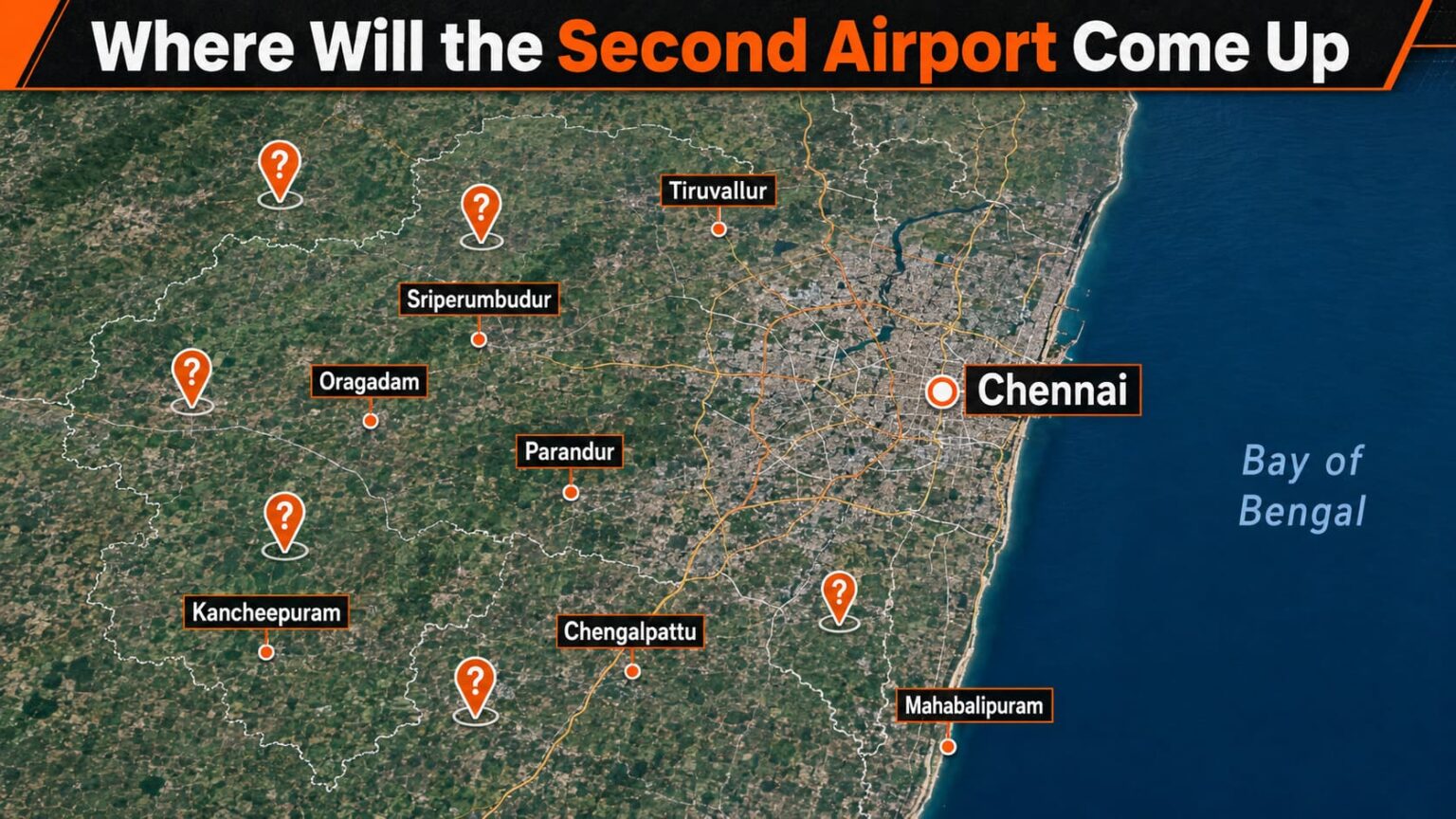
Tamil Nadu has decided not to proceed with Parandur as the site for Chennai’s second airport, marking a major reversal in one of the State’s most debated infrastructure projects.
The Parandur greenfield airport was announced in 2022 by the previous DMK government and was planned in Kancheepuram district to reduce pressure on Chennai International Airport.
The proposed airport site was spread across nearly 5,746 acres in Kancheepuram district, covering several villages in Kancheepuram and Sriperumbudur taluks.
The project had already moved through major stages, including site clearance, in-principle approval and land acquisition. Nearly 1,700 acres of land had reportedly been acquired so far. The project had faced strong opposition from residents and farmers, especially from Ekanapuram and surrounding villages.
However, the present government has now taken the position that the airport should not come up at Parandur because of concerns over fertile agricultural land, waterbodies, wetlands and local livelihoods.
The government has clarified that it is not against Chennai getting a second airport. The objection is specifically to Parandur as the location. Officials and experts are expected to look for an alternative site.
Why Parandur Became Controversial
The proposed airport site covered large stretches of farmland and water-rich areas.
🧑🌾 Local residents argued that the project would affect fertile agricultural land and disturb waterbodies and wetlands.
🧑🌾Farmers feared losing their livelihoods due to displacement and the loss of cultivable land.
🧑🌾Environmentalists also expressed concerns that the project could disrupt natural drainage patterns, increase flood risks, and cause long-term ecological damage.
For residents who have been protesting for several years, this is a major political and emotional victory. For them, Parandur airport was not just an infrastructure project. It was a direct threat to their homes, farms, water sources and way of life.
Industry Warns of Setback
Industry representatives have said that dropping the project after approvals and land acquisition may hurt Tamil Nadu’s growth plans.
V.N. Shivashankar, senior vice-president of the Southern India Chamber of Commerce and Industry, has said that Tamil Nadu should not immediately scrap the project after securing major approvals. According to him, Chennai needs a modern airport, and cancelling the project after years of planning could hurt the State’s development prospects.
For a city like Chennai, which competes with Bengaluru, Hyderabad and other major investment destinations, airport capacity is not a small issue. A delayed second airport may affect long-term competitiveness.
Finding a New Airport Site Will Not Be Easy
Aviation experts have also pointed out that finding a new site for an airport is a long and technically complicated process. Before Parandur was chosen, the government had already studied multiple locations.
Airport sites are not selected only based on land availability. They must meet several aviation, safety and infrastructure requirements, including: suitable airspace, wind conditions, runway alignment, obstacle-free approach paths, environmental clearances, land acquisition feasibility and good road and rail connectivity.
If the government starts the site-selection process again, identifying a new site itself may take at least one year. After that, the Airports Authority of India may have to conduct pre-feasibility studies. Site clearance and in-principle approval may take another two years. Land acquisition, construction and operational readiness may then take another five to six years.
This means Chennai’s second airport timeline could be pushed back by nearly eight to ten years or even more.
What Happens to the Land Already Acquired?
The biggest unanswered question now is the fate of the nearly 1,700 acres already acquired for the Parandur airport.
Since the government has only now announced its decision regarding Parandur, several key issues are yet to be clarified.
In the coming days, the government is expected to spell out what will happen to the acquired land—whether it will be returned to landowners, retained for another public purpose, transferred to a government land bank, or kept pending until a final decision is taken.
The matter is likely to attract close attention because compensation has reportedly been paid in many cases. For landowners, the focus will now be on the government’s next steps and whether any mechanism will be considered for restoring land and addressing related concerns.
What the Land Acquisition Act Says
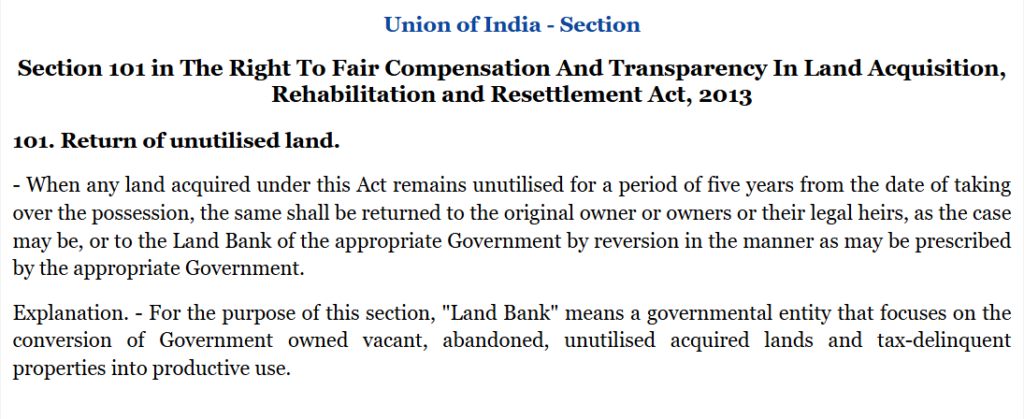
Under Section 101 of the Right to Fair Compensation and Transparency in Land Acquisition, Rehabilitation and Resettlement Act, 2013, if acquired land remains unutilised for five years from the date of taking possession, it shall be returned to the original owners or their legal heirs, or transferred to the government land bank through the prescribed process.

While the law provides for the possibility of land being restored if an acquisition project is abandoned, what will actually happen if the Parandur project is officially dropped remains uncertain. The outcome will depend on factors such as whether possession has been taken, whether compensation has been paid, the acquisition route used and the government’s final decision.
Conclusion
The Parandur airport decision has created both relief and uncertainty. Farmers and residents see it as a victory for land, water and livelihood protection. Industry leaders, however, fear that Chennai’s second airport may now be delayed by many years.
The next important announcement will be the new airport site. Until then, the fate of the acquired Parandur land remains the biggest legal and political question.