

A separate property-tax controversy has emerged in Tambaram Corporation shortly after Greater Chennai Corporation suspended its GIS-based reassessment exercise.
Residents and welfare associations in Tambaram, Pallavaram, Chitlapakkam and Sembakkam have complained of sharp increases in their half-yearly property-tax demands.
Tambaram Corporation has received at least 100 complaints. However, unlike GCC, Tambaram officials have not confirmed that a Corporation-wide reassessment exercise has been undertaken.
What Tambaram Corporation Has Said
Tambaram Corporation Commissioner S. Balachander said some properties may have been under-assessed or that there could have been a misunderstanding.
He said each complaint would be examined and that the grievances would be addressed.
However, the Corporation has not yet publicly explained:
- Why the assessments were changed
- Whether a common reassessment exercise was conducted
- Whether GIS or satellite information was used
- Whether Basic Street Rates were changed
- Whether property areas or usage classifications were corrected
- How many properties received higher demands
- Whether previous municipal databases were recently merged
- Whether the disputed collection will be suspended
This absence of a clear calculation is now the biggest issue facing property owners.
Reported Property-Tax Increases
Residents have reported several striking examples.
A 468 sq ft commercial property reportedly saw its half-yearly property tax increase from ₹3,000 in 2024–25 to ₹11,725 in 2025–26. Its solid-waste user charge also increased from ₹1,800 to ₹3,000.
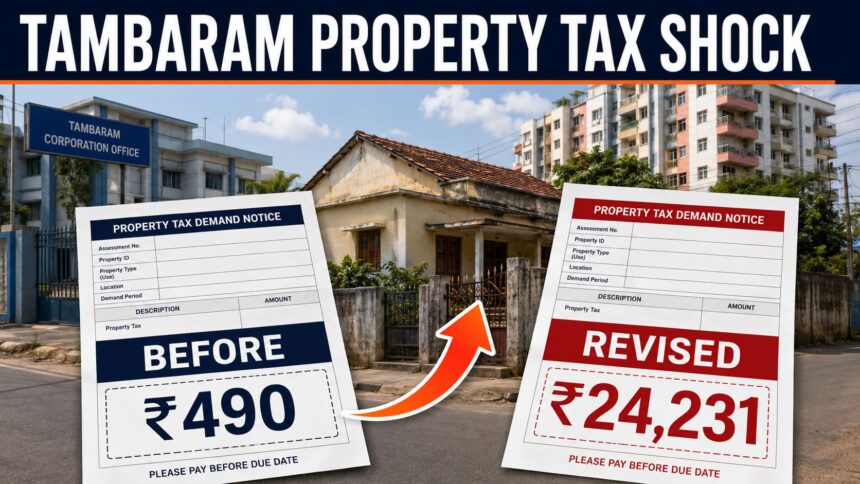
In Pallavaram, the owner of a 2,620 sq ft ancestral property claimed that the half-yearly tax increased from ₹490 to ₹24,231.
These figures have been reported from individual complaints. Tambaram Corporation has not yet officially confirmed that the calculations are correct.
Is Chitlapakkam Being Taxed More Than Boat Club Road?
A residents’ association compared Tambaram’s Basic Street Rates with those applied within Greater Chennai Corporation.
According to its representation, a comparable 1,500 sq ft residential property on Babu Street in Chitlapakkam could attract annual property tax of approximately ₹23,238. The association estimated that a similar property on Chennai’s Boat Club Road would attract around ₹16,250.
The Tamil Nadu government has reportedly forwarded this representation to the Tambaram Commissioner for examination.
The comparison is serious, but it requires an official response. Property tax does not depend on street location alone. Building age, built-up area, usage, construction type, occupancy and other components can change the final demand.
Did Uniform Property-Tax Rates Cause the Increase?
Some residents believe the disputed demands are linked to Tambaram Corporation’s long-standing plan to bring its merged areas under a uniform property-tax system.
Tambaram Corporation was created by combining areas that previously followed different municipal and town-panchayat assessment systems.
These included the former municipalities of Tambaram, Pallavaram, Pammal, Anakaputhur and Sembakkam, along with former town panchayats such as Chitlapakkam, Madambakkam, Perungalathur, Peerkankaranai and Tiruneermalai.
Plans to integrate the different tax databases were discussed as early as 2022. However, Tambaram Corporation has not officially confirmed that the present increases are the result of that integration.
It is therefore too early to describe the issue as a uniform Corporation-wide tax hike.
What Exactly Should Owners Check?
Owners who receive a revised Tambaram property-tax demand should compare the old and new assessments carefully.
Important details include:
- Property ID and door number
- Ward and zone
- Basic Street Rate
- Plot and built-up area
- Area recorded for each floor
- Residential, commercial or mixed usage
- Building age
- Type of construction
- Half-yearly property tax
- Solid-waste user charge
- Arrears, interest or penalties
- Effective date of the revision
An increase may result from one incorrect entry, such as a residential property being classified as commercial or an additional floor being wrongly recorded.
Documents Needed to Challenge an Incorrect Demand
Owners should preserve and submit:
- Previous property-tax demand
- Revised demand
- Latest payment receipt
- Registered title deed
- Approved building plan
- Independent property measurements
- Evidence of the building’s age
- Proof of residential use, if wrongly classified
- Written request for the Corporation’s complete calculation sheet
Complaints can be submitted to the Tambaram Corporation Commissioner. The official contact details include:
- WhatsApp complaints: 918438353355
- Toll-free number: 1800 425 4355
- Office: 28, Muthurangam Street, Tambaram West, Chennai – 600045
Owners should insist on a written acknowledgement instead of relying only on a verbal complaint.
Independent Property Verification Matters
Verified.RealEstate can help property owners compare the actual built-up area with the approved plan, municipal assessment and supporting property records.
An independent property survey can identify whether the Corporation has recorded an incorrect area, additional floor or property usage. Documented measurements can strengthen the owner’s representation and help explain exactly where the revised calculation may have gone wrong.
To Sum Up
Tambaram Corporation has promised to examine complaints individually, but it has not announced a suspension similar to GCC’s decision.
The next major development will be whether the Corporation publishes its reassessment method, provides detailed calculation sheets, corrects individual errors or orders a wider review of the revised demands.
Until that clarification arrives, the reported increases remain disputed assessments—not a confirmed Tambaram-wide property-tax revision.