

Background: What Case Was the Supreme Court Hearing?
In February 2026, the Supreme Court of India was hearing a case titled State of Himachal Pradesh v. Naresh Sharma.
The matter was about shifting the office of the Himachal Pradesh RERA from Shimla to Dharamshala. The state government had challenged a High Court order on this issue.
The Supreme Court allowed the shifting of the RERA office. However, during the hearing, the judges made strong comments about how RERA is functioning across India.
What the Supreme Court Said
The case was heard by a Bench led by Chief Justice Surya Kant and Justice Joymalya Bagchi.
During the hearing, the judges made unusually strong observations:
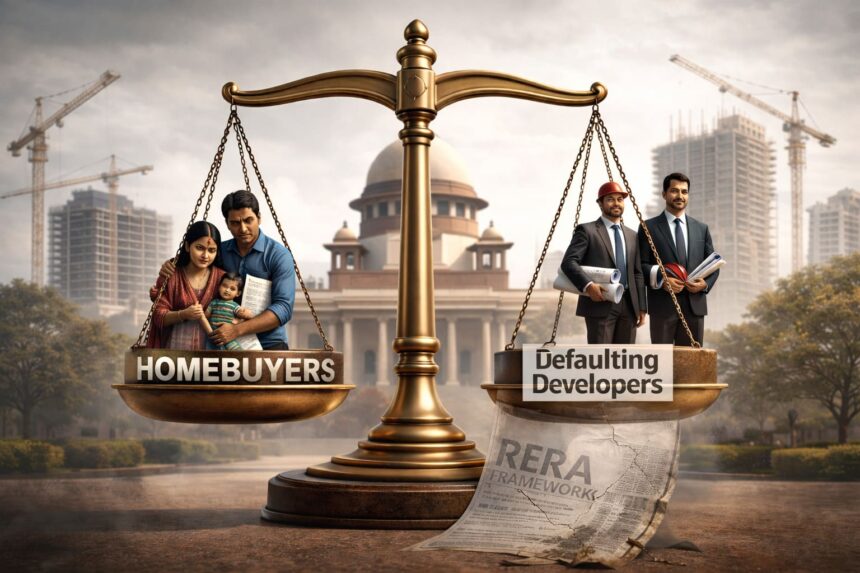
- The Court said that many RERA authorities seem to be helping defaulting builders instead of protecting homebuyers.
- The judges expressed concern that the main purpose of RERA — to safeguard buyers — is not being properly achieved.
- The Bench even remarked that if RERA only supports errant developers and fails to give real protection to buyers, “it might be better to abolish this institution.”
However, it is very important to understand that:
👉 The Supreme Court did not pass any order abolishing RERA.
👉 These were oral remarks made during the hearing.
👉 RERA continues to remain in force as law.
Why Did the Court Make Such Strong Remarks?
RERA (Real Estate Regulatory Authority) was created under the Real Estate (Regulation and Development) Act, 2016 to:
- Ensure timely delivery of projects
- Protect homebuyers from delays and fraud
- Increase transparency in real estate
- Provide faster dispute resolution
But the Court appeared concerned about:
- Poor enforcement of RERA orders
- Delays in giving relief to buyers
- Weak action against defaulting builders
- Inconsistent functioning across states
The judges’ comments reflect frustration about how the law is being implemented, not about the validity of the law itself.
Is RERA Being Abolished?
No.
There is no judgment striking down RERA. The law remains fully valid.
For RERA to be abolished, Parliament would have to amend or repeal the Act. The Supreme Court cannot remove the law simply through oral comments in a hearing.
PM Modi Had Previously Flagged Issues in RERA Functioning
Prime Minister Narendra Modi, on addressing Pragati meeting on May 2026, has put the Real Estate (Regulation and Development) Act, 2016 (RERA) under scrutiny, urging authorities to look beyond just closing numbers of complaints and focus on whether homebuyers are actually getting meaningful relief.
He questioned whether complaints marked as “disposed” truly result in compensation or possession and highlighted concerns about the quality of grievance redressal across RERA bodies.
The Prime Minister also asked state officials to ensure strict compliance with RERA rules, improve accountability, and check that all eligible real estate projects are properly registered — stressing that real justice for homebuyers is more important than simply counting disposed complaints.
What This Means for Homebuyers and Developers
For homebuyers:
- The Supreme Court is closely watching how RERA authorities function.
- There may be pressure on states to improve enforcement and accountability.
For developers:
- Regulatory scrutiny may increase.
- Authorities may be pushed to act more strictly in cases of default.
Conclusion
The February 2026 hearing in State of Himachal Pradesh v. Naresh Sharma became significant not because of the office shift, but because it triggered a larger discussion on whether RERA is truly protecting homebuyers.
The Supreme Court’s message is clear:
If RERA does not fulfill its purpose, serious reforms may be needed.
But as of now, RERA remains the governing law for real estate regulation in India.